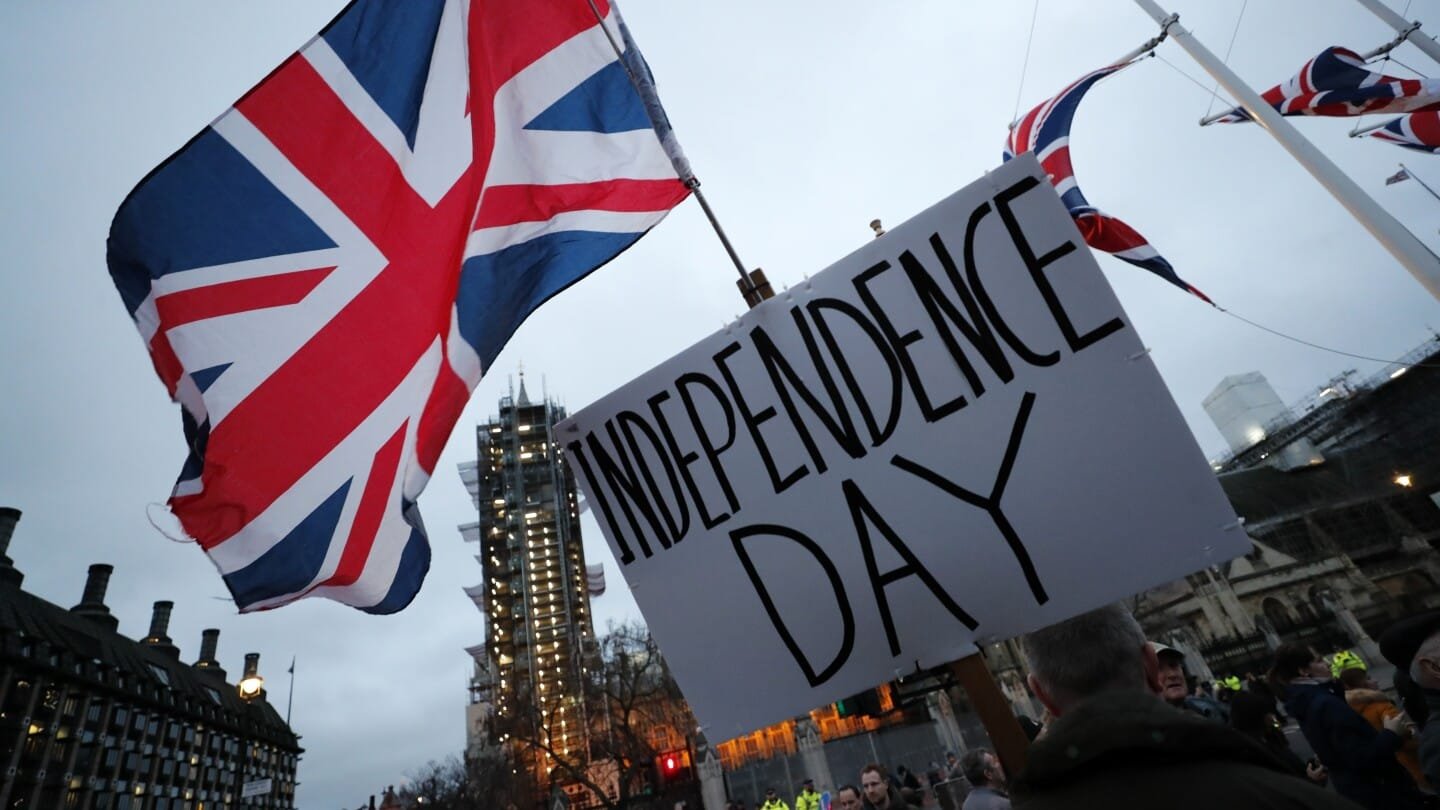
LONDON (news agencies) — Five years ago Friday, two crowds of people gathered near Britain’s Parliament — some with Union Jacks and cheers, others European Union flags and tears.
On Jan. 31, 2020 at 11 p.m. London time – midnight at EU headquarters in Brussels — the U.K. officially left the bloc after almost five decades of membership that had brought free movement and free trade between Britain and 27 other European countries.
For Brexit supporters, the U.K. was now a sovereign nation in charge of its own destiny. For opponents, it was an isolated and diminished country.
It was, inarguably, a divided nation that had taken a leap into the dark. Five years on, people and businesses are still wrestling with the economic, social and cultural aftershocks.
“The impact has been really quite profound,” said political scientist Anand Menon, who heads the think-tank U.K. in a Changing Europe. “It’s changed our economy.
“And our politics has been changed quite fundamentally as well,” he added. “We’ve seen a new division around Brexit becoming part of electoral politics.”
An island nation with a robust sense of its historical importance, Britain had long been an uneasy member of the EU when it held a referendum in June 2016 on whether to remain or leave. Decades of deindustrialization, followed by years of public spending cuts and high immigration, made fertile ground for the argument that Brexit would let the U.K. “take back control” of its borders, laws and economy.
Yet the result — 52% to 48% in favor of leaving — came as a shock to many. Neither the Conservative government, which campaigned to stay in the EU, nor pro-Brexit campaigners had planned for the messy details of the split.
The referendum was followed by years of wrangling over divorce terms between a wounded EU and a fractious U.K. that caused gridlock in Parliament and ultimately defeated Prime Minister Theresa May. She resigned in 2019 and was replaced by Boris Johnson, who vowed to “get Brexit done.”
It wasn’t so simple.
The U.K. left without agreement on its future economic relationship with the EU, which accounted for half the country’s trade. The political departure was followed by 11 months of testy negotiations on divorce terms, culminating in agreement on Christmas Eve in 2020.
The bare-bones trade deal saw the U.K. leave the bloc’s single market and customs union. It meant goods could move without tariffs or quotas, but brought new red tape, costs and delays for trading businesses.
“It has cost us money. We are definitely slower and it’s more expensive. But we’ve survived,” said Lars Andersen, whose London-based company, My Nametags, ships brightly colored labels for kids’ clothes and school supplies to more than 150 countries.
To keep trading with the EU, Andersen has had to set up a base in Ireland, through which all orders destined for EU countries must pass before being sent on. He says the hassle has been worth it, but some other small businesses he knows have stopped trading with the EU or moved manufacturing out of the U.K.
Julianne Ponan, founder and CEO of allergen-free food producer Creative Nature, had a growing export business to EU countries that was devastated by Brexit. Since then she has successfully turned to markets in the Middle East and Australia, something she says has been a positive outcome of leaving the EU.
Having mastered the new red tape, she is now gradually building up business with Europe again.
“But we’ve lost four years of growth there,” she said. “And that’s the sad part. We would be a lot further ahead in our journey if Brexit hadn’t happened.”
The government’s Office for Budget Responsibility forecasts that U.K. exports and imports will both be around 15% lower in the long run than if the U.K. had remained in the EU, and economic productivity 4% less than it otherwise would have been.
Brexit supporters argue that short-term pain will be offset by Britain’s new freedom to strike trade deals around the world. Since Brexit. the U.K. has signed trade agreements with countries including Australia, New Zealand and Canada.
But David Henig, a trade expert at the European Center for International Political Economy, said they have not offset the hit to trade with Britain’s nearest neighbors.




 United Arab Emirates Dirham Exchange Rate