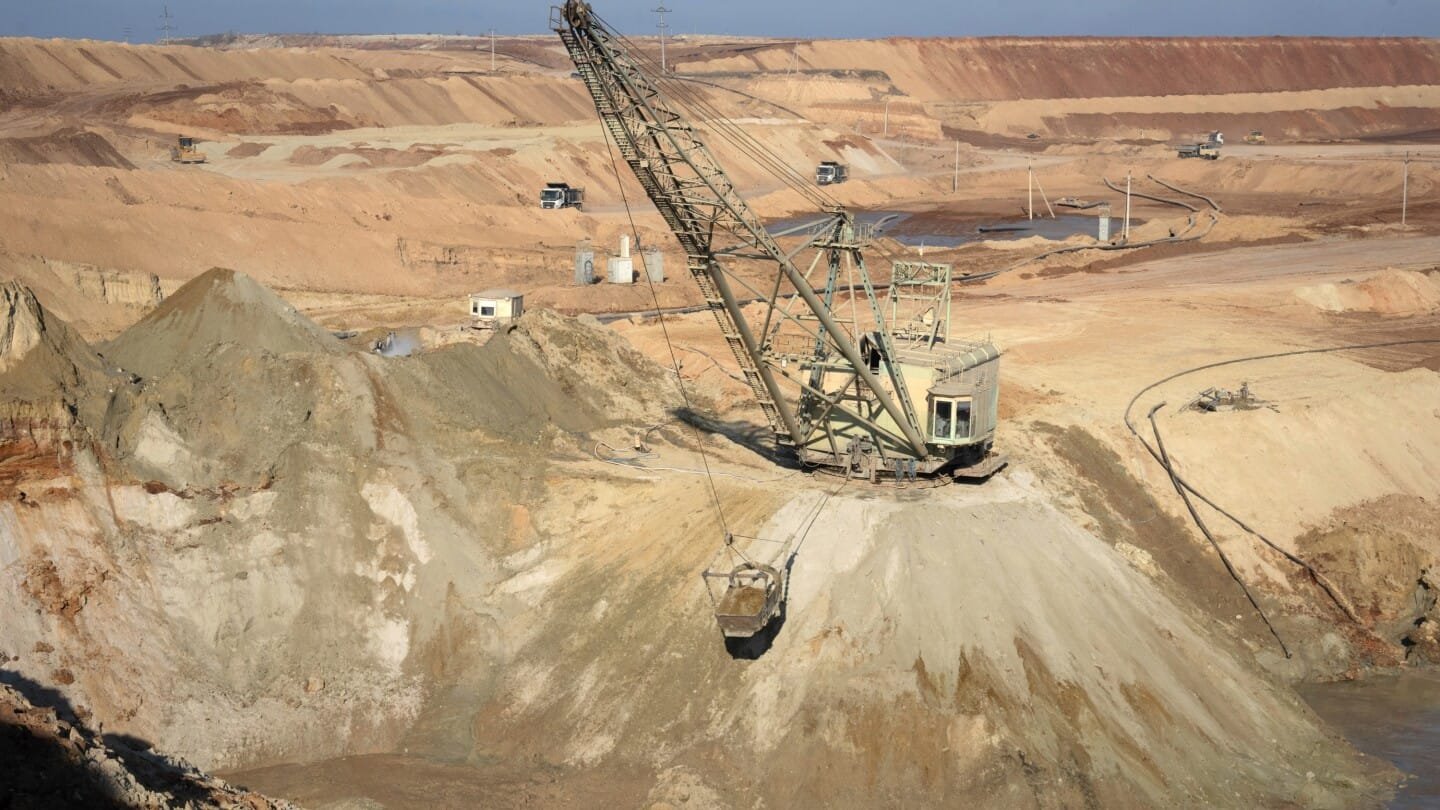
KIROVOHRAD REGION, Ukraine (news agencies) — The mineral ilmenite is extracted from mounds of sand deep in the earth and refined using a method that summons the force of gravity, resulting in a substance that glimmers like a moonlit sky.
Ukraine boasts vast reserves of ilmenite — a key element used to produce titanium — in the heavy mineral sands that stretch for miles along the country’s embattled east.
Much of it, as with all of Ukraine’s critical minerals industry, is underdeveloped because of war as well as onerous state policies.
That is poised to change if U.S. President Donald Trump’s administration agrees to a deal with Ukraine to exchange critical minerals for continued American military aid.
In the central region of Kirovohrad, the ilmenite open-pit mine is a canyon of precious deposits that its owner is keen to develop with U.S. companies. But many unknowns stand in the way of turning these riches into profit: cost, licensing terms and whether such a deal will be underpinned by security guarantees.
Ukrainian President Volodymyr Zelenskyy said Saturday at the Munich Security Conference that he did not permit his ministers to sign a mineral resource agreement with the U.S. because the current version is not “ready to protect us, our interests.”
Ukrainian businessmen with knowledge of the minerals industry also privately expressed skepticism about whether a deal is viable. The capital-intensive industry is unlikely to yield results in years, if not decades, as geological data is either limited or classified. Many question what conditions American companies are willing to risk to build up the industry and whether existing Ukrainian policies that have so far deterred local businessmen will accommodate foreign investors.
“The main thing we can gain is certain security guarantees obtained through economic means, so that someone stronger than us has an interest in protecting us,” said Andriy Brodsky, CEO of Velta, a leading titanium mining company in Ukraine.
A deal, which would essentially barter one resource for another, could help strengthen Kyiv’s relationship with the Trump administration.
The United States is a major consumer of critical raw earth minerals such as lithium and gallium, two elements that Ukraine has in proven reserves. Trump has specifically mentioned rare earth elements, but these are not well researched, industry experts told media.
Titanium, used in aerospace, defense and industry, is also high in demand and the U.S. is a leading importer of ilmenite. Sourcing the minerals from Ukraine would reduce future reliance on Russia and China.
In exchange, Kyiv would continue to receive a steady stream of American weaponry that offers leverage against Moscow and without which Ukraine cannot ward off future Russian aggression in the event of a ceasefire.
The question of security guarantees is a sticking point for companies, Ukrainian businessmen and analysts said. A senior Ukrainian official, speaking anonymously to describe private conversations, told the news agencies that U.S. companies expressed interest in investing but needed to ensure their billions will be safeguarded in the event of renewed conflict. But once invested in Ukraine, the presence of American business interests alone might act as a guarantee, Brodsky said.
“If this process starts, it will continue,” Brodsky said. “Once the investment figures exceed hundreds of billions, the Americans, a highly pragmatic people, will protect their profits earned on Ukrainian soil. They will defend their interests against Russia, China, Korea, Iran and anyone else. They will protect what they consider theirs.”
Brodsky, who just returned from a trip to Washington and New York, said the conversation among U.S. businesses is changing in Kyiv’s favor.
“A lot of people in very serious and wealthy offices are saying that now, we — our country and my company — are in the right place and doing exactly what needs to be done at this moment,” he said.
Velta has worked with American partners for many years. Brodsky has begun negotiating with companies he believes could be a partner in the event of a deal.
Ukraine has never been attractive to foreign investors because of prohibitive government policies — not offering incentives to attract foreigners, for instance. Brodsky believes that international companies will need to pair up with local partners to flourish.
American companies have several ways to enter the market, explained Ksenia Orynchak, director of the National Association of Extractive Industries of Ukraine, but would require traversing “certain circles of hell” in Ukraine’s bureaucracy. Teaming up with an existing Ukrainian license owner is possibly the most straightforward.
She said more exploration is needed in the field and hinted existing data may have been acquired through ulterior motives. Under the Soviet system, geologists stood to gain if they claimed to have found large reserves.






 United Arab Emirates Dirham Exchange Rate