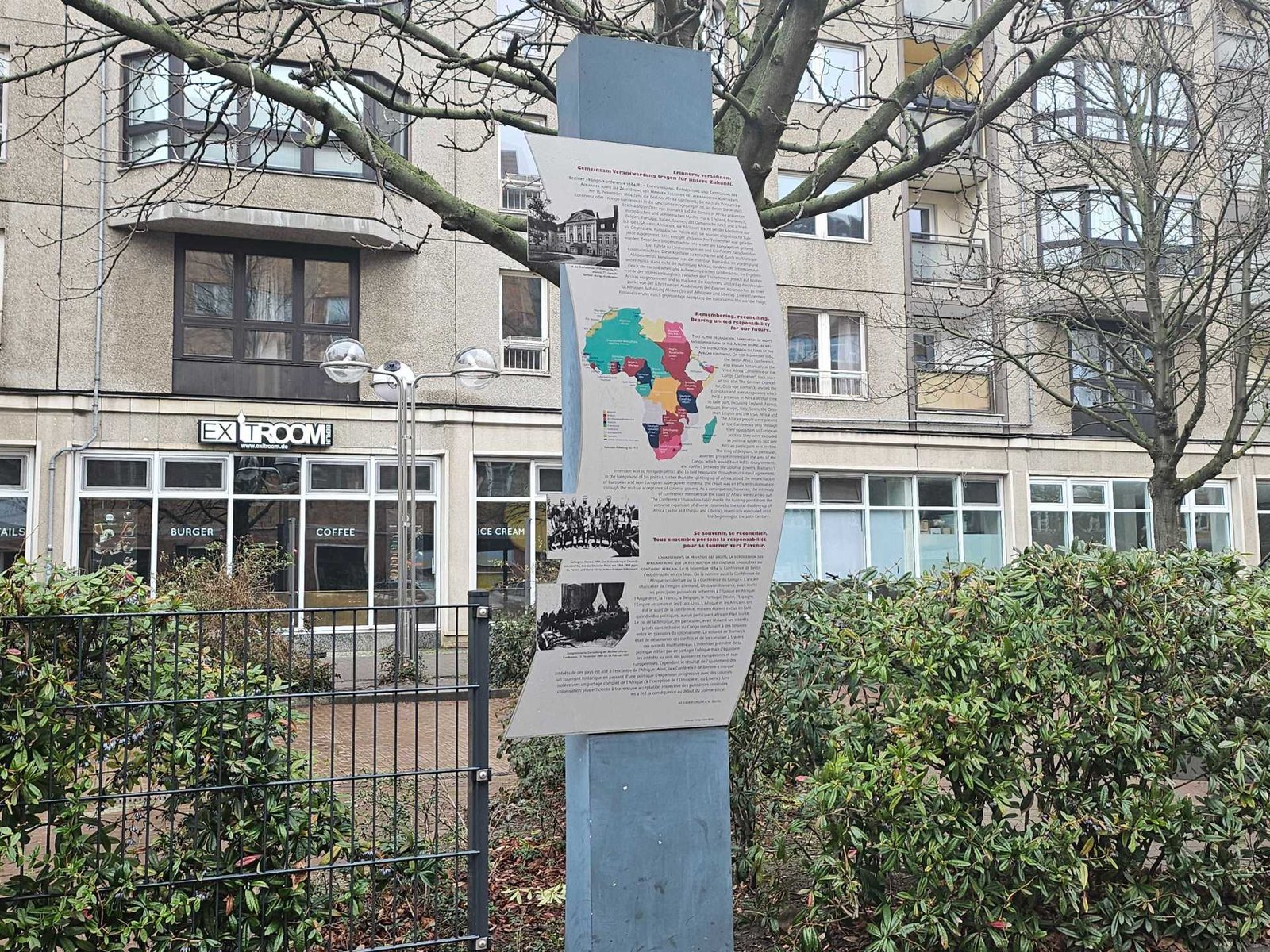
Berlin, Germany – The plaque that marks 77 William Street, the building in the German capital where a meeting that forever shaped Africa’s fate took place, is different.
Unlike those beside it – official square plaques that tell of Germany’s Nazi history in sombre colours – this one is set awkwardly in front of a tree and bears an old map of Africa in vibrant hues of red and blue. That’s because it’s fairly new – put up just three years ago by the nonprofit Afrika Forum instead of the city of Berlin.
In a country long hailed for its detailed and prolific remembrance of Nazi crimes during the 20th century, the Africa plaque’s obscure loneliness highlights how Germany remembers – or forgets – its colonial past.
On a winter afternoon, a few tourists troop past without as much as a glance, heading towards the remnants of the Berlin Wall, about 200 metres (650 feet) away, and a memorial for Jews murdered in the Holocaust. No longer a palace, the old 77 building now houses an apartment block and a couple of restaurants and cafes on the bottom level. Even the people working nearby do not know how important this location is in African history – “Keine Ahnung [No idea],” one waitress, replied, when asked.
Exactly 140 years ago today, European leaders gathered at this spot finalised the carving up of Africa and the rules of the colonisation game. They’d been haggling on and off for about three months, from November 15, 1884, until February 26, 1885, arguing about who owned which territories on the continent. Known as the Berlin or the Congo Conference, the meeting would go on to accelerate the occupation of African nations, affecting the fate of that continent in ways that still reverberate today.
Here in Germany though, that history is largely a black hole.
“I don’t remember that we talked about colonialism a lot,” Berlin resident Sanga Lenz, 34, told media. Growing up, her school’s history curriculum centred around the Holocaust, the second world war, and the Cold War. A history teacher once took the class to a slavery exhibition and introduced Lenz to German imperialism. But it wasn’t until 2020 when she stumbled on a photo of an old male relative who was deployed to the colonies that she realised just how deeply connected she was to that past.
“He was stationed in German East Africa and he was building these train tracks there. I was like, wait a minute. Of course, this happened, but nobody ever talked about it. Growing up in Germany people talk about how some relatives were Nazis, but no one talks about this history,” Lenz said incredulously.
Johnny Whitlam, a tour guide in the city, said he is one of few who tries to bring his clients through William Street to point out the Africa plaque. “People are usually happy to find out about this, even if that’s not what they came to see,” he said.



 United Arab Emirates Dirham Exchange Rate