
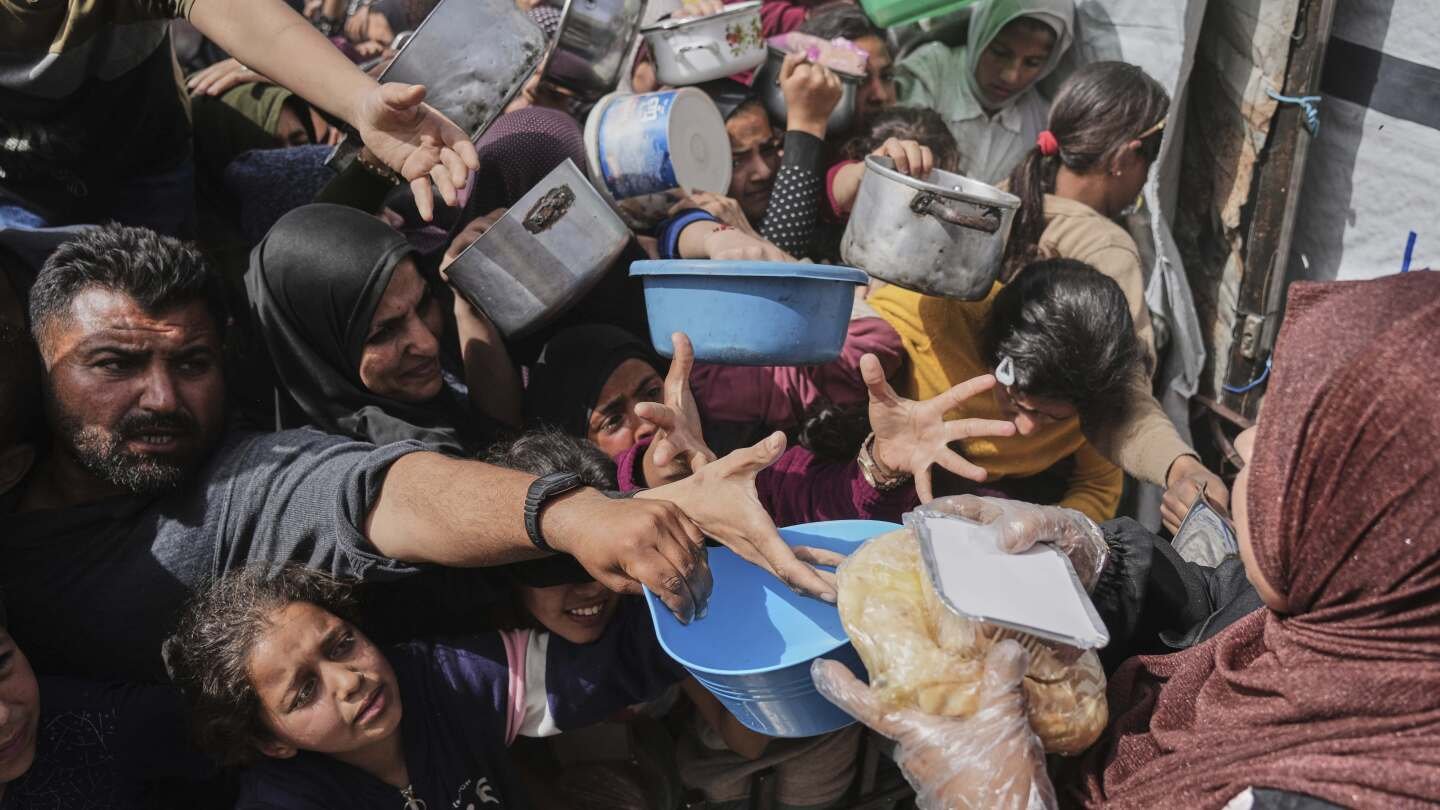
TEL AVIV, Israel (news agencies) — Israel has blocked aid from entering Gaza for two months and says it won’t allow food, fuel, water or medicine into the besieged territory until it puts in place a system giving it control over the distribution.
But officials from the U.N. and aid groups say proposals Israel has floated to use its military to distribute vital supplies are untenable. These officials say they would allow military and political objectives to impede humanitarian goals, put restrictions on who is eligible to give and receive aid, and could force large numbers of Palestinians to move — which would violate international law.
Israel has not detailed any of its proposals publicly or put them down in writing. But aid groups have been documenting their conversations with Israeli officials, and media obtained more than 40 pages of notes summarizing Israel’s proposals and aid groups’ concerns about them.
Aid groups say Israel shouldn’t have any direct role in distributing aid once it arrives in Gaza, and most are saying they will refuse to be part of any such system.
“Israel has the responsibility to facilitate our work, not weaponize it,” said Jens Laerke, a spokesperson for the U.N. agency that oversees the coordination of aid Gaza.
“The humanitarian community is ready to deliver, and either our work is enabled … or Israel will have the responsibility to find another way to meet the needs of 2.1 million people and bear the moral and legal consequences if they fail to do so,” he said.
None of the ideas Israel has proposed are set in stone, aid workers say, but the conversations have come to a standstill as groups push back.
The Israeli military agency in charge of coordinating aid to Gaza, known as COGAT, did not respond to a request for comment and referred news agencies to the prime minister’s office. The prime minister’s office did not respond either.
Since the beginning of March, Israel has cut off Gaza from all imports, leading to what is believed to be the most severe shortage of food, medicine and other supplies in nearly 19 months of war with Hamas. Israel says the goal of its blockade is to pressure Hamas to free the remaining 59 hostages taken during its October 2023 attack on Israel that launched the war.
Israel says it must take control of aid distribution, arguing without providing evidence that Hamas and other militants siphon off supplies. Aid workers deny there is a significant diversion of aid to militants, saying the U.N. strictly monitors distribution.
One of Israel’s core proposals is a more centralized system — made up of five food distribution hubs — that would give it greater oversight, aid groups say.
Israel has proposed having all aid sent through a single crossing in southern Gaza and using the military or private security contractors to deliver it to these hubs, according to the documents shared with news agencies and aid workers familiar with the discussions. The distribution hubs would all be south of the Netzarim Corridor that isolates northern Gaza from the rest of the territory, the documents say.
One of the aid groups’ greatest fears is that requiring Palestinians to retrieve aid from a small number of sites — instead of making it available closer to where they live — would force families to move to get assistance. International humanitarian law forbids the forcible transfer of people.
Aid officials also worry that Palestinians could end up permanently displaced, living in “de facto internment conditions,” according to a document signed by 20 aid groups operating in Gaza.
The hubs also raise safety fears. With so few of them, huge crowds of desperate Palestinians will need to gather in locations that are presumably close to Israeli troops.



 United Arab Emirates Dirham Exchange Rate