
Overlaying this already combustible scenario is the ever-intensifying reality of climate change
Ghulam Haider
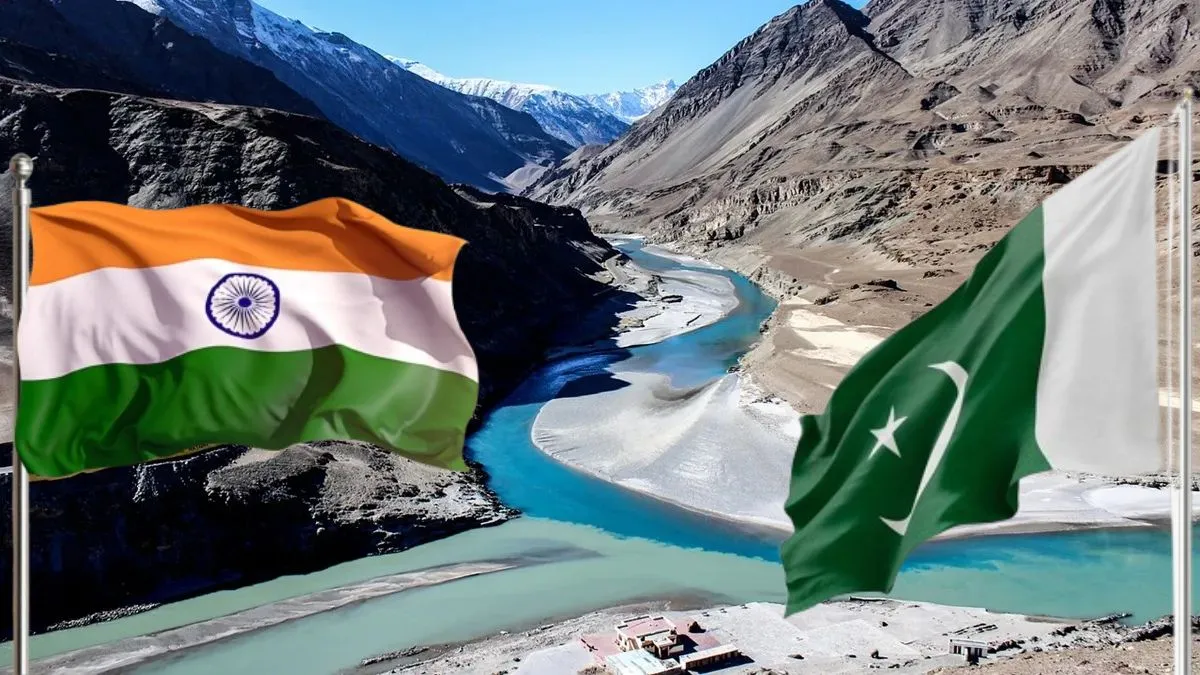
Long hailed as one of the world’s most resilient water-sharing accords, the Indus Waters Treaty infrastructure is developing cracks under the strain of deteriorating Pakistan-India relations. Signed in 1960 with the mediation of the World Bank, the treaty divides the waters of the Indus River system between Pakistan and India. As per the treaty, India has exclusive rights over the three eastern rivers—Ravi, Beas, and Sutlej — while Pakistan controls the three western rivers — Indus, Jhelum, and Chenab.
But, now, in a region already teetering on geopolitical uncertainty, India’s threats in the wake of the Pahlgam incident — and recent steps — toward suspending or renegotiating the treaty signal a perilous new era.
What once served as a rare example of cooperation between the two nuclear-armed rivals may soon become a flashpoint. India’s announcement to hold the Indus treaty in abeyance has stark long- and short-term implications for Pakistan. To understand the magnitude of the threat, it is vital to recognize just how dependent Pakistan is on the Indus River system.
Nearly 90 per cent of Pakistan’s agricultural output depends on irrigation from the Indus and its tributaries. This is not just a matter of livelihood — it is a matter of survival. Water availability in Pakistan has already declined from 5,000 cubic meters per capita in 1947 to under 1,000 cubic meters per capita today, placing it on the threshold of absolute water scarcity.
A suspension of the treaty, or even India’s manipulation of flows through upstream dams, could devastate key agricultural regions such as Punjab and Sindh. Crops like wheat, rice, and cotton — mainstays of the country’s food security and export economy — would be among the first casualties.
Moreover, urban centers like Karachi and Lahore, already struggling with water stress, would experience even more acute shortages. In a country where water riots are not unheard of, such scarcity could trigger civil unrest and deepen political instability.
“India’s move to suspend the Indus Waters Treaty is not only indicative of its aggression and extremism, but it also constitutes a serious breach of international law, and it cannot unilaterally suspend or revoke it. It is a legally binding and a guaranteed agreement brokered by the World Bank. Article 12(4) of the treaty states that termination is only possible through mutual written consent from both India and Pakistan. It is a perpetual agreement, not limited by time or circumstance. Any unilateral withdrawal amounts to a breach of the treaty. If India stops honouring the treaty under the pretext of termination, suspension, withdrawal or revocation, it would effectively be deciding to disrupt the natural flow of water into Pakistan. What India may term a revocation, Pakistan will rightfully interpret as a violation,” says water expert Zafar Iqbal Wattoo.
India’s construction of multiple run-of-the-river hydroelectric projects on the western rivers has long been a source of tension. Projects like Kishanganga and Ratle, located in Indian Illegally Occupied Jammu and Kashmir, are within the letter of the treaty — but barely. Pakistan has repeatedly challenged these projects in international forums, fearing that India could manipulate water flows during crucial crops seasons or in times of conflict.
Now, with political winds shifting under the Modi government’s muscular nationalism, India has taken a more confrontational tone. In 2023, New Delhi formally notified Islamabad of its intention to modify the treaty, citing decades of legal gridlock. Though framed as a procedural move, it marks the most serious challenge to the Indus treat’s sanctity since its inception.
Should India choose to unilaterally suspend or weaponize water flows, it would mark a dangerous departure from its historical restraint. For Pakistan, this would not only be a hydrological disaster — it would be a national security emergency.
India’s posturing on the Indus treaty also has broader implications for regional diplomacy and international law. For decades, the treaty has been a rare symbol of functional bilateralism in South Asia. Its collapse would not only erode trust but also weaken global norms surrounding transboundary water cooperation.
Countries like China, which already exerts significant hydrological control over rivers flowing into South and Southeast Asia, would be watching closely. A precedent where a powerful upstream country rewrites river-sharing rules unilaterally could trigger a domino effect in other fragile river basins around the world — from the Mekong to the Nile.
The World Bank, already reluctant to re-engage in the arbitration of disputes due to procedural deadlocks, may fully withdraw as a neutral guarantor. This would leave Pakistan diplomatically isolated, especially if its historical allies like China or Gulf States remain non-committal
Zaffar Iqbal Wattoo explains what happens if India obstructs the downstream flow of water to Pakistan. “Could this set a precedent for China upstream?” If India attempts to block water from the rivers flowing into Pakistan, it would not only violate international water law but also establish a dangerous precedent. Under international law, an upstream state of India has no right to hinder the natural flow of water to a downstream state of Pakistan, regardless of whether a treaty is in place or not. Should India take such a step, it may encourage a new regional norm — one that other powers, like China, could exploit by citing India’s example to justify obstructing the Brahmaputra’s flow into India. Thus, India’s actions would endanger not only Pakistan but also its own interests, as global powers like China are closely monitoring the situation.
Moreover, the World Bank, already reluctant to re-engage in the arbitration of disputes due to procedural deadlocks, may fully withdraw as a neutral guarantor. This would leave Pakistan diplomatically isolated, especially if its historical allies like China or Gulf States are non-committal.
Overlaying this already combustible scenario is the ever-intensifying reality of climate change. The Himalayan glaciers, the primary source of the Indus system, are retreating at unprecedented rates. Seasonal patterns are shifting, and unpredictable glacial lake outburst floods are becoming more frequent.
If India, emboldened by a legal exit from the treaty, accelerates dam construction or water diversion, Pakistan would face compounded unpredictability. In such a volatile climatic context, the ability to forecast water availability is critical for both crop planning and disaster preparedness. A treaty breakdown would strip Pakistan of even that limited predictability. This is not theoretical — this is mathematical inevitability. In a hotter, drier future, every drop counts.
While the military remains aware of the security implications of water scarcity, civilian governments have often failed to prioritize water diplomacy. The Indus Water Treaty is not just an international agreement — it is a domestic development imperative.
The road ahead is grim but not necessarily irreversible. Several policy measures, both reactive and proactive, could mitigate the damage, but only if adopted with urgency.
Pakistan must internationalize India’s treaty threats through active diplomacy at the UN, World Bank, and with key allies. Water wars begin when the world chooses silence. Islamabad should establish a permanent, high-level water diplomacy task force comprising foreign policy experts, hydrologists, and intelligence professionals to coordinate a long-term response.
Fixing leaks in Pakistan’s own irrigation and urban water systems could free up to 40 per cent of the water currently lost. This would help reduce dependency on treaty-based flows. With one of the world’s lowest water storage capacities for just 30 days, Pakistan must accelerate the construction of new reservoirs like Diamer-Bhasha Dam. It is no longer a matter of development; it is one of survival. Likewise, investing in drought-resistant crops, early-warning systems, and climate-smart agriculture can mitigate the impacts of water volatility.
The threat to the Indus Waters Treaty is not just a bilateral issue — it is a test of whether diplomacy can triumph over geopolitical belligerence in a region where wars have been waged for far less.
If the waters of the Indus are weaponized, Pakistan’s very fabric including economy, food supply, and stability will begin to unravel. And, in a region already riddled with fault lines such a breakdown could carry consequences far beyond the banks of the river.
“Amendments to the treaty can only be made through mutual consent and formal ratification by both parties. India’s unilateral move to suspend the treaty would not only violate the treaty’s established mechanisms such as the Permanent Indus Commission, neutral experts, or a court of arbitration for dispute resolution but would also go against the very spirit of the treaty. Despite multiple wars and political tensions, this treaty has stood the test of time, reinforcing its legal authority and moral significance,” says Zafar Iqbal Wattoo, adding that the world should care, and, more importantly, Pakistan must act before the river that gave it life becomes the conduit of its undoing.






 United Arab Emirates Dirham Exchange Rate