
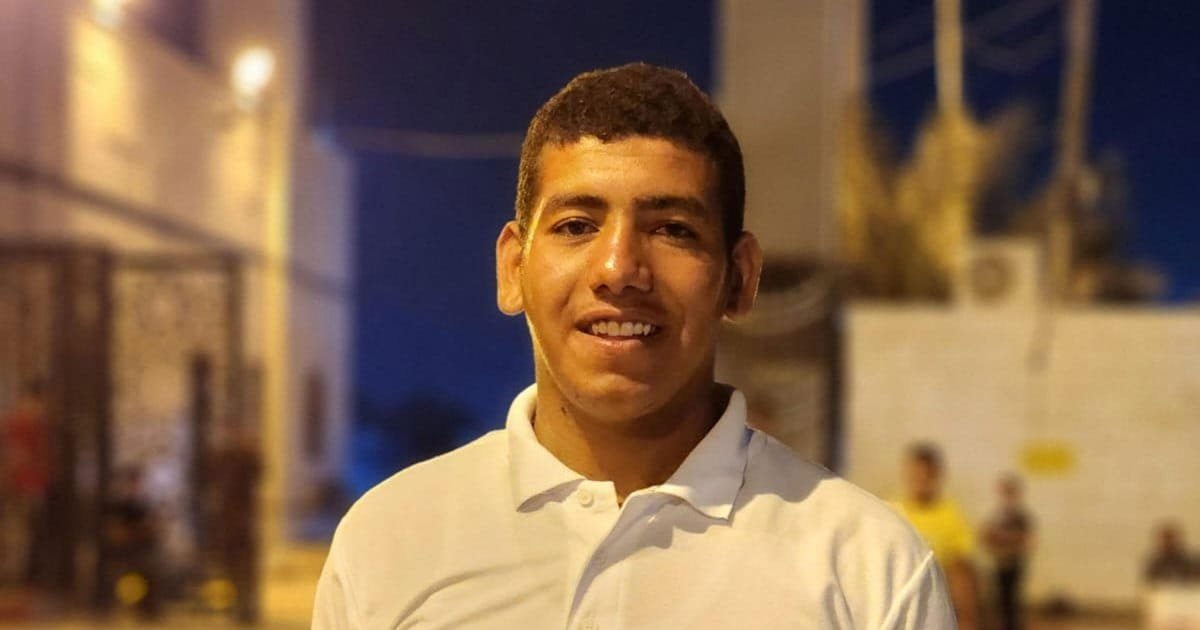
My friend Nader was killed at a GHF site. I want those responsible for his murder held to account.
On June 6, I decided for the first time to head to one of the distribution sites run by what is known as the Gaza Humanitarian Foundation (GHF). On the long 12km walk on foot, I was accompanied by a few friends.
I went with a faint hope of getting some food for my family. What we encountered bore no trace of humanity. The scene we saw play out at the distribution centre resembled a battlefield.
Israeli military vehicles stood alongside GHF trucks, with a massive barrier in front of them. Occupation soldiers were stationed on elevated positions, their weapons pointed directly at the Palestinian civilians gathering.
At one point, two trucks arrived and dumped the aid on the ground in a degrading manner. Anyone who tried to approach was met with gunfire from the Israeli soldiers. Eventually, an Israeli soldier announced over a loudspeaker, “Now you can get the aid,” and the crowd rushed towards the boxes.
Men shoved and pushed, children cried, and women trembled from fear and exhaustion. Just a small minority managed to lay their hands on some aid. Some tried to steal from those who had made it. The vast majority – myself included – went back home empty-handed.
It felt as if we were selling our dignity for scraps. I saw it as a deliberate humiliation, a reshaping of the consciousness of our educated society, and its transformation into a broken community.
I went two more times to the GHF site.
On the third trip, I was accompanied by Nader, a 23-year-old youth whom I had met during displacement. Nader lived near me and regularly went to the GHF site.
On July 19, Nader and my 16-year-old cousin Khaled prepared to go to the GHF site. I decided not to go, having lost all hope in that place, fully convinced it was a trap where Gazans were killed daily under the banner of “humanitarian work”.
They said they would try to get there early to secure food. Nader never returned. Khaled came back wounded with shrapnel in his leg.
Israeli forces had opened fire and launched several shells at the starving civilians. Most of the martyrs had been at the front of the line. Nader was hit by three bullets – in the chest, abdomen, and leg – along with shrapnel from a shell that landed near him.
Nader’s murder was devastating for his family; he was their sole provider. They could find no words to express their grief, only tears that fell on his lifeless body, as they mourned him.
Nader’s death was registered in the grim statistic of Palestinians killed at aid distribution sites, which today stands at 1,500. To the world, he was just a number; to me, he was a good man who had harmed no one but always helped others; he was robbed of everything by the occupation, his home, his job, his dreams of travelling and working in design and video editing. His family is now doomed to starve.
Since GHF began operating in Gaza over two months ago, nearly every major humanitarian organisation has condemned it and its method of aid distribution.
On August 7, Doctors Without Borders published a report titled: This is Not Aid. This is Organized Killing. It provided medical evidence that civilians were being deliberately targeted and described GHF sites as “death traps”.
He even claimed that Hamas deliberately harmed Palestinian civilians to blame the Israeli army or GHF. Yet the reality on the ground, witnessed by me firsthand, is that the only people with guns present at GHF sites are their mercenary guards and occupation soldiers. The Palestinians coming there are starving civilians, their bones protruding from extreme hunger.
The continuing operations of GHF have implications beyond the Gaza Strip. Granting legitimacy to this organisation instead of condemning and dismantling it risks turning humanitarian aid centres into killing fields everywhere.
I do not want my friend Nader’s death to be in vain. Everyone responsible for his killing, and everyone who allowed aid to be distributed through GHF, or funded it, or gave it a false humanitarian cover, must be held accountable. What we need is not only to stop these practices, but to prosecute everyone who turned aid into a trap, used hunger as a weapon, and contributed to the killing of innocents.
Silence over these crimes is complicity, and silence today means they will happen again tomorrow.
The views expressed in this article are the author’s own and do not necessarily reflect media’s editorial stance.







 United Arab Emirates Dirham Exchange Rate