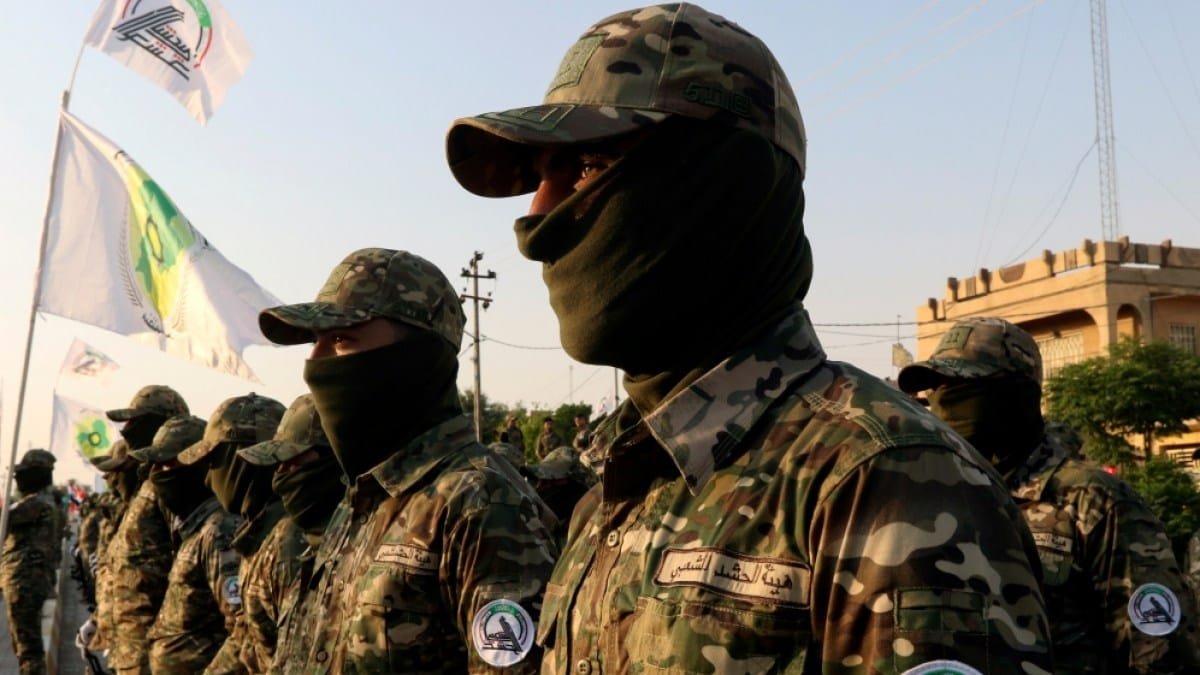
On July 27, two brigades from the mostly Shia Popular Mobilisation Forces (PMF) stormed the Iraqi Ministry of Agriculture, clashing with police.
While the incident could be seen as a power struggle for position, it also indicates a certain degree of daring on the part of the brigades, which ended up killing a police officer.
The brigades were called in by Ayad Kadhim Ali after he was dismissed as the head of the ministry’s office in Baghdad’s Karkh district, according to Mehmet Alaca, an expert on Iraq’s Shia militias. Ali is affiliated with Kataib Hezbollah, as are the brigades that attacked the ministry, analysts told media.
The incident is seen as a litmus test of whether the Iraqi state can hold PMF factions accountable for breaking the law.
Iraq’s government argues that passing a new legislation – which would fully integrate the PMF into the state – would help them do so. Proponents of the bill argue it would incentivise the PMF to act within the confines of the law, but detractors fear it would give legal cover to militias, which are already too strong.
The PMF, also known as al-Hashd al-Shaabi, is an umbrella organisation of mostly Shia armed groups, some of whom have close ties to neighbouring Iran. A few of these groups first emerged during the Iraqi resistance to US occupation.
Like Kataib Imam Ali, most PMF factions were formed after Iraqi Grand Ayatollah Ali al-Sistani issued a fatwa in 2014, urging all able-bodied men to join the state to defend Iraq from ISIL (ISIS).
At the time, ISIL controlled large swaths of territory across Syria and Iraq, equivalent to the size of England. ISIL even captured the Iraqi city of Mosul and declared a “caliphate” from there.
By 2016, Iraq’s parliament had passed a law that recognised the PMF as a component of the state’s national security.
But the law lacks clarity around command and control and budgetary oversight, and it has failed to prevent some groups from taking unilateral action to attack United States assets and soldiers stationed in the country.
In 2024, for instance, the PMF was awarded a budget of $3.4bn, which exceeded the total budget of Lebanon.
The PMF
While the figure is small relative to the $21.1bn allocated to Iraq’s Ministry of Defence that same year, it is a sizeable amount that the state allocated to a body that it did not even have an accurate membership list for.
Each registered PMF faction submits a list of names to be paid, and these lists are then reviewed by the Ministry of Finance. However, PMF leaders often intervene to push payments through unchallenged, according to a 2021 report by the Chatham House think tank.
“From the beginning, the PMF was adamant that it was part of the state and not a militia,” said Renad Mansour, an expert on Iraq with Chatham House.
Over the past 10 years, PMF factions have created political wings, run in parliamentary elections and gained access to lucrative state money after securing important administrative positions in key ministries.
Yet as they accrued power, some used their arms against the state to safeguard their patronage networks and influence over key ministries.
In 2021, PMF groups linked to Iran launched a drone at the home of then-Prime Minister Mustafa al-Kadhimi, reportedly an attempt to upend the government after losing many parliamentary seats and thus access to state money in the recent elections, said Alaca, the expert on Iraqi Shia militias.
The Iraqi government drafted the new law in March. It would give all PMF factions official, stable employment and bring them under the control of Prime Minister Mohamed Shia al-Sudani as commander-in-chief
Proponents of the draft law mainly include a bloc of five Shia parties known as the Coordination Framework.
“The argument pushed by those advocating for the law is that by offering an institutional safe haven for armed factions under a reformed PMF, it would incentivise those to comply with the national chain of command – thereby diminishing their appetite to take action outside the state,” explained Inna Rudolf, an expert on the PMF and a senior research fellow at the Centre for Statecraft & National Security at King’s College London.
Most importantly to the PMF, the law offers it much-needed legal cover at a time when the US and Israel are threatening to target groups they consider Iranian proxies.
It would grant PMF members full access to intelligence, which some argue is a risky proposition because the intelligence could be passed to Iran.






 United Arab Emirates Dirham Exchange Rate