
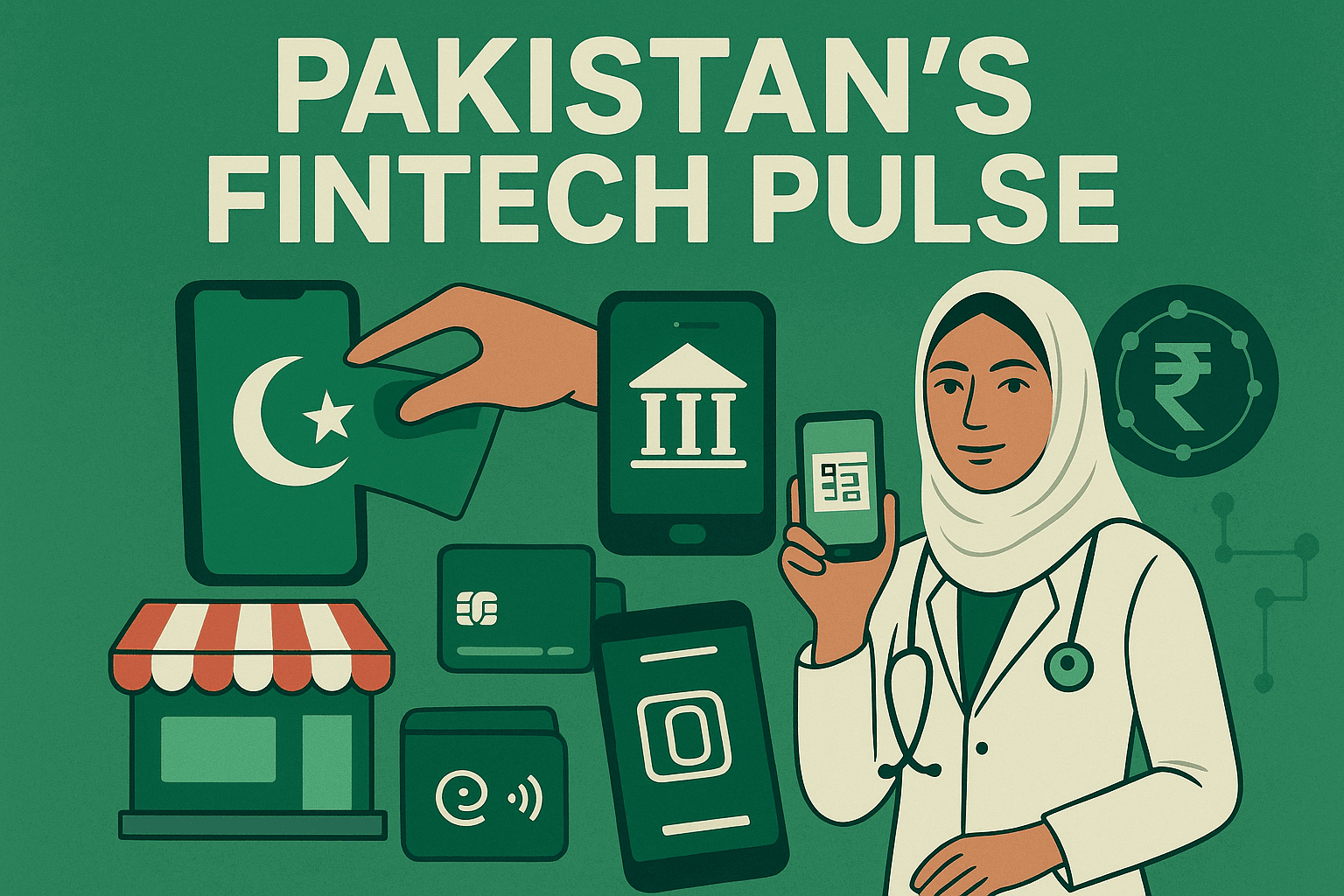
Branchless banking has fundamentally changed that equation. Riding on the back of mobile technology, companies like Easypaisa, JazzCash, UBL Omni, and SadaPay have extended financial services to previously unbanked populations.
By Ghulam Haider
In the last decade, Pakistan has witnessed a silent financial revolution: the rise of branchless banking. From the streets of Karachi to the highlands of Gilgit, millions of people now carry their banks in their pockets. Mobile wallets, QR payments, and biometric verifications have replaced long queues at bank branches, offering unprecedented convenience, speed, and access.
This financial democratization has been largely driven by the rise of fintech solutions—digital platforms enabling transactions without physical bank branches. With over 80 million mobile wallets and more than 180 million cellular subscribers, Pakistan has leapfrogged traditional banking limitations. Yet, this progress brings with it a complex challenge: how to balance innovation with data privacy, security, and financial inclusivity, especially across rural and urban divides.
The branchless banking has been transforming Pakistan’s financial landscape, while critically examining its limitations and the safeguards necessary to ensure this transformation remains ethical, equitable, and inclusive.
For decades, Pakistan’s formal banking system catered to a narrow segment of society. According to the World Bank’s 2017 Global Findex, only 21% of Pakistani adults had a bank account. Traditional brick-and-mortar banking failed to penetrate vast swathes of rural Pakistan due to high operational costs, low financial literacy, and geographical inaccessibility.
However, over few years, branchless banking has fundamentally changed that equation. Riding on the back of mobile technology, companies like Easypaisa, JazzCash, UBL Omni, and SadaPay have extended financial services to large swathes of previously unbanked populations. Whether it’s sending remittances, paying utility bills, purchasing goods & groceries, or receiving government disbursements, branchless platforms allow users to conduct transactions securely via mobile phones, without ever stepping inside a bank.
In rural districts where banks are few and often distant, this is not just convenience — it’s empowerment. A woman in Tharparkar can now receive her BISP (Benazir Income Support Programme) stipend directly to her mobile wallet. A shopkeeper in Swat can pay his supplier digitally. In urban and rural Pakistan, gig workers, delivery riders, freelancers, and small traders now operate on fintech rails, bypassing the need for formal banking infrastructure.
Pakistan’s fintech ecosystem has exploded in recent years. Spurred by regulatory encouragement from the State Bank of Pakistan (SBP) and investment from global venture capitalists, dozens of digital banks and wallet services have emerged. Players like TAG, NayaPay, and Finja are building app-based platforms that enable customers to open accounts, manage savings, and transact without ever interacting with a bank teller.
Fintech has enabled two vital pillars of inclusion: NADRA’s biometric infrastructure, and remote Know Your Customer (KYC) processes have made account opening a matter of minutes. This is a game-changer for populations traditionally excluded due to documentation challenges or geographic isolation. Likewise, micro-loans, savings accounts, insurance, and merchant services are now tailored for low-income segments.
Even daily wage labourers and rickshaw drivers can access short-term credit or savings tools with a few taps on their phones. Moreover, fintechs have helped digitize the informal economy. QR codes now hang from thousands of roadside stalls, Pan Shops, and Dhabas, bringing them into the formal fold.
While the proliferation of digital banking tools is remarkable, it raises a pressing question: who owns the data? and more importantly: who protects it?
Every digital transaction leaves a trail — from purchasing habits to geolocation data, biometric scans, and income levels. In the absence of strong data protection legislation and robust oversight mechanisms, this treasure trove of sensitive information becomes vulnerable to misuse, profiling, and exploitation.
Pakistan needs to have stringent Personal Data Protection Law to bridge the legal vacuum that presents critical concerns. Many users, especially those with limited digital literacy, may not fully understand how their data is being collected, used, or shared. Fintech companies like global tech giants may be tempted to monetize user data without proper disclosures. In 2022 alone, several financial institutions in Pakistan reported attempted data breaches. As fintech platforms scale, so does the attack surface for cybercriminals.
To safeguard the future of digital finance, Pakistan must prioritize a robust regulatory framework that governs data collection, processing, and sharing — with clear penalties for violations, and user rights to access, rectify, and delete their data.
Branchless banking paints an aspirational future — but are rural populations equally benefiting? Digital divide persists across three axes. Rural Pakistan still suffers from poor mobile broadband coverage, especially in Balochistan, parts of Sindh, and Gilgit-Baltistan. While urban youth quickly adapt to apps and QR payments, older rural populations often rely on mobile agents or SMS-based services.
Without education, these users are vulnerable to fraud and misinformation. Only about 20% of mobile wallet users are women, reflecting entrenched social and digital barriers. Cultural norms, phone ownership gaps, and lack of financial autonomy inhibit rural women’s participation in digital finance.
Moreover, the cashless push risks marginalizing communities who still depend on tangible currency for daily transactions. Informal workers, farmers, and artisans often lack smartphones, stable incomes, or documentation — all of which are preconditions for digital banking.
To address this, Pakistan must adopt a multi-layered inclusion strategy by providing low-cost smartphones and internet access in underserved areas, expanding the network of mobile money agents to remote villages, offering cash-in/cash-out facilities. It needs to promote apps with regional languages, voice instructions, and women-focused financial products, and partner with NGOs and community leaders to educate users on safe digital practices and rights.
The State Bank of Pakistan deserves credit for pioneering branchless banking regulations early on. The Branchless Banking Regulations (2016) and EMI Licensing Framework (2019) enabled a regulatory sandbox for innovation while ensuring consumer safeguards.
More recently, the Raast Instant Payment System, developed by SBP, has created an interoperable backbone for real-time, secure, and low-cost digital transactions. By integrating government disbursements, salary payments, and peer-to-peer transfers, Raast is fast becoming a national utility for inclusive finance.
To sustain this momentum, the government must do more in three critical areas. The government must enact and enforce data protection laws implemented with an independent data commission to ensure accountability. The government should promote digital public goods as the open-source identity systems, digital credit registries, and interoperability standards can level the playing field for fintechs and benefit end users. Similarly, government should offer tax breaks and grants to fintechs building solutions for marginalized communities — women, persons with disabilities, and the elderly.
Branchless banking in Pakistan is not merely a technological shift — it’s a paradigm shift in how people experience trust, value, and economic agency. It has already brought millions into the financial fold and is poised to lift many more out of poverty and informality.
Yet, this revolution must be handled with care. Fintechs cannot become digital monopolies. Users cannot be treated as data points. And progress cannot come at the cost of privacy, equity, or dignity. The task ahead is to institutionalize safeguards without stifling innovation. To protect the vulnerable while empowering the bold. To ensure that the path to a cashless economy is not only paved with apps and algorithms, but with trust, transparency, and fairness. Pakistan’s branchless banking journey has only just begun — and if managed wisely, it may just become a model for the developing world.





 United Arab Emirates Dirham Exchange Rate