
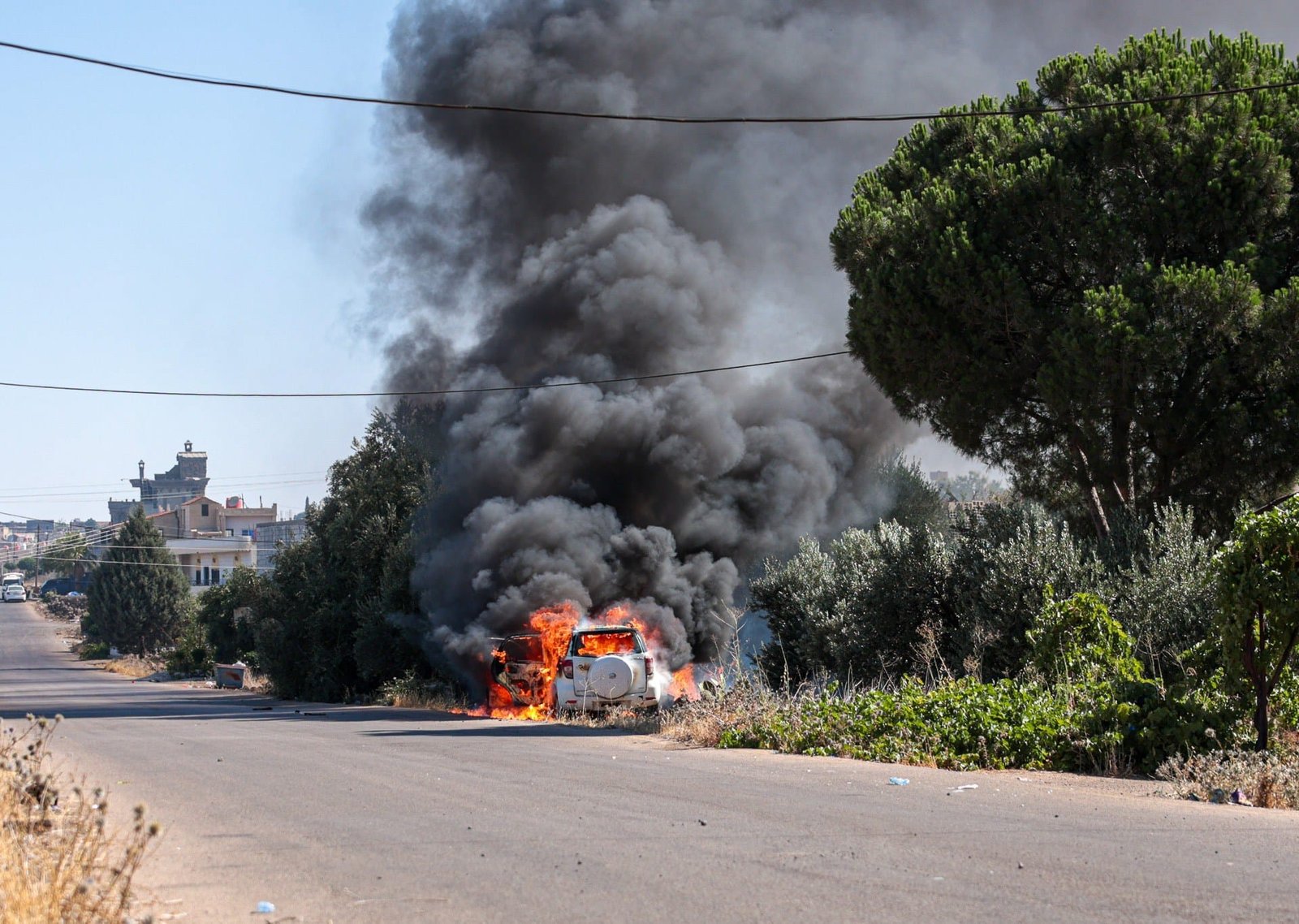
A history of outside incitement, along with present-day economic crisis and climate collapse, have contributed to intercommunal tensions.
The flare-up of violence in Syria’s southern province of Suwayda in July has once again raised fears that the country may slip back into conflict. Media headlines were quick to paint this as another episode in the region’s longstanding “sectarian strife” between Druze and Sunni Bedouin communities. But such framing obscures more than it reveals.
The reality is more complex. While sectarian identities have been invoked during periods of tension, the root causes of this conflict lie elsewhere: in historical disputes over land and pastures, in competition over smuggling routes and state patronage, and in economic collapse exacerbated by prolonged drought and climate change. To reduce this flare-up to a matter of religious hatred is to erase the deeper political ecology and social history of the region and obfuscate ways to resolve tensions.
In the 18th century, the Druze began migrating to Jabal al-Arab, a mountainous region in what was then the Hauran Sanjak of the Ottoman Empire, as a result of contestations among the various Druze tribes in Mount Lebanon. They established villages, cultivated land, and eventually asserted political and military dominance in the region.
The Druze saw their settlement of the area as reclaiming barren terrain — a land they described in their oral tradition as “empty”. But this narrative has been deeply contested by the Bedouin herding communities, who had a presence in the region centuries earlier.
The Bedouin were a mobile society and did not establish permanent settlements; they used the land seasonally to graze their herds, navigating ancient migration routes and relying on water sources that could not be owned privately. To them, these were not vacant spaces but ancestral landscapes, and the Druze tribes were the newcomers.
This inevitably led to conflict. Skirmishes over pasture rights, access to wells, and control of borderlands were a recurring feature of the region’s social fabric. Historical accounts refer to these confrontations as ghazawat — tribal raids and counterraids that were as much about resource competition as they were about honour and survival. Druze oral history tended to depict Bedouins as marauders, prone to betrayal. Bedouin narratives portrayed Druze expansion as a form of territorial encroachment.
And yet, the relationship was never exclusively hostile. There were periods of coexistence and cooperation: Druze farmers hired Bedouin herders, and Bedouin communities relied on Druze markets and grain supplies. But this fragile equilibrium often collapsed during times of stress, particularly during drought, state collapse, or political interference.
Over the course of the past two centuries, successive regimes — from the Ottomans to the French Mandate and then the rule of the Assad family — exploited and entrenched local tensions to serve broader strategies of control.
In 1925, a revolt broke out in Jabal al-Arab led by Druze commander Sultan al-Atrash. Bedouin groups joined forces with the Druze, fighting together in major engagements such as the battles of al-Kafr and al-Mazraa. This moment of cooperation between Druze and Bedouin communities was born out of shared grievances and a collective opposition to colonial rule. It demonstrated the potential for intercommunal unity in resistance.
After independence in 1946, this fragile relationship deteriorated once more when President Adib Shishakli launched a violent campaign against the Druze, portraying them as a threat to national unity. His forces occupied the Jabal and reportedly encouraged Bedouin tribes to raid Druze villages, rekindling fears of collusion and solidifying a narrative of betrayal.
During this same era of early independence, the Syrian constitution set out to settle all Bedouin communities and remove many privileges they had been granted during the French Mandate. In 1958, during Syria’s union with Egypt, the Law of the Tribes was repealed, and Bedouin tribes ceased to possess any separate legal identity. They were also seen as a threat to national unity alongside the Druze.
In the decades that followed, especially under the rule of the Assad family, the state maintained stability by suppressing open conflict without addressing underlying grievances. In the 1980s and 90s, Druze and Bedouin communities coexisted uneasily, having minimal interaction and occasional land or grazing disputes.
This uneasy calm collapsed in 2000, when a localised altercation escalated into deadly clashes in Suwayda. The violence reignited historical tensions, hardened communal boundaries, and exposed the limits of authoritarian stability.
Druze migration
The outbreak of civil war in 2011 further destabilised Druze-Bedouin relations as Islamist factions, particularly ISIL (ISIS) and al-Nusra Front, exploited Bedouin marginalisation to recruit fighters and establish footholds in the Syrian desert. While not all Bedouin communities aligned with these groups, the association between some Bedouin tribes and Islamist armed groups deepened Druze suspicions and intensified the perception of the Bedouin as a security threat.
The massacre in Suwayda in 2018, which was carried out by ISIL and reportedly facilitated by “sleeper cells” in nearby Bedouin communities, reinforced this narrative of betrayal. Islamist manipulation of Bedouin discontent thus served to fracture already fragile intercommunal relations, undoing years of fragile coexistence between two historically entangled groups.
Controlling a checkpoint or a smuggling route today can mean the difference between subsistence and destitution. For Druze factions in Suwayda and Bedouin groups operating on the desert fringes, this has translated into conflict over territory, disguised as security enforcement or tribal honour.
These are strategic contests over mobility and access. A Bedouin group accused of cooperating with traffickers may clash with a Druze militia that seeks to police the area, or vice versa. Accusations of betrayal, retaliatory killings, and road closures follow. What might appear externally as communal violence is, in practice, a struggle over the spoils of an informal economy in a lawless zone.
Compounding this is the region’s increasing vulnerability to climate change. Recurrent droughts have devastated traditional forms of livelihood. Druze farmers have seen crop yields collapse; Bedouin pastoralists can no longer sustain herds on shrinking grasslands. What was once a seasonal rhythm of co-dependence — grazing on open land in winter, planting and harvest in summer — has broken down. Both communities now compete over increasingly scarce and degraded land.
In this context, to frame the violence purely as a sectarian feud is not only inaccurate; it is politically dangerous. Such a narrative serves those who benefit from fragmentation. Portraying local conflicts as ancient hatreds justifies repression and delays any serious efforts to implement decentralisation or pursue reconciliation. It erases the long history of cooperation, trade, and even shared struggle between Druze and Bedouin tribal communities. And it silences the real, material demands at stake: secure land rights, sustainable economic opportunities, and an end to imposed political marginality.
Understanding this conflict as economic and political, rather than a religious or tribal one, is the first step towards ending it.
The views expressed in this article are the authors’ own and do not necessarily reflect media’s editorial stance.






 United Arab Emirates Dirham Exchange Rate