
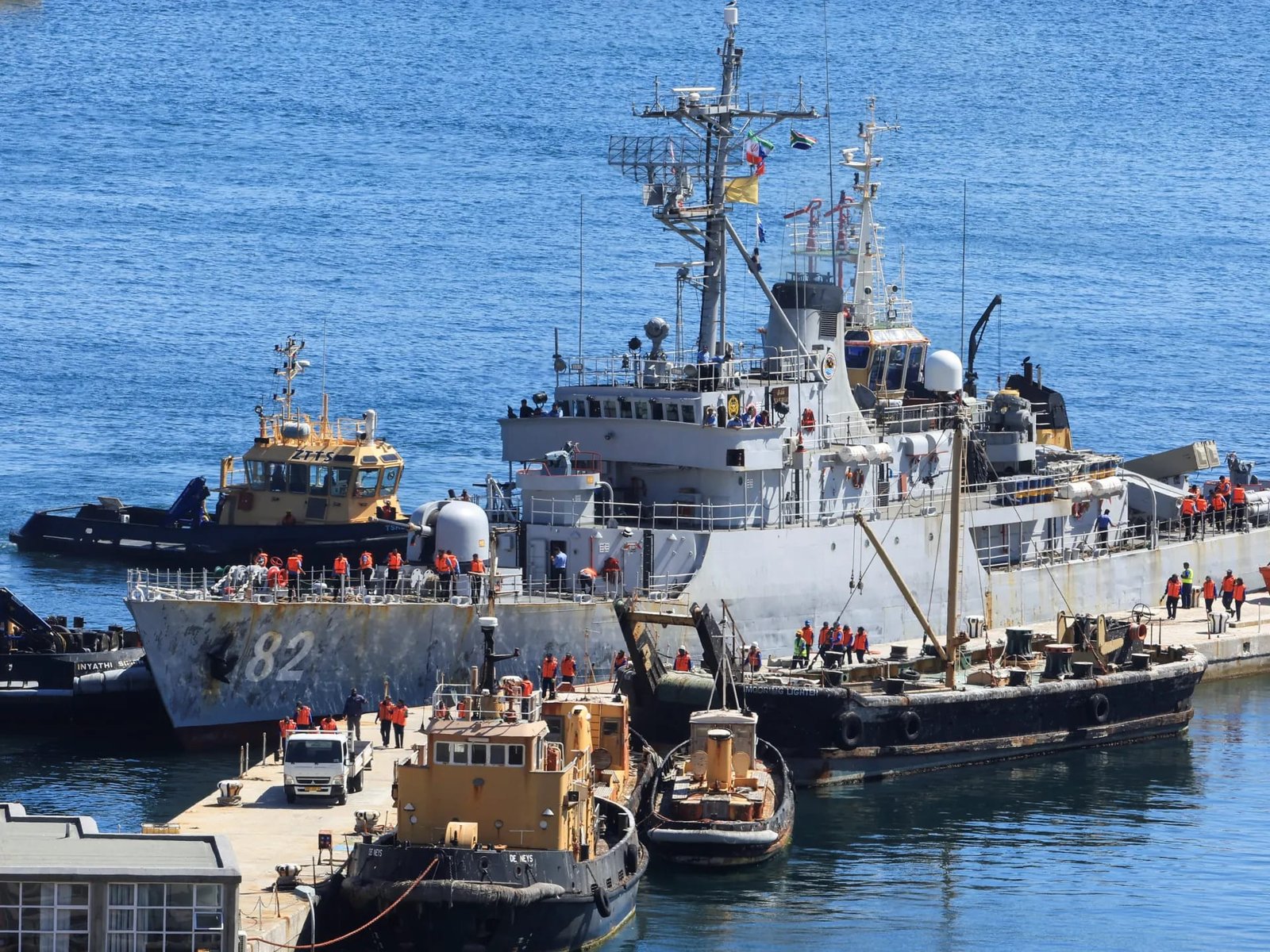
South Africa’s government is facing backlash from the US and from within its own administration for hosting Iran’s navy.
South Africa has launched an inquiry into Iran’s participation in joint naval drills with BRICS nations last week, apparently against the orders of President Cyril Ramaphosa.
BRICS is a group of 10 countries: Brazil, China, Egypt, Ethiopia, India, Indonesia, Iran, Russia, South Africa and the United Arab Emirates. The acronym BRICS represents the initial letters of the founding members, Brazil, Russia, India, China and South Africa.
The group, formed in 2006, initially focused on trade, but has since expanded its mandate to include security and cultural exchanges.
It concluded a week of joint naval drills in South African waters on January 16. The drills have caused controversy in the country and drawn the ire of the United States.
Although South Africa regularly holds drills with Russia and China, the latest maritime training comes amid heightened tensions between the US and many of the group’s members, particularly Iran, which until last week was grappling with mass protests at home that turned deadly.
Pretoria said the exercise, named Will for Peace 2026, was essential for ensuring maritime safety and international cooperation. The training “brings together navies from BRICS Plus countries for … joint maritime safety operations [and] interoperability drills”, a statement from the South African military noted before the exercises.
However, US President Donald Trump’s administration, which has previously accused BRICS of being “anti-American” and has threatened its members with tariffs, has strongly criticised the naval exercises.
Here’s what we know about the exercises and why they were controversial:
South Africa hosted the BRICS naval exercise, which included warships from participating countries, on January 9-16.
China led the training, which took place near the southwestern coastal city of Simon’s Town, which is home to a major South African naval base.
Exercises in rescue and maritime strike operations as well as technical exchanges were planned, according to China’s Ministry of National Defense. All BRICS countries were invited.
Captain Nndwakhulu Thomas Thamaha, South Africa’s joint task force commander, said at the opening ceremony that the operation was not just a military exercise but a statement of intent by BRICS countries to forge closer alliances with each other.
“It is a demonstration of our collective resolve to work together,” Thamaha said. “In an increasingly complex maritime environment, cooperation such as this is not an option. It is essential.”
What were the drills for?
The purpose, he said, was to “ensure the safety of shipping lanes and maritime economic activities”.
South African Deputy Defence Minister Bantu Holomisa told journalists that the drills had been planned before the current tensions between some BRICS members and the US.
South Africa, the host country, dispatched a frigate.
Indonesia, Ethiopia and Brazil joined the exercises as observers.
India, the current chair of the group, chose not to participate and distanced itself from the war games.
“We clarify that the exercise in question was entirely a South African initiative in which some BRICS members took part,” India’s Ministry of External Affairs said in a statement. “It was not a regular or institutionalised BRICS activity, nor did all BRICS members take part in it. India has not participated in previous such activities.”
The US is angry that South Africa allowed Iran to participate in the drills at a time when Tehran was accused of launching a violent crackdown on antigovernment protests that had spread across the country.
The protests broke out in late December, when shopkeepers in Tehran closed up their businesses and demonstrated against inflation and the falling value of the rial. These protests swelled into a broader challenge to Iran’s rulers, as thousands of people took to the streets nationwide to demonstrate over a few weeks.
Security forces in some areas cracked down on the crowds, resulting in the deaths of “several thousands”, according to a statement on Saturday by Supreme Leader Ayatollah Ali Khamenei. While activists said thousands of protesters were killed, the Iranian government said this was an exaggeration and claimed police officers and security service members formed a significant chunk of those who were killed.
The Iranian authorities also claimed the US and Israel had armed and funded “terrorists” to inflame the protests. They said agents affiliated with foreign powers, and not state forces, were responsible for the deaths of civilians, including protesters.
The mass uprising is one of the most disruptive the country has witnessed since the 1979 Iranian Revolution. Tens of thousands of people are believed to have been arrested.
Before the BRICS drills, the US warned South African President Cyril Ramaphosa that Iran’s participation would reflect badly on his country, according to a report by the Daily Maverick, a South African newspaper.
Ramaphosa subsequently ordered Iran to withdraw from the exercises on January 9, the paper reported.


 United Arab Emirates Dirham Exchange Rate