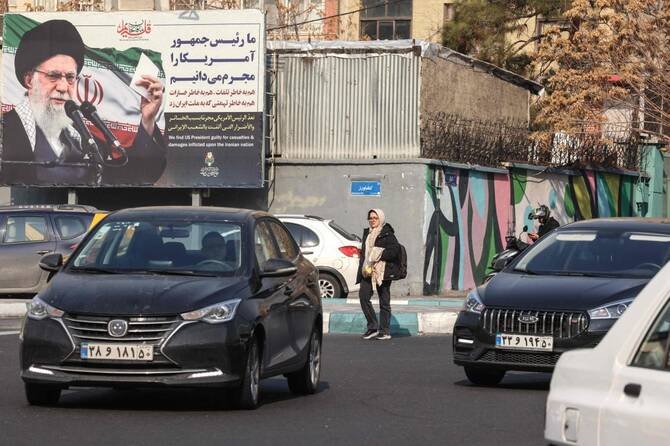
U.S. weighs targeting security leaders as Gulf allies warn of regional blowback; Tehran prepares for potential confrontation while seeking diplomacy.
DUBAI – U.S. President Donald Trump is actively considering military strikes against Iranian security forces and leaders in an effort to inspire a renewed protest movement and push for regime change, according to multiple sources familiar with the discussions.
The plans, which remain under deliberation, include targeted attacks on commanders and institutions held responsible for the violent crackdown on nationwide protests earlier this month that left thousands dead. Two U.S. sources said the goal is to embolden protesters to “overrun government and security buildings.”
One option under review involves a broader strike against Iran’s ballistic missile capabilities or nuclear enrichment sites, a move analysts say could escalate into sustained conflict.
The arrival of a U.S. aircraft carrier strike group in the region this week has expanded Washington’s military options, even as regional allies express deep concern. Arab and Israeli officials warned that airstrikes alone would not topple Iran’s clerical leadership and risk triggering wider instability.
“If you’re going to topple the regime, you have to put boots on the ground,” said a senior Israeli official familiar with U.S.-Israeli planning.
Iran has signaled it is preparing for possible military confrontation while pursuing diplomatic channels. A senior Iranian official said Tehran is “making use of diplomatic channels” but accused Washington of showing no openness to dialogue.
Regional Fears of Fallout
Gulf states — including Saudi Arabia, Qatar, Oman, and Egypt — have privately urged the U.S. against military action, fearing retaliatory strikes from Iran or its proxies.
“The United States may pull the trigger, but it will not live with the consequences. We will,” an Arab official warned.
Experts caution that fragmentation within Iran could mirror the chaos of Syria or post-invasion Iraq, with destabilizing effects across the Middle East.
Leadership in Flux
Supreme Leader Ayatollah Ali Khamenei, 86, has reduced his public role since Israeli strikes last year killed senior Iranian commanders, but retains ultimate authority over key state matters. Day-to-day governance has shifted toward figures aligned with the Islamic Revolutionary Guard Corps (IRGC), though no clear successor to Khamenei has emerged.
While U.S. and Israeli assessments acknowledge the Iranian government has been weakened by protests and economic crisis, they conclude it remains firmly in control absent large-scale military defections.
Trump publicly warned Iran on Wednesday to return to nuclear negotiations, threatening that any future U.S. attack would be more severe than last June’s bombings.
As tensions rise, the international community watches whether Washington will choose military escalation or diplomatic pressure — with the Middle East bracing for the outcome.





 United Arab Emirates Dirham Exchange Rate