And could a sudden deployment of major US naval and air force assets indicate a strike on Iran is imminent?
The United States is intensifying a military build-up off Iran that experts say could be an indicator that Washington is planning to strike the country.
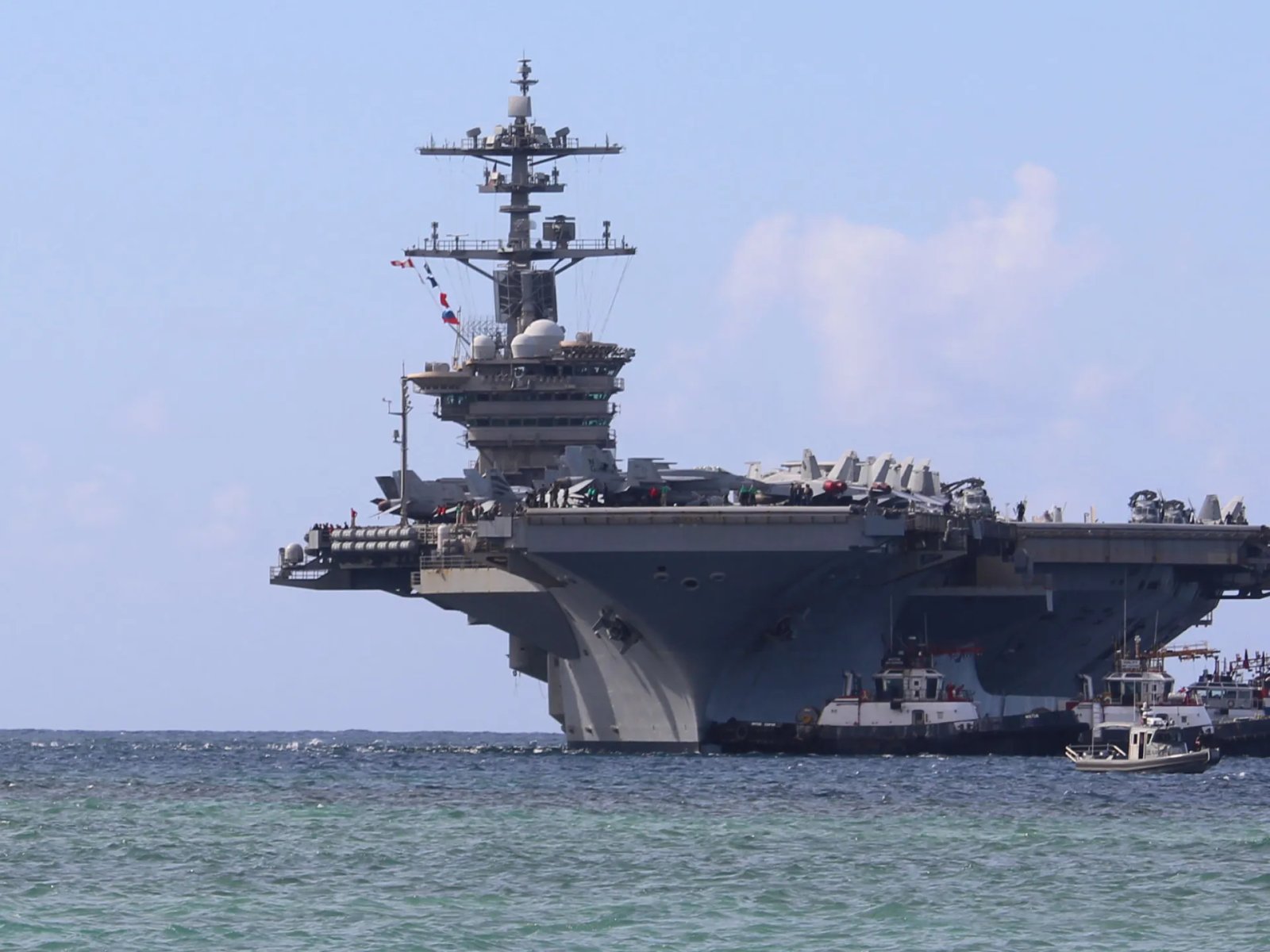
The USS Abraham Lincoln, a nuclear-powered aircraft carrier, is one of several military assets the US has deployed to the Arabian Sea in recent days.
The US also deployed assets from around the world to the region during the 12-day Iran-Israel War in June last year, when Washington sided with its ally Israel and heavily bombed three Iranian nuclear sites.
And later last year, the US stockpiled military assets in the Caribbean just weeks before launching a series of strikes on Venezuelan boats it claimed – without proof – were trafficking drugs to the US. Eventually, the US abducted Venezuelan President Nicolas Maduro from Caracas in a military assault on January 3.
Following mass protests in Iran from late December, when thousands took to the streets first to complain about the country’s failing currency, but later on, demanding government change, Iranian security forces were accused of massacring demonstrators. The United Nations special rapporteur to Iran said at least 5,000 protesters were killed, while thousands have been detained.
US President Donald Trump seized on the opportunity to lambast Iran’s clerical leaders, telling demonstrators that “help is on its way”, and threatening military action if Iran carried out executions of prisoners.
Earlier this month, Trump dialled back his threats when, he said, the Iranian government assured him there would be no executions. And, when protests were finally quashed last week, he claimed planned executions had been halted because of him, although Iran disputes that account.
Nonetheless, Trump’s rhetoric and the unusual deployment of US military assets to the coast of Iran in recent days may indicate that strikes could be imminent, some analysts say.
However, he warned, if Iran does execute protesters, US military action on the country would make June’s attack on three Iranian nuclear sites “look like peanuts”.
Here’s what we know about what US assets have been deployed:
US Central Command (CENTCOM) confirmed in a post on X on Monday that a nuclear-powered aircraft carrier, USS Abraham Lincoln, has been sent to the Middle East to “promote regional security and stability”.
The vessel, which departed her homeport of San Diego, California in November and had been operating in the South China Sea until last week, is one of the US Navy’s largest warships.
While CENTCOM did not offer more details on why the ship had been deployed, its statement signals a large US naval deployment towards Iran at a time when tensions between Washington and Tehran have soared.
What US military assets have arrived in the region?
On Tuesday, the US Air Forces Central Command (AFCENT) also announced “multi-day readiness” military drills throughout its “areas of responsibility”, referring to 20-some nations in the Middle East, Asia and Africa that host US military bases.
In a statement, AFCENT said the drills would help to improve its capacity to deploy assets and personnel, strengthen its partnerships with host countries, and prepare for “flexible responses”.
The US maintains a vast military footprint in the Middle East and has been expanding its assets and capabilities there since 2024, as part of its attempt to deter the Iran-backed Houthis in Yemen, who have been targeting Israel-linked commercial vehicles in the Red Sea in solidarity with Palestinians in Gaza.
There were about 40,000 US service members in the region by June 2025, according to the Council on Foreign Relations.
Overall, there are eight permanent US military bases in Bahrain, Egypt, Iraq, Israel, Jordan, Kuwait, Qatar, Saudi Arabia, Syria and the United Arab Emirates.
Other US military installations are situated in Oman and Turkiye.
Iran bombed Qatar’s Al Udeid military airbase, which hosts US troops, on June 23, 2025, in response to Washington’s strikes on Iranian nuclear sites the day before, at the end of the 12-day Iran-Israel war. No deaths or injuries were recorded, and satellite imagery noted that military aircraft had been evacuated in anticipation of the strikes. Iran’s attack was largely seen as a face-saving exercise.
The USS Abraham Lincoln (CVN-72) serves as a mobile airfield and the flagship vessel of the US Navy’s Carrier Strike Group 3, an operational formation that includes several thousand personnel – likely between 6,000 and 7,000 sailors and marines.
With an overall length of 333 metres (1,092 feet), the vessel is one of the US Navy’s largest warships. It is part of a 10-member elite class of US aircraft carriers that use nuclear reactors, rather than diesel engines, to power their propeller shafts. They can operate for decades without requiring fuel.
USS Abraham Lincoln, despite its huge size, is designed for exceptional speed over extended periods. It runs at more than 56km/h (35mph), a speed at which it can quickly manoeuvre and evade attacks.
At least three destroyers – smaller, faster warships that flank the bigger vessels as escorts – are also known to be in the formation. They are Arleigh Burke-class guided missile destroyers – all-steel ships capable of launching Tomahawk missiles for land strikes and providing ballistic missile defence. All three belong to the destroyer unit assigned to USS Abraham Lincoln-Destroyer Squadron 21.
The destroyers are:
Carrier strike formations also usually include a cruiser, an attack submarine and one replenishment ship.






 United Arab Emirates Dirham Exchange Rate