
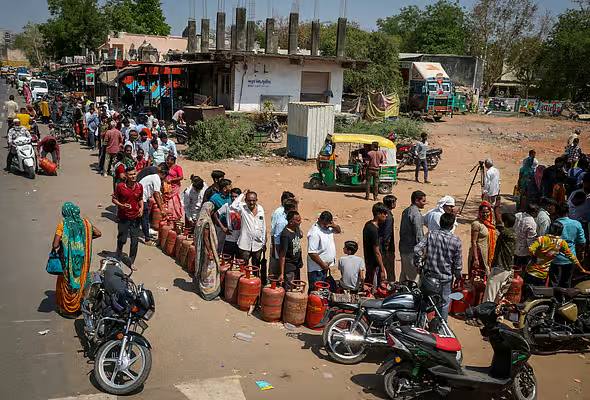
India imports 60% of its LPG needs, with 90% transiting through the Strait of Hormuz. Supply chain disruptions amid the US-Israel-Iran war have triggered shortages and price hikes.
As the US-Israel-Iran war disrupts maritime routes in West Asia, India is grappling with a severe liquefied petroleum gas (LPG) shortage. The crisis stems from the closure of the Strait of Hormuz—a critical chokepoint through which 90% of India’s LPG imports pass.
With over 330 million households relying on LPG cylinders for daily cooking, the disruption has forced the government to accelerate efforts to shift urban consumers toward piped natural gas (PNG). Here’s a breakdown of the two fuels and the factors driving the current crisis.
What’s the Difference Between LPG and PNG?
While both are used for cooking, their sourcing, delivery, and cost structures differ significantly.
| Feature | LPG (Liquefied Petroleum Gas) | PNG (Piped Natural Gas) |
|---|---|---|
| Delivery | Stored in cylinders; distributed via a network of dealers. | Supplied directly to homes through underground pipelines. |
| Composition | Propane and butane, stored under pressure in liquid form. | Primarily methane, delivered in gaseous form. |
| Consumer Base | Approx. 330 million users across urban and rural India. | Approx. 16 million users, mostly in metropolitan cities. |
| Cost | More expensive; prices fluctuate based on global crude oil rates. | 30–40% cheaper than LPG due to a more efficient supply chain. |
| Supply Chain | Complex—involves bottling plants, trucks, and road transport. | Simpler—direct pipeline connection to kitchens. |
India’s Push for PNG
Introduced in Delhi in 1998, PNG has remained limited to major cities and state capitals, as laying pipelines in remote or rural areas poses infrastructural challenges. However, with India consuming nearly 190 MMSCMD (million metric standard cubic meters per day) of natural gas—half of which is domestically produced—the government is now aggressively promoting PNG to reduce reliance on imported fuels.
The target is to expand PNG connections to over 125 million households by 2034, aiming to strengthen energy security and cushion the economy against global supply shocks.
Why Is There an LPG Crisis Now?
The current LPG shortage is directly linked to geopolitical tensions in West Asia. The closure of the Strait of Hormuz—following the US-Israel-Iran war—has choked a vital artery for Indian energy imports.
- Import Dependence: India imports 60% of its total LPG requirement.
- Vulnerable Route: Nearly 90% of these imports pass through the Strait of Hormuz.
- Impact: Supply chain disruptions have led to dwindling stockpiles, long waiting periods for cylinders, and rising prices for consumers.
What Lies Ahead?
With LPG supplies under strain and PNG infrastructure still limited to urban hubs, India faces a dual challenge: ensuring immediate energy access for hundreds of millions while accelerating a long-term shift toward piped gas. Analysts suggest that the crisis may fast-track pipeline expansion projects, but for now, consumers in smaller towns and remote areas remain the most vulnerable to price volatility and shortages.







 United Arab Emirates Dirham Exchange Rate