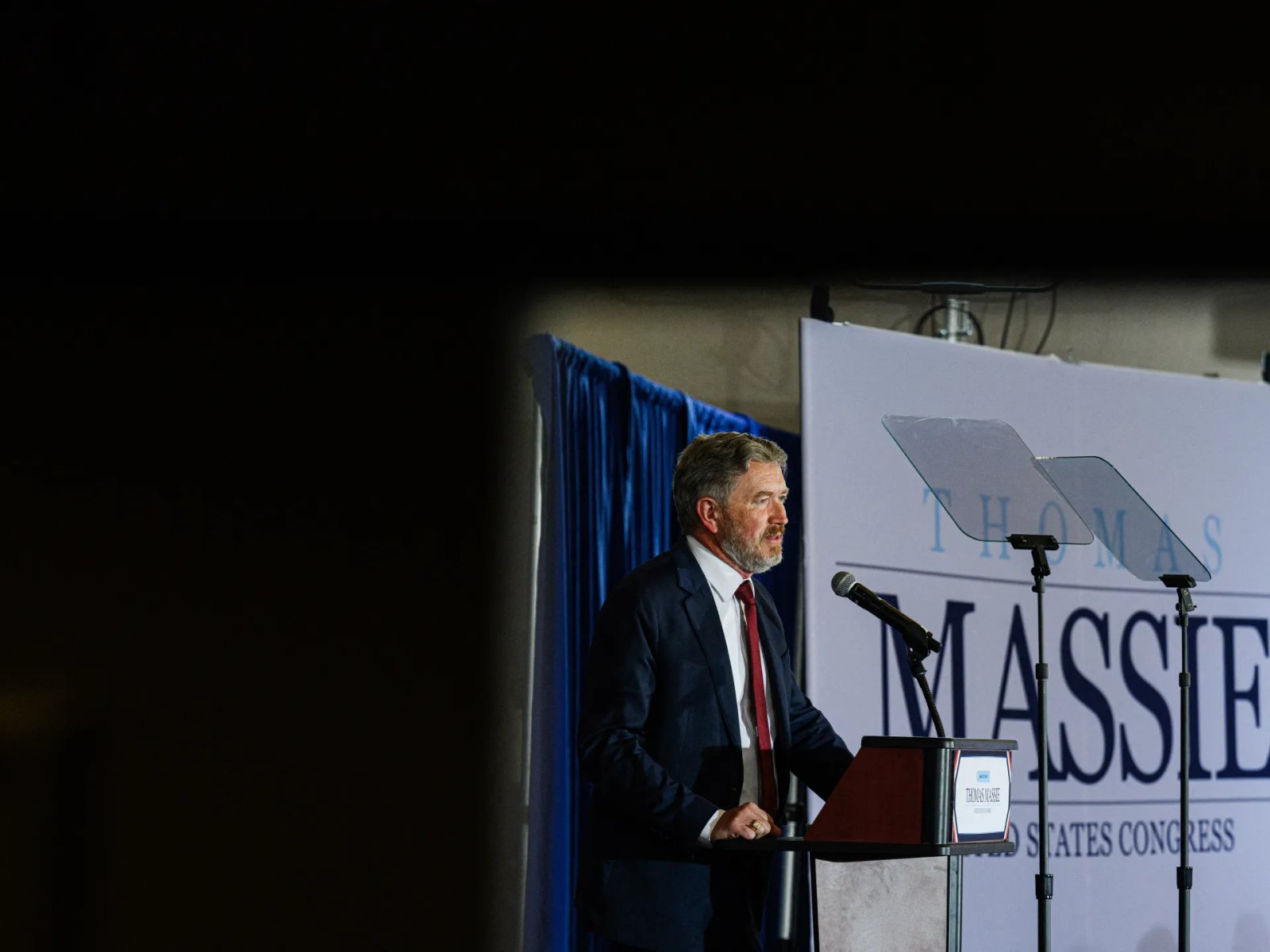
US Representative Thomas Massie lost his Republican primary on Tuesday after one of the most expensive and politically charged congressional campaigns in modern United States history. For the Israel lobby and its allies, the result marked a decisive victory. US President Donald Trump deployed his political weight against Massie, endorsing his chosen challenger, Ed Gallrein, and turning a local race into a national confrontation. At the same time, pro-Israel organisations and billionaire donors, including Miriam Adelson, poured extraordinary sums into Kentucky to defeat a congressman whose offence was questioning military aid to Israel and challenging the expanding influence of pro-Israel lobbying power in Washington.
Yet beneath the celebration lies a deeper and more troubling reality. The Kentucky race exposed a widening backlash among Americans increasingly uneasy with the scale of political influence exercised by organisations and donors aligned with a foreign state. What unfolded no longer resembled a conventional congressional primary. To many voters, the contest appeared less about Kentucky, less about conservative priorities, and less even about US national interests than about enforcing ideological conformity to Israel’s political preferences and punishing dissent within the Republican Party.
That perception may ultimately matter more than the result itself.
For decades, support for Israel functioned in Washington as an almost untouchable consensus. Republicans and Democrats competed to demonstrate loyalty to the Israeli state while organisations such as the American Israel Public Affairs Committee (AIPAC) built a vast influence apparatus through campaign finance, donor networks, think tanks, media access and coordinated pressure. Criticism of Israeli policy risked donor retaliation, media isolation and accusations of anti-Semitism. Fear, more than persuasion, maintained discipline.
The Gaza war disrupted that framework. Millions of Americans were exposed daily to images of flattened neighbourhoods, destroyed hospitals, starving civilians and mass casualties circulating on social media. Whatever one’s views on Hamas or Israeli security concerns, the scale of destruction reshaped public consciousness, especially among younger Americans who no longer accept narratives framing Israel primarily as a perpetual victim.
Increasingly, they see Palestinians as a population living under occupation, blockade and structural dispossession. That shift is no longer confined to progressive politics; it is spreading into conservative and libertarian spaces on the American right.
Massie became politically dangerous precisely because he reflected that convergence. He is not a progressive anti-Zionist but a libertarian conservative who opposes foreign intervention broadly and rejects foreign aid in principle, including aid to Israel. Even this limited dissent proved intolerable to powerful pro-Israel interests.
The response was overwhelming.
Tens of millions of dollars poured into Kentucky in a campaign designed not only to defeat Massie but to make an example of him. Outside groups saturated the district with advertising portraying him as disloyal and extreme. Trump’s intervention intensified the race, with the full machinery of the White House aligned behind Massie’s opponent. In an extraordinary breach of norms, Defense Secretary Pete Hegseth travelled to Kentucky the day before the vote to campaign personally for Gallrein, an unusual move for a sitting cabinet officer, and one taken against the backdrop of the ongoing US military operation in Iran.







 United Arab Emirates Dirham Exchange Rate