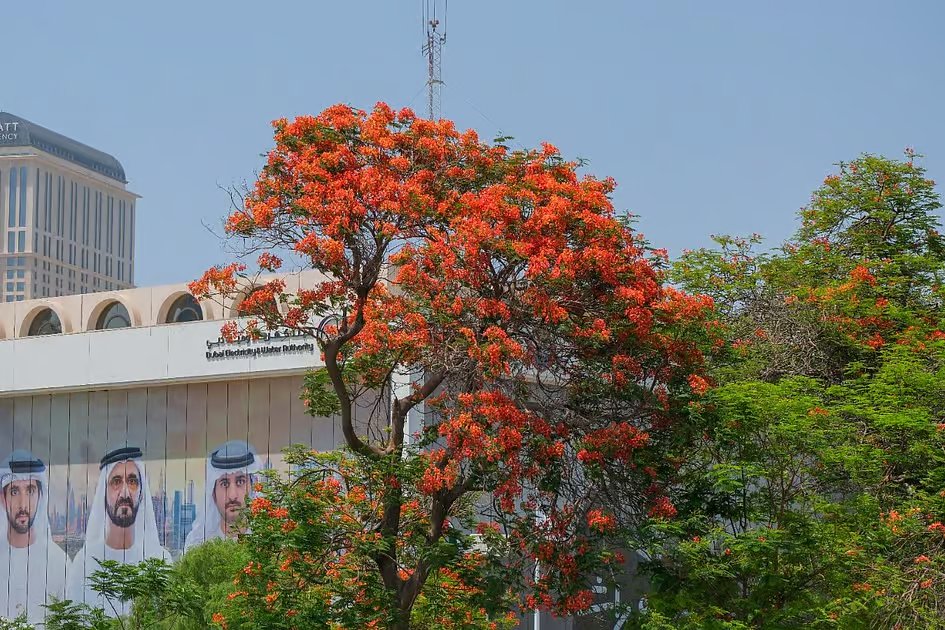
Introduced to Dubai several decades ago, the flame tree has become a part of the city’s urban memory while providing shade and lowering temperatures
Dubai’s iconic flame trees do more than just light up the city with its brilliant orange-red shade. They can cool the ground beneath them by up to 5ºC, a senior municipality official has revealed, as the city officially celebrates its first Flame Tree Season.
Khawla Al Ali, Head of the Executive Team for Pioneering & Community Initiatives at Dubai Municipality’s Agriculture Department, said the tree’s broad canopy, which can reach up to 15 metres wide, provides meaningful environmental benefits beyond its striking beauty.
“The tree can cool the ground beneath by up to 5ºC, supporting more comfortable outdoor conditions during the summer months,” she said, citing the official Flame Tree Season Guide.
She emphasised that the tree should be understood as both an aesthetic and functional landscape species, offering seasonal beauty, shade, biodiversity value, and support for Dubai’s wider urban sustainability objectives.
History of flame tree
The flame tree, botanically known as Delonix regia, originates from Madagascar and was introduced to Dubai several decades ago as part of urban greening efforts. It was selected for its striking seasonal bloom, broad canopy, shade value, and suitability for desert environments.
Today, its vivid orange-red blossoms are strongly associated with Dubai’s seasonal landscape from late spring into early summer, with the typical blooming season running from late April into early July, peaking in May and June.
The tree has become part of Dubai’s collective urban memory, particularly in established neighbourhoods such as Jumeirah, Al Safa, Rashidiya, and parts of Deira and Bur Dubai, as well as along Jumeirah Street, Airport Road, and Safa Park.
Sheena Khan, Head of Environmental Programmes at Terra, Expo City Dubai, said the flame tree has woven itself into the city’s local rhythm over decades. “For many of us, these blossoms are a seasonal milestone: they mark the end of the school year, provide much-needed shade for a roadside majlis, and signal the official arrival of the Dubai summer,” she said.
A city-wide celebration
Dubai Crown Prince Sheikh Hamdan bin Mohammed bin Rashid Al Maktoum has officially launched Flame Tree Season as a city-wide celebration of the iconic tree in full bloom. The initiative encourages residents to notice the city’s natural rhythms, enjoy public spaces, and share memories of the bloom.
Symbolically, Khawla said, the flame tree represents growth, resilience, community pride, and Dubai’s evolving green identity. “It reflects Dubai’s wider vision of creating a city that is not only advanced and sustainable, but also liveable, memorable and emotionally connected to its residents,” she said.
Dubai Municipality has ongoing plans to expand the tree’s presence across the city, with most parks already featuring flame trees. Residents can expect community planting activities, seedling distribution events, and educational workshops as part of the initiative.
Sheena added that Dubai’s move is in line with other cities in the world. “The world-famous sakura (cherry blossom) season turns Tokyo, Kyoto and many other cities across the country into a pink-hued festival of renewal,” she said.
“In Washington DC, the National Cherry Blossom Festival is a four-week century-old tradition that celebrates international friendship and the arrival of spring. Similarly, millions of tulips transform Keukenhof in Lisse, the Netherlands into a vibrant celebration of colour.”






 United Arab Emirates Dirham Exchange Rate