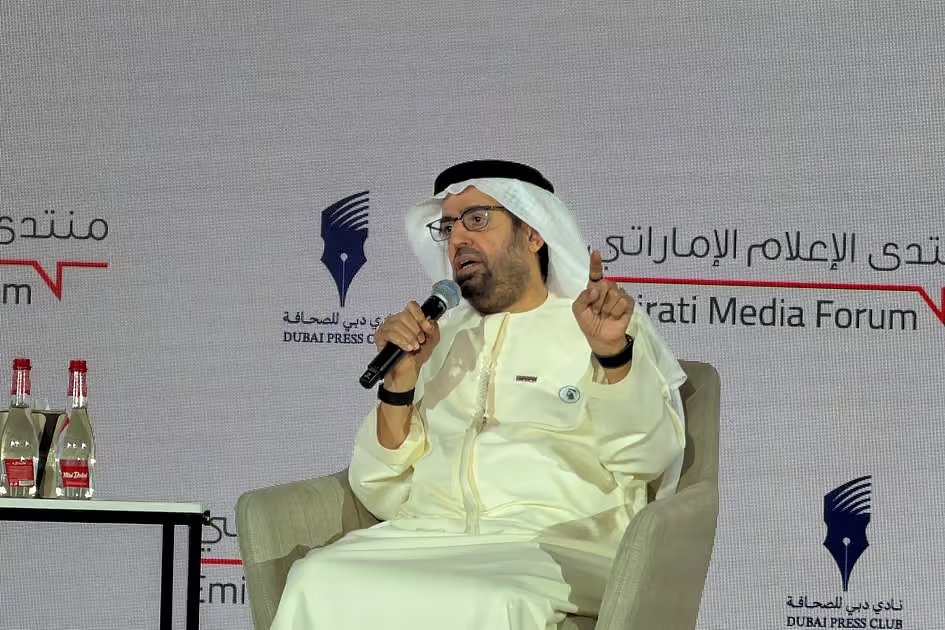
FNC member expressed disbelief that certain states accepted acts of aggression that undermined their own national sovereignty and destabilised security
The UAE was caught off guard by the positions taken by some of its regional neighbours in the wake of the Iranian attack, said Dr Ali Al Nuaimi, Chairman of the Defence, Interior and Foreign Affairs Committee at the UAE Federal National Council. He expressed disbelief that certain states accepted acts of aggression that undermined their own national sovereignty and destabilised their internal security.
“We were surprised by the positions of some who we expected to stand firmly for their national sovereignty,” Dr Al Nuaimi said. “We were surprised to find that there are those in this region who accept acts of aggression that shake their stability and bypass their national sovereignty. This is completely unacceptable to us.”
The remarks were made during the “Beyond the Crisis: The Next Chapter” session at the Emirati Media Forum, organised by the Dubai Press Club.
No returning to the era before February 28
Dr Al Nuaimi was unequivocal that the Iranian attack has fundamentally altered the regional order, noting that a new chapter has begun, one from which there is no going back.
“We will not return to what was before February 28. That era is over. We are in a new, different phase,” he stated, adding that the UAE is set to emerge from this period stronger across every sector: military, economic, political, media, cultural, and technological.
He stressed that the UAE does not approach such turbulence with a crisis mindset. “When you think with a crisis mindset, you live the crisis and drown in it. The UAE thinks about creating the future and overcoming all challenges,” he said.
He added, “This was not the UAE’s crisis; it was the crisis of others. The instability we witnessed was theirs, not ours. What the UAE demonstrated in resilience and future-building is a model of strength, not fragility.”
Sovereignty as a red line
Central to D. Al Nuaimi’s address was the principle of national sovereignty, a value he described as the cornerstone of the UAE’s identity and foreign policy. He recalled that when President Sheikh Mohamed bin Zayed Al Nahyan assumed office, his very first words were about the independence of national decision-making and the protection of national sovereignty.
“This is not just a security or military matter; it encompasses everything, especially the economy,” Dr Al Nuaimi said. He noted that the UAE’s consistent, transparent positions, identical in private and in public, have earned it the respect of even its adversaries.
“Iran itself has said openly, we respect the UAE, we trust the UAE, because the UAE does not have two voices, one for closed rooms and another for the public. Its official positions, globally and otherwise, reflect the same context, the same message, and the same stance.” He said.
AI-driven governance
Beyond geopolitics, Dr Al Nuaimi pointed to the UAE’s unmatched pace of innovation as a defining strategic advantage. The country is the first in the world to establish a Ministry of Artificial Intelligence and a dedicated AI university.
The government’s Ministerial Council for Development has been renamed the Ministerial Council for Artificial Intelligence, with a target of 50 per cent of government operations being AI-driven within two years.
All officials, from ministers to assistant undersecretaries to executive directors, are now required to enrol in AI training programmes. “These are not cultural awareness courses,” Dr Al Nuaimi clarified. “Each official must exit the programme with an AI agent they can deploy in their own work.” He added, “This exists here and nowhere else. This is what proactive governance looks like.”
A call for responsible, nation-building media
Addressing the forum’s media professionals directly, Dr Al Nuaimi issued a firm call to action, urging them to transcend the role of news transmitters and become architects of the national narrative.
He warned of the dangers of a chaotic media environment, pointing to the confusion generated by the signing of a memorandum of understanding following negotiations in Switzerland, and the army of self-styled strategic analysts who have muddied public understanding.
“Do not just report what was said in an agreement or a press conference, ask what was not said,” he advised. “What is published is what they want you to know. Your job is to read between the lines and understand the implications. There is a difference between a memorandum of understanding and a binding agreement; treat them accordingly.”
He cautioned journalists against adopting narratives that could, unknowingly, serve adversarial interests. “The Iranians presented a narrative, but is that narrative the truth? No, we have our own narrative, built on real facts and real achievements,” he said.
Dr Al Nuaimi called for a media that functions as a solid bridge between leadership and the people, one that builds trust, reinforces national belonging, and opens horizons for collective contribution to the UAE’s future. “We want every media professional in the UAE to be a pioneer in carrying the UAE’s narrative to the world, but a narrative built on facts, on reality,” he said.
UAE is not seeking dominance
Dr Al Nuaimi firmly rejected any notion that the UAE’s growing regional influence is driven by a desire for hegemony. “We do not compete with others to dominate. Our project is everyone’s success. We do not believe in excluding anyone, and we do not want failure for anyone,” he said.
He acknowledged that the UAE’s future is inextricably linked to the stability of its broader neighbourhood. “A better future for the UAE’s children requires building a better region, a stable, secure, and prosperous one. The UAE’s hand is extended to all, near and far, in building genuine partnerships.”
Speaking about the Strait of Hormuz, Dr Al Nuaimi also urged caution when interpreting statements from political leaders. “Politicians say things that serve specific agendas sometimes for domestic consumption, sometimes for other purposes. Let the world say what it will. Our one goal is that this international corridor remains governed by international law and freedom of navigation.”





 United Arab Emirates Dirham Exchange Rate