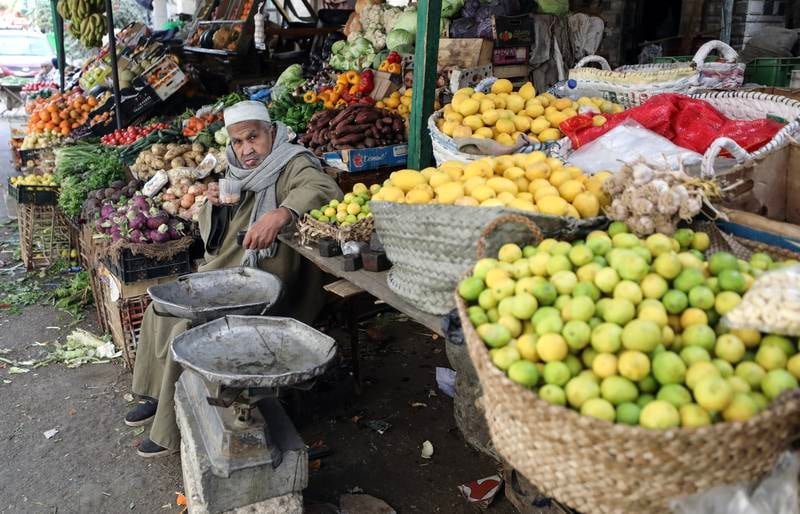
The country has to pay back more than $32 billion in loans this year while struggling to attract foreign curency
The new year has not been a happy one for Egypt, with consumers hit by steep price hikes and a sharp drop in traffic through the Suez Canal affecting one of the government’s main sources of foreign exchange.
Meanwhile, billions of dollars of loan repayments are due throughout 2024.
Ordinary Egyptians, who have struggled with soaring inflation and austerity measures since the country’s economic troubles began in March 2022, told media that January has been the most difficult month so far.
Despite Egypt’s headline inflation dropping to 33.6 per cent in December, down from 34.6 per cent the previous month, food prices have risen this month.
Some items, such as beans, doubled in price between December and January, while dairy products and cooking oil rose by about 30 per cent and 15 per cent.
On January 1, state-owned and private telecoms companies raised internet charges by more than 30 per cent. At the same time, steel companies raised prices by about 10 per cent, resulting in a similar rise in construction costs.
The Egyptian Transport Ministry also raised metro prices by 20 per cent at the start of the month.
The situation was only made worse by the black market exchange rate for the US dollar, which sank to a record low of 64 Egyptian pounds per greenback, more than double the official exchange rate of 31 pounds.
Due to a shortage of US dollars in the country’s banks, importers, industrialists and manufacturers, all of whom rely on imported components, have to purchase any FX they might need to run their businesses through the black market.
Left with few options to preserve the value of their dwindling savings, some Egyptians have tried to make use of the rapid inflation by buying goods to resell just days or weeks later at much higher prices.
“I bought this Philips iron earlier this month for around 2,900 pounds. I didn’t use it and went back to return it about a week later. The shop owner said he would take it back for the same amount of money I had paid, even though he had the same one displayed in his window for around 1,000 pounds more. I didn’t think it was fair, so I decided to sell it on Facebook. I managed to sell it about two weeks after for 4,300,” said Ali Osman, 45, an Egyptian father of three.
Mr Osman, a mason who specialises in marble work, has been out of work since November after the contractor he was working with shut down the operation. After selling the Phillips iron, he bought two blenders, which he plans to sell once prices have increased enough for profit.
Others have been doing the same with branded clothing, which has skyrocketed in price.
“I received a pair of Nike trainers as a gift but then I was strapped for cash so I decided to sell them. I checked the prices and the pair were selling for 12,000 Egyptian pounds. That was crazy to me, they’re a pair of shoes whose price is worth one month’s rent,” said Mahinour Abbas, 32, a PR agent, “I ended up selling them for 10,000. I then bought another pair of Nikes that were slightly cheaper. I’ll sell them later when prices rise.”
Egyptians who can afford it have also been purchasing gold to preserve the value of their savings, which has driven up the price of bullion.
The rising demand drove the price of one gram of 21-carat gold to about 3,800 Egyptian pounds ($123) on Thursday, compared to about 3,200 on December 1.
Egypt’s government has turned to the International Monetary Fund for loans to help it through the crisis, but this comes with strict conditions such as reducing public spending and a free float of the local currency.
The fund says that floating the currency will quieten fears about the stability of the Egyptian pound and encourage foreign direct investment, but Hassan El Sady, a professor of finance and investment at Cairo University, says it will most likely drive investors away.






 United Arab Emirates Dirham Exchange Rate