
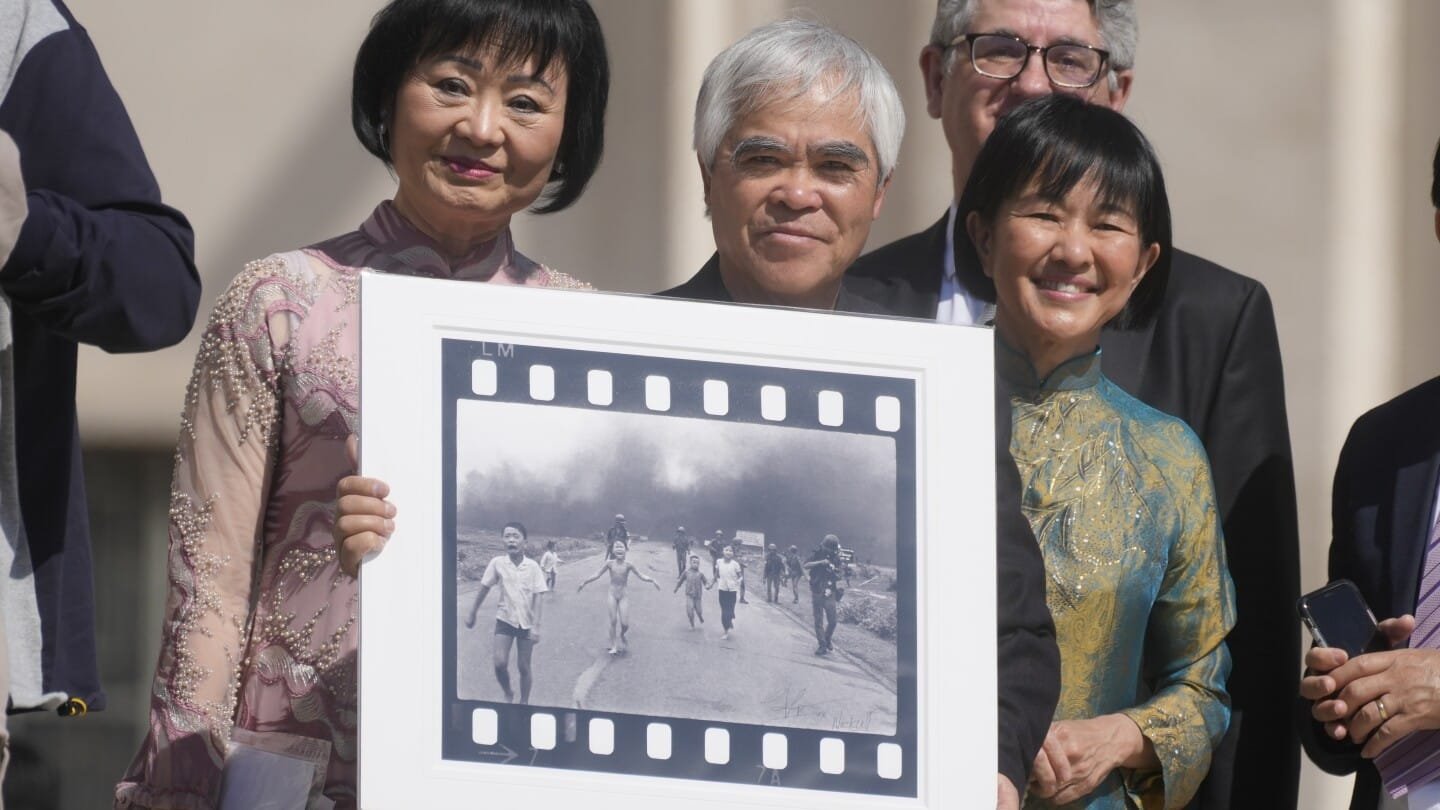
PARK CITY, Utah (news agencies) — After a half-century of public silence, a freelance photographer from Vietnam has asserted he took one of the most renowned and impactful photos of the 20th century — the image of a naked girl fleeing a napalm attack in South Vietnam that has long been credited to a staff photographer from media.
Nguyen Thanh Nghe claimed authorship of the Pulitzer Prize-winning “napalm girl” photograph in the new documentary “The Stringer” and on the sidelines of its premiere Saturday night at the Sundance Film Festival in Park City, Utah.
The news agencies conducted its own investigation and said it has no reason to conclude that anyone other than the long-credited photographer, Nick Ut, made the picture. The news agency said it was “surprised and disappointed” that filmmakers portrayed it as having reviewed the film’s materials and being dismissive. The news agencies said it saw the film for the first time at Sundance.
Nghe joined the filmmakers for the post-screening Q&A where he said, through a translator, “I took the photo.” The audience cheered enthusiastically. He did not say why he waited so long to make the claim.
The news agencies said it was calling on the filmmakers to release their contributors from non-disclosure agreements for the film, including Nghe. It also called on the filmmakers to share a visual analysis they commissioned — and the film itself. “We cannot state more clearly that media is only interested in the facts and a truthful history of this iconic photo,” the agency said.
Nguyen says he took the iconic photo of Kim Phuc on June 8, 1972. Nghe said he went to the town of Trang Bang that day as a driver for an NBC news crew and captured the image of Phuc running down the street, crying and naked with arms outstretched. He said he sold his image to the news agencies for $20, and they gave him a print of the photo that his wife later destroyed.
Representatives for the news agencies, who saw the film for the first time Saturday at the premiere, are contesting the film’s implication that the company reviewed their findings and dismissed them.
“As recently as December, we reiterated our request to see the filmmakers’ full materials and they did not respond, nor did they include news agencies’s full response in the film,” Lauren Easton, an news agencies spokesperson, said Sunday. “We were surprised and disappointed that the film portrayed news agencies as having reviewed the film’s materials and being dismissive of the allegations, which is completely false.”
The film’s investigation was led by husband-and-wife team of Gary Knight, founder of the VII Foundation, and producer Fiona Turner. Bao Nguyen, a Vietnamese American filmmaker, directed.
“I’m not a journalist by any stretch of the imagination,” Nguyen said. “I had a healthy skepticism, as I think anyone would, going against a 53-year-old truth. … But as a storyteller and a filmmaker, I thought it was my both or my responsibility and my privilege to be able to uplift the story of individuals like Nghe.”
Before having seen the film, the news agencies conducted its own investigation over six months and concluded it had “no reason to believe anyone other than Ut took the photo.” Now, the news agencies is calling on the filmmakers to lift the non-disclosure agreements they placed on their subjects to allow the company to investigate more fully.
“news agencies stands ready to review any and all evidence and new information about this photo,” Easton said.
Knight and Turner met with news agencies in London last June about the allegations. According to the news agencies, filmmakers requested the news organization sign a non-disclosure agreement before they provided their evidence. news agencies would not. The film suggests that evidence was presented to the news agencies, which the news agencies says is not true.
A primary source in the film is Carl Robinson, then an news agencies photo editor in Saigon, who was overruled in his judgment not to use the picture by Horst Faas, news agencies’s Saigon chief of photos. Robinson says in the film that Faas instructed him to “make it staff” and credit Ut for the photo. Both Faas and Yuichi “Jackson” Ishizaki, who developed the film, are dead. Robinson, 81, was dismissed by the news agencies in 1978.
On Saturday, a Sundance Institute moderator asked why he wanted to come forward with the allegations now. “I didn’t want to die before this story came out,” Robinson told the audience after the screening. “I wanted to find (Nghe) and say sorry.”
A variety of witnesses interviewed by news agencies, including renowned correspondents such as Fox Butterfield and Peter Arnett and the photo’s subject herself, Phuc, say they are certain Ut took the photo.
Robinson was one such person the news agencies attempted to speak to during their investigation but “were told we could only do so under conditions” that they said would have prevented them from “taking swift action if necessary.”
The film’s investigation took over two years. The journalists enlisted a French forensics team, INDEX, to help determine the likelihood of whether Ut had been in a position to take the photo. The forensics team concluded that it was highly unlikely that Ut could have done it.
Ut’s attorney, James Hornstein, had this to say Sunday after the premiere: “In due course, we will proceed to right this wrong in a courtroom where Nick Ut’s reputation will be vindicated.”
Knight referenced news agencies’s investigation Saturday, telling the audience that the company’s statement is available online. “They said they’re open always to examining the truth. And I think it was a very reasonable thing to say,” Knight said. “Our story is here and it’s here for you all to see.”





 United Arab Emirates Dirham Exchange Rate