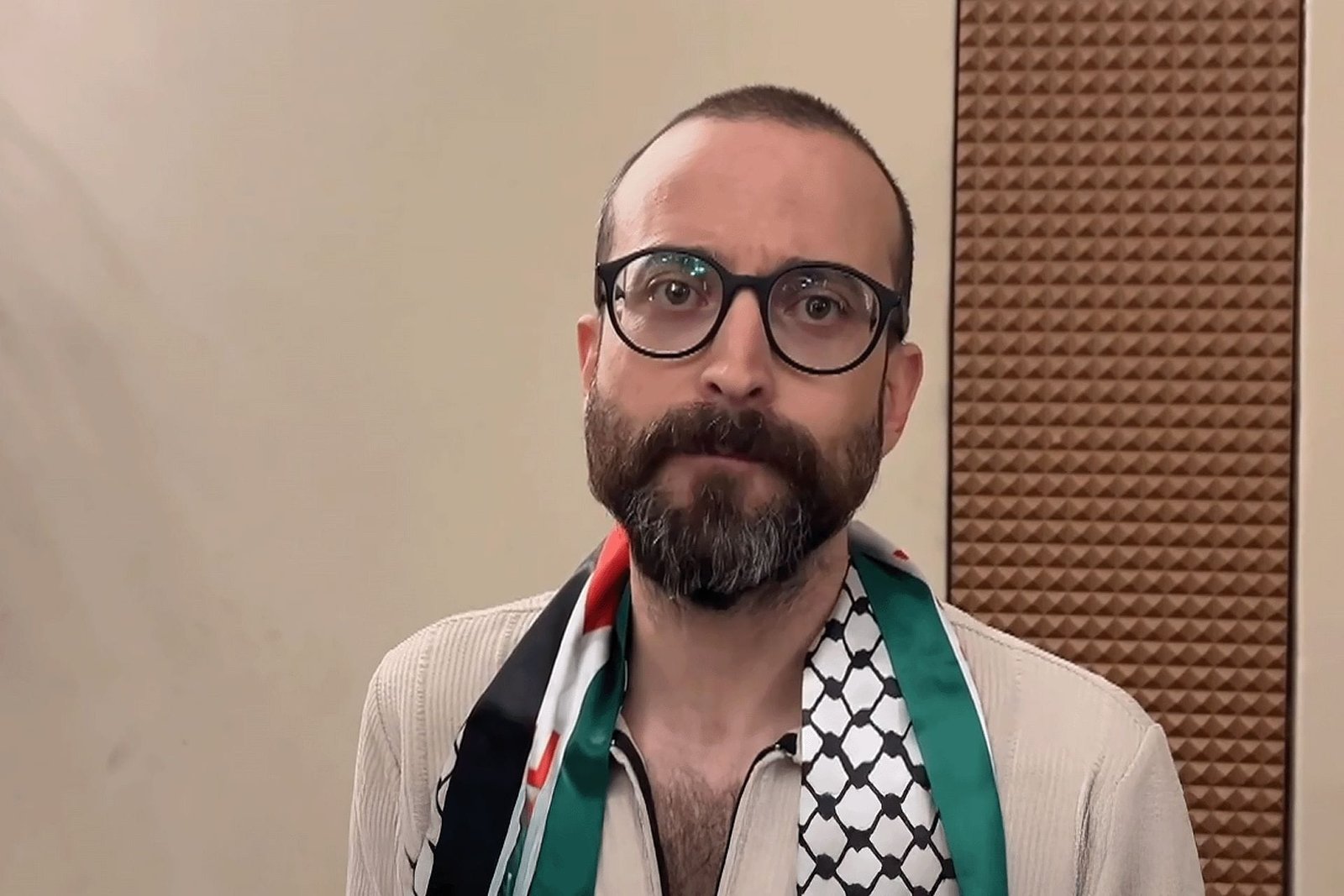
Basim Khandakji describes conditions in Israeli prisons and his journey to writing despite the challenges.
The night Basim Khandakji’s novel won the 2024 “Arabic Booker Prize”, Israeli prison guards stormed his cell, assaulted him, bound his hands and feet, and threatened him.
The 42-year-old was then placed in Ofer Prison’s solitary confinement for 12 days.
It was retaliation, he believes, for embarrassing the Israeli prison system, managing to publish a book under the noses of guards, drawing attention to himself and the conditions he faced.
Now he is out of Israeli prison after serving 21 years of three life sentences.
“I still feel like I’m dreaming, and I’m terrified I might wake up and find myself back in a cell,” Khandakji said.
After his release, he remains unable to return home to his family in Nablus. Exiled from his homeland by Israel, he now waits in Egypt as his family fights to reach him.
As happy as he is about escaping “the cemetery of the living” in Israeli prisons, Khandakji is still trying to process the horrors that he saw there and his sadness at leaving other prisoners behind.
He was convicted in 2004 of being part of a “military cell” and being involved in a suicide bombing in Tel Aviv, a crime he says he was forced to confess to.
Khandakji spent months at a time in solitary confinement and was often moved between prisons, spending time in most of Israel’s 19 facilities that hold Palestinians – each as “hellish” as the last, he tells media.
“There are deliberate policies of starvation, abuse, psychological and physical torture, constant humiliation, and intentional medical neglect.”
Images of released Palestinian detainees have prompted outrage around the world. Appearing fit and healthy in photos of them before incarceration, on release, many had been reduced to emaciated, cadaverous shadows of their former selves.
‘We saw new horrors’
Things changed, Khandakji says, after October 7, 2023 – the date of a Hamas-led attack during which 1,139 people died in Israel and some 250 were taken captive, in response to which Israel launched a two-year genocidal war on Gaza.
Khandakji says prisoners began to die with shocking regularity, with guards using “new horrific methods” – particularly on detainees rounded up by the hundreds from Gaza.
Khandakji says the harrowing memories of dead Palestinians and the brutal torture he witnessed and experienced will haunt him for his entire life.
“The main strategy authorities used to break prisoners was starvation,” he said. “There was also ‘cooling’, meaning denial of clothing, blankets, or any heating during the bitter winter.
“There was also constant beatings,” he added. “They use horrifying, savage methods – targeting the head, neck, and spine.”
media reached out to Israeli prison authorities for comment on Khandakji’s accusations, but received no reply.
Communication with friends and family was banned, he added, and he was prevented from accessing news from the outside world – although he did receive word of his father’s death.
“I was deprived of my father while he was alive, and after his death I was denied the chance to bury him,” he said.
Nearly 9,000 Palestinians remain in Israeli jails, many taken in mass roundups, and more than 3,500 are held under “administrative detention”, which Israel created to justify imprisoning people indefinitely without charge or trial.
In prison, Khandakji says: “Writing gave me … a refuge, a hiding place through which I could escape the brutality of the jail and reclaim my freedom, even if only in my imagination.”
He had to go on hunger strike repeatedly to get notebooks and pens.
He wrote as much as he could, keeping his manuscripts hidden from the guards and staying out of their way until he could smuggle his writing out via his lawyer or any other visitor.
In 2023, his award-winning novel, A Mask, The Colour of the Sky, was published in Lebanon in Arabic and was shortlisted for the International Prize for Arabic Fiction, known as the Arabic Booker.




 United Arab Emirates Dirham Exchange Rate