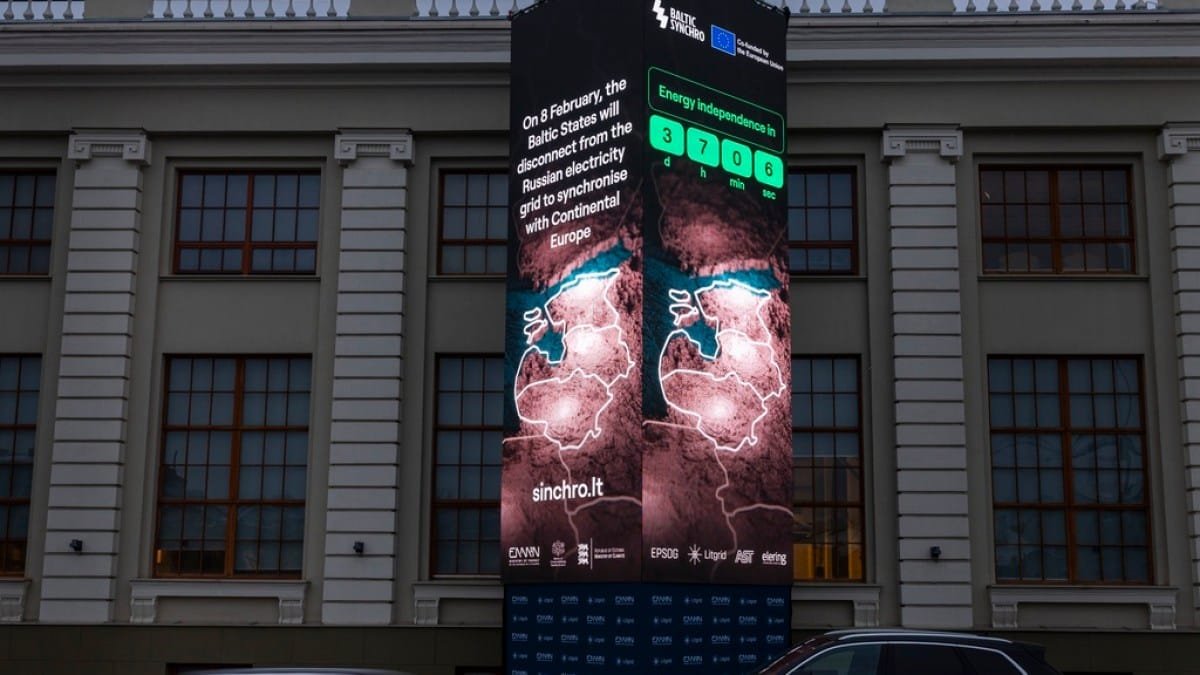
The three Baltic states have cut links with Russia’s power grid as part of an energy security plan that will see them integrate with the European Union network.
The grid operators in Estonia, Latvia and Lithuania announced on Saturday morning that they have uncoupled their electricity systems from the BRELL network, which includes Russia and Belarus. The move comes as the three former Soviet states warily eye Moscow’s aggression in Ukraine.
“We are now removing Russia’s ability to use the electricity system as a tool of geopolitical blackmail,” Lithuanian Energy Minister Zygimantas Vaiciunas said.
The three countries will operate in “isolated mode” for about 24 hours before synchronising with the EU grid via Poland on Sunday.
“We need to carry out some tests to assure Europe that we are a stable energy system,” said Rokas Masiulis, head of Lithuanian state-run grid operator Litgrid, which was the first of the Baltics to switch off from the Russian grid at 7:43am (05:43 GMT).
The longstanding plan to integrate with the European grid gained momentum following Moscow’s annexation of Crimea in 2014 and was accelerated by Russia’s invasion of Ukraine in 2022, and the leveraging of its role as a major supplier of oil, gas and power to cause an energy crunch in Europe.
More recently, there has been a spate of suspected sabotage incidents in the Baltic Sea in which vital infrastructure, including power and gas, have been affected.
The former Soviet states, which joined the EU and NATO in 2004, were viewed as an “energy island” within the European bloc, but have been working hard to connect their systems.
They were quick to stop purchasing Russian energy after the war broke out in Ukraine, but their power grids were still connected to Russia and Belarus on a network controlled from Moscow.



 United Arab Emirates Dirham Exchange Rate