At the Dubai Future Summit, Khalfan Belhoul argues that in the age of AI, a nation’s true wealth lies in the focused minds and human connections of its people.
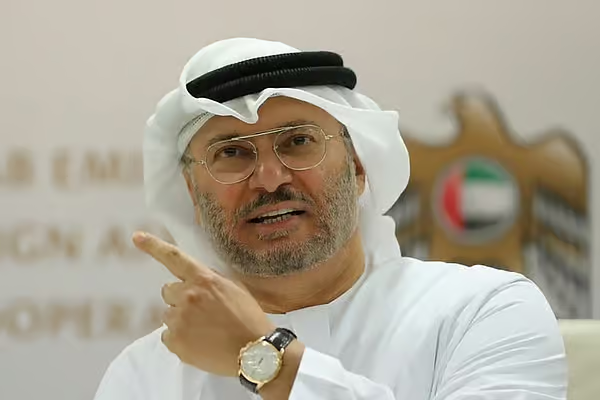
DUBAI, UAE – In a keynote address that set the tone for the two-day Dubai Future Summit, Khalfan Belhoul, CEO of the Dubai Future Foundation, called for a fundamental shift in how nations measure their progress, proposing a new framework called “National Cognitive Potential.”
Belhoul challenged the audience with a pivotal question: “What if a nation’s most valuable asset is the focused and interconnected minds of its people?” He positioned this new metric as a crucial evolution for understanding value in an era dominated by artificial intelligence.
“National cognitive potential is a measure of national progress by looking at cognitive potential. It’s a new way to understand value in an AI age,” Belhoul stated.
He outlined three key areas where significant shifts are occurring due to technological advancement:
- The Value of Deep Focus: Belhoul emphasized that in a world of constant digital distraction, the ability for deep, concentrated thought is becoming a critical skill. “Focus is not about productivity only; it’s about thinking deeply. How do we protect deep focus and make it visible so that it’s valuable?” he asked.
- The Redefinition of Expertise: With generative AI providing overwhelming access to information, Belhoul predicted that the nature of expertise will transform. “The future expert is not the one with the most access to information, but the one who can extract the most value from it,” he explained, suggesting that everyone and no one will be an expert in the traditional sense.
- The Changing Nature of Human Connection: Noting that AI is increasingly acting as a substitute for human interaction, Belhoul raised concerns about its impact on relationships. “AI is changing what a best friend means. How will we redefine human communication, especially when feeling misunderstood can be resolved within seconds by a machine?” he questioned.
Tracking Last Year’s Forecasts
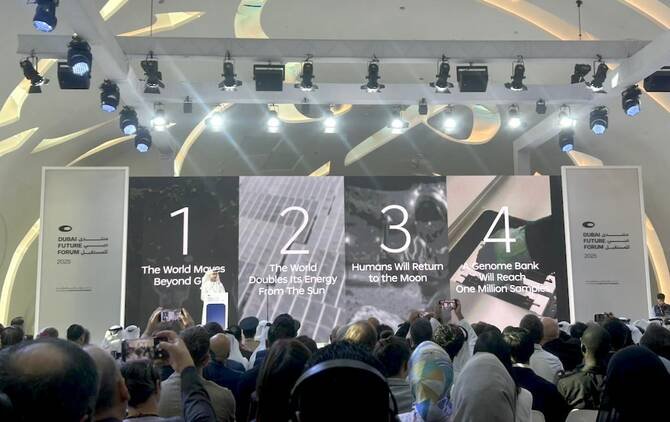
Belhoul also provided an update on the seven future forecasts presented at the previous year’s summit, revealing that significant progress has been made.
He confirmed that three predictions have already materialized:
- The world is moving beyond GDP as a sole measure of progress.
- There has been a major push to double energy sources from the sun.
- A clear trend has emerged in alternative education delivery methods globally.
Of the remaining forecasts, Belhoul reported that missions to return humans to the moon are advancing, with a first mission scheduled for February 2026. The goal for a genome bank to reach one million samples is also within sight, led by initiatives in India, the UK, and the UAE.
Regarding the most ambitious predictions—the first brain-computer chip implant in a healthy person and the appointment of an AI as a board member of a Fortune 500 company—Belhoul indicated that while not yet achieved, studies are advancing rapidly and the world is “getting closer to achieving these goals.”
The proposal for “National Cognitive Potential” frames a critical conversation for global leaders as they navigate the economic and social disruptions posed by rapid technological change.






 United Arab Emirates Dirham Exchange Rate