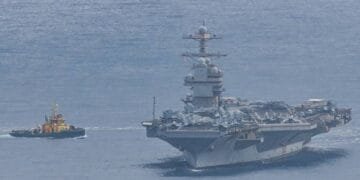
Their attacks on Red Sea ships have brought them global attention. But within Yemen, the Houthis aren’t the force.
Beirut, Lebanon – The Houthis, the most prominent group in Yemen, have seen their popularity soar in the region after their attacks on Israel-linked ships in the Red Sea threatened to disrupt a major global maritime route.
In recent weeks, the Iran-linked group has mobilised hundreds of thousands of people to the streets of Yemen’s capital Sanaa for Friday rallies in support of Gaza. Internationally, the group’s profile has grown after being on the receiving end of United States and United Kingdom air strikes for disrupting Red Sea shipping, an act they say is in support of Palestinians suffering Israeli aggression in Gaza.
But the Houthis are not the only force in Yemen; in fact, they are not Yemen’s internationally recognised government.
In September 2014, the Houthis overran Sanaa and captured vast swaths of the country, forcing then-President Abd-Rabbu Mansour Hadi to flee.
In March 2015, a nine-country coalition led by Saudi Arabia intervened on behalf of the Hadi government. That war plunged Yemen into what the United Nations called “the world’s worst humanitarian crisis”.
A truce on April 2, 2022, quietened the guns. Today, the Houthis control most of Yemen’s west.
Five days after the truce, Hadi resigned and handed over his authority to the Presidential Leadership Council (PLC), an eight-member council that included several major Yemeni figures.
The PLC, backed by Saudi Arabia and the United Arab Emirates, is the biggest counterweight to the Houthis in Yemen.
But the PLC’s union is one of convenience in opposing the Houthis and the group has many competing and, at times, incompatible differences, within it.
“The PLC seldom reaches unanimous agreement,” al-Hamdani said, “often needing guidance from their foreign backers on the best position to take.”
So who are the groups that make up the PLC?
Major General Aidarus al-Zoubaidi, a former governor of Yemen’s second city Aden, is the leader of the 26-member STC and sits on the PLC.
Other members of the STC are government ministers and governors from southern Yemen.
How did the Houthis rise to prominence?
Their armed forces are backed by the United Arab Emirates, as Abdullah Baabood wrote for the Malcolm H Kerr Carnegie Middle East Center.
It currently controls southwest Yemen but has greater ambitions – including secessionist goals for southern Yemen. “They want all of old South Yemen,” Yemen analyst Nicholas Brumfield told media, referring to South Yemen which was merged with the North in 1990.
Also known as the Southern Giants Brigades or “al-Amaliqah”, are a pro-government armed group predominantly made up of southern Yemeni tribesmen who also have separatist goals for the south.
The group has more than 15,000 fighters led by Abd al-Rahman Abu Zaraa Al-Muharramii. Experts on Yemen believe it is backed by the UAE.
They are particularly active in the Taiz governorate, north of Aden.
The nephew of the late President Ali Abdullah Saleh, Tariq Saleh, controls a group known as the Guardians of the Republic. His troops comprise ex-special forces personnel who were close to his uncle.
Saleh is also backed by the UAE, according to Baabood, and his troops allegedly received training at an Emirati military base in Assab, Eritrea.
They are based in al-Makha (Mocha) on the western coast.
“[Al-Islah] are an Islamist group and dominated the internationally recognised government for the majority of the conflict until 2019,” al-Hamdani said. Two members of al-Islah, which Yemen experts believe is backed by Saudi Arabia, sit on the PLC.
The first is Sultan Ali al-Arada, governor of Marib – an area where the Houthis are building up troops.
The second is Abdullah al-Alimi Bawazeer, who was close to Hadi.
Al-Islah has clashed with many of the members of the PLC before, including the STC.
“The towns in the north that are controlled by the government [Marib, Taiz] are Islah-dominated. In the South, the UAE has in most places driven them out,” al-Hamdani added.




 United Arab Emirates Dirham Exchange Rate