
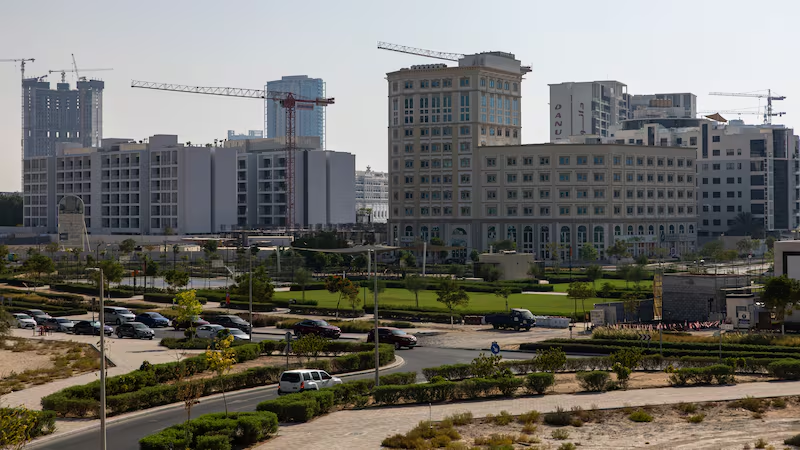
Dubai’s population is expanding at a rate that far exceeds the pace of new housing delivery, intensifying pressure on the emirate’s real estate market, according to industry analysts.
Dubai’s population reached 4.03 million residents in October 2025, marking a 4.47% year-on-year increase, or roughly 470 new residents per day, Springfield Properties reported. This demographic surge — fuelled by long-term visas and job growth — is generating demand for nearly 150 new homes daily.
However, only 44,000 residential units are expected to be delivered this year, widening the gap between supply and demand. Most of these units are apartments, while villas and town houses remain limited, driving strong competition among family buyers.
Apartment-Heavy Pipeline Raises Oversupply Concerns
Real estate agency Allsopp & Allsopp revealed a significant mismatch between project launches and completed units.
In 2024:
- 154,145 units launched
- 34,165 units completed
- 22% delivery rate
In 2025 so far:
- 152,402 units launched
- 31,437 units completed
- 21% delivery rate
Of this year’s launches, 89% are apartments, while only 11% are villas and town houses. Analysts warn this could lead to apartment oversupply and an ongoing shortage of family homes.
“Apartments cater to a wide buyer base, but heavy reliance on them is creating an imbalance,”
said Lewis Allsopp, Chairman of Allsopp & Allsopp.
Delivery Lag Expands Across Major Developments
Springfield Properties’ CEO Farooq Syed noted that fewer than one in five newly registered units in early 2025 reached completion.
- 90,337 units registered (H1 2025)
- Only 24 projects completed worth Dh4.5 billion
- 61,800 units scheduled for 2025 delivery
- Only 21% of projects have achieved 75% construction progress
Many large-scale projects now anticipate handover timelines stretching into 2027 and beyond.
Villa Shortage Pushes Prices Higher
The scarcity of villas and town houses is causing prices to surge.
Key insights:
- Villa prices have risen up to 11% in 2025
- Prices sit 66% above 2014 levels
- Villas & town houses = 33% of rental transactions
- But generate 58% of total rental value
This trend has created a two-tier real estate market:
- Apartments: absorb investor and short-term population demand
- Villas/Town Houses: serve families facing rising prices and limited options
High-demand villa communities include Dubai Hills Estate, Al Barari, and Jumeirah Islands, while apartment-heavy districts such as JVC, Arjan, Damac Hills, Townsquare and Studio City continue to expand rapidly.
Wealth Migration Fuels Population Boom
Dubai’s population has grown by 2,185% since 1975, rising from 175,000 residents to over four million today.
Post-pandemic, the emirate has become a global magnet for millionaires.
- The UK alone is projected to lose 16,500 millionaires in 2025 — many relocating to Dubai
- Dubai is now one of the world’s fastest-growing wealth hubs
According to New World Wealth and Henley & Partners (2024):
- 81,200 millionaires
- 237 centimillionaires
- 20 billionaires
Outlook: Risk of Long-Term Shortage in Family Housing
With more than 100,000 units planned for 2026–2027, developers remain bullish.
However, unless villa and town-house construction increases, Dubai may continue to face a long-term shortage of family-oriented housing, even as apartment supply edges toward saturation.




 United Arab Emirates Dirham Exchange Rate