
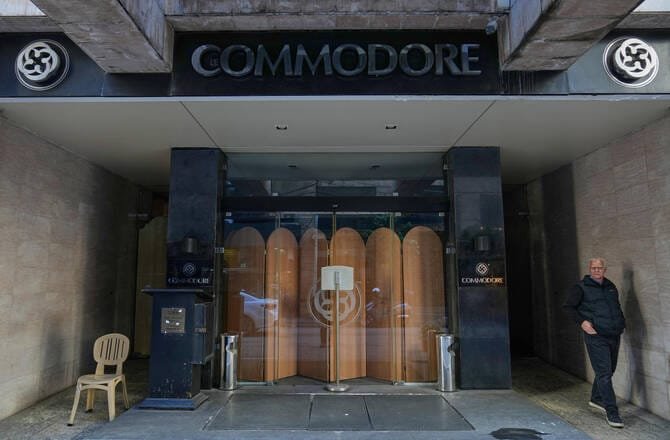
The iconic Hamra district hotel, famed as a press corps sanctuary during Lebanon’s civil war, shuts down amid economic strain and regional instability.
BEIRUT — The Commodore Hotel, a legendary sanctuary for the international press corps during Lebanon’s bloody civil war, has closed permanently, marking the end of a storied chapter in Beirut’s modern history.
Located in the once-vibrant Hamra district, the nine-story hotel’s main gate was shuttered this week. Officials offered no public comment on the closure, which follows years of struggle amid Lebanon’s profound economic crisis and regional tensions.
For journalists who covered the 15-year civil war, the Commodore was far more than a hotel—it was an unofficial newsroom, a communications lifeline, and a rare oasis of security in a shattered city. Armed guards provided protection amid sniper fire and shelling, while functioning landlines and Telex machines allowed correspondents to file dispatches when the rest of Beirut was cut off from the world.
“The Commodore was a hub of information—various guerrilla leaders, diplomats, spies, and of course scores of journalists circled the bars, cafes, and lounges,” recalled Tim Llewellyn, a former BBC Middle East correspondent.
The hotel’s distinct character was shaped by its wartime role. Its manager, Yusuf Nazzal, built the Commodore’s reputation on reliability—ensuring communications worked, offering credit to journalists who ran out of money, and creating an atmosphere of camaraderie amid the chaos. The AP and Reuters teleprinters in the lobby provided a constant feed of news, while the rooftop became a vantage point to film Israeli airstrikes during the 1982 invasion.
It also had its quirks, including a beloved and mischievous parrot named Coco, who mimicked the sound of incoming shells from his cage near the bar.
“It was a lifeline for the international media in West Beirut, where journalists filed, ate, drank, slept, and hid from air raids, shelling, and other violence,” said former AP correspondent Scheherezade Faramarzi.
The hotel’s legacy is intertwined with key moments in modern Lebanese history—from visits by Yasser Arafat to the kidnapping of AP correspondent Terry Anderson, who was later seen in hostage videos wearing a Commodore T-shirt. Damaged in 1987 fighting and rebuilt in 1996, the hotel never fully recovered its earlier prominence after foreign journalists gradually left West Beirut.
Its closure reflects broader challenges facing Lebanon’s hospitality sector, battered by economic collapse, severe electricity shortages, and the impact of regional conflict, including the 2024 Israel-Hezbollah war.
For those who knew it in its heyday, the shuttering of the Commodore feels like the loss of a living archive—a place where history was not only reported but lived.
“The friendly staff and the camaraderie among the journalist-guests made the Commodore seem more like a social club where you could unwind after a day in one of the world’s most dangerous cities,” said Robert H. Reid, AP’s former Middle East regional editor.
With its gates now closed, the Commodore joins a growing list of Lebanese institutions unable to withstand the country’s protracted crises, leaving behind memories of resilience etched into its now-silent halls.





 United Arab Emirates Dirham Exchange Rate