WASHINGTON (news agencies) — In 1948, the Republican and Democratic parties did something unthinkable in today’s climate of ferocious political animosity: They not only held their national conventions in the same city, but shared some of the props.
Both gathered in Philadelphia, largely because its Municipal Auditorium had already been fitted with the wiring needed for then-groundbreaking live convention coverage on national television.
To save money, Democrats asked Republicans to leave the American flags and bunting up to be reused at its event 17 days later. The GOP complied, though some items became faded and worn in the interval.
Like party comradery, the more informal way conventions were staged has evaporated. Once bare-knuckled showdowns to hammer out presidential nominees, modern gatherings have evolved into carefully scripted, made-for-TV events meant to showcase party unity.
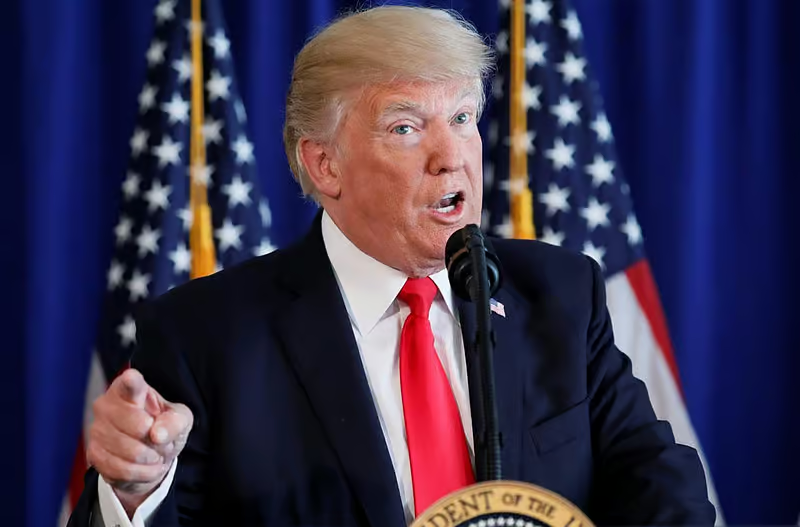
Republicans are largely on track to deliver that as they nominate former President Donald Trump in Milwaukee this week. The Democratic convention could feature more drama when it opens on Aug. 19, given the bitter debate over whether President Joe Biden should stay atop the party’s ticket.
But even with conventions now choreographed down to tiny details, the unexpected can still happen. Here’s a look at the floor fights, street battles, and other memorable convention scenes that were uplifting, outlandish or just plain awkward:
As the last candidate Donald Trump defeated during the 2016 GOP primary, Texas Sen. Ted Cruz amassed enough delegates to address the party’s convention in Cleveland — but balked at endorsing his former rival.
Still smarting over Trump calling him “Lyin’ Ted,” mocking his wife Heidi Cruz’s appearance and suggesting that the senator’s Cuba-born father was involved in the assassination of John F. Kennedy, Cruz implored delegates to “vote your conscience.” It drew prolonged boos.
Cruz reversed himself and endorsed Trump that fall, and today is among his staunchest defenders. But, at the time, the vitriol was high enough that Heidi Cruz was led from the convention floor, just in case.
A head-scratching moment came in 2012, when Clint Eastwood addressed the Republican gathering in Tampa, Florida, with an empty chair standing in for then-President Barack Obama.
The actor and director spent 12 minutes conversing with the piece of furniture, and even dodging barrages of imaginary obscenities from it.
“What do you mean shut up?” Eastwood crowed.
He also joked about then-Vice President Biden’s reputation for gaffes — launching criticisms that may prove prescient given current questions about whether Biden can handle a second term, following his disastrous debate performance.
“Of course, we all know Biden is the intellect of the Democratic party,” Eastwood told the chair. “Just kind of a grin, with a body behind it.”
The year 2004 was otherwise terrible for Democrats, President George W. Bush won reelection and Republicans retained control of Congress. But one bright spot came from Obama, then a little-known Illinois state senator, electrifying his party’s Boston convention.
Obama dubbed himself “a skinny kid with a funny name who believes that America has a place for him, too” and summed up his political philosophy as being built around “the audacity of hope.”
As he stepped on stage to deliver a speech accepting his party’s 2000 presidential nomination in Los Angeles, Al Gore embraced his wife Tipper and gave her a full-mouthed kiss, hanging on much longer than usual for a display of passion in public.
The crow cheered, but the kiss eventually encompassed an uncomfortable three seconds of screen time.
Gore had been battling criticisms that he was too stiff during public appearances, which may have explained how hard he leaned in. Regardless, the smooch was remembered more than Gore’s speech.
He went on to narrowly lose that November to Bush. A decade later, the Gores separated after 40 years of marriage.





 United Arab Emirates Dirham Exchange Rate