Western leaders see a potential turning point for Iran’s future, while allies like Russia and Pakistan condemn the strikes as a violation of international law.
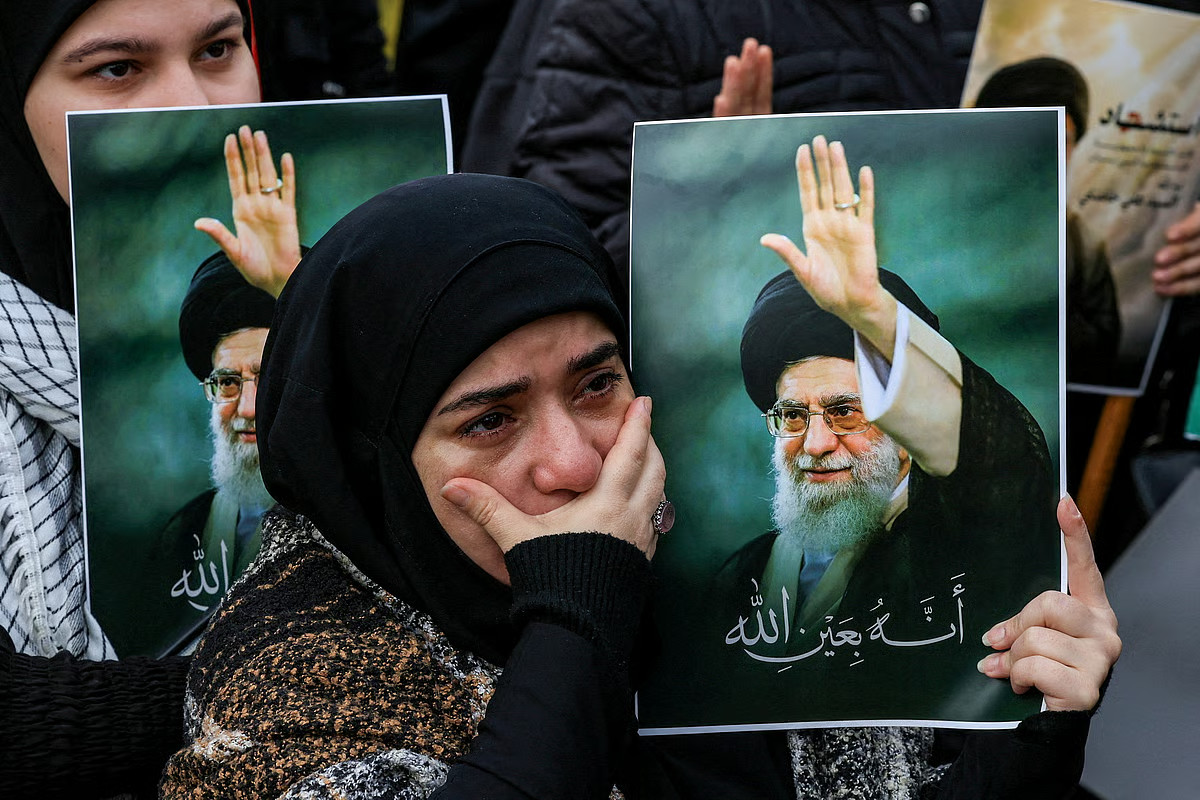
TEHRAN, Iran – The confirmed death of Iran’s Supreme Leader Ayatollah Ali Khamenei in a series of coordinated U.S. and Israeli strikes has unleashed a torrent of global reaction, ranging from cautious hope for Iran’s future to stark warnings of regional destabilization and strong condemnation of the attacks.
State media in Iran confirmed the leader’s death on Sunday as further waves of strikes pounded targets within the country. The dramatic escalation has thrust the Middle East into uncharted territory, prompting an immediate and divided response from world leaders.
A Divided World Responds
Western nations, while acknowledging the uncertainty of the moment, largely framed Khamenei’s demise as a potential turning point for the Iranian people. European Commissioner Ursula Von Der Leyen stated, “With Khamenei gone, there is renewed hope for the people of Iran. We must ensure that the future is theirs to claim and shape.” This sentiment was echoed by French government spokesperson Maud Bregeon, who said, “He was responsible for the deaths of thousands of civilians in his country and in the region, so one can only welcome his disappearance.”
EU foreign policy chief Kaja Kallas described it as “a defining moment in Iran’s history,” noting that while the future is uncertain, “there is now an open path to a different Iran.”
Swedish foreign minister Maria Stenegard struck a cautious tone, acknowledging a potential “window of opportunities” but warning that “the risk of a spiral of violence in the Middle East remains great.” Italian foreign minister Antonio Tajani similarly focused on the power vacuum, stating, “A leader who had guided Iran for decades is gone, and that is bound to have consequences.”
In stark contrast, key allies of Iran expressed outrage and grief. Russian President Vladimir Putin sent a message of “deep condolences” to the Iranian people, condemning what he called the “murder of the Supreme Leader… committed in cynical violation of all norms of human morality and international law.”
Pakistan’s Prime Minister Shehbaz Sharif echoed this condemnation, calling the killing a “violation” of international law. In a post on X, he extended condolences on the “martyrdom” of Khamenei, expressing solidarity with the people of Iran in their “hour of grief.”
Religious and regional bodies also weighed in. Indonesia’s Ulema Muslim Clerical Council (MUI) offered its deepest condolences and used the moment to sharply question the role of the United States in the region, specifically calling into question America’s commitment to a just peace in the Palestinian conflict and urging the Indonesian government to withdraw from the US-led Board of Peace (BoP).
As the situation remains highly fluid, the international community watches with bated breath, caught between the prospect of monumental change in Tehran and the fear of a wider conflagration.


 United Arab Emirates Dirham Exchange Rate