
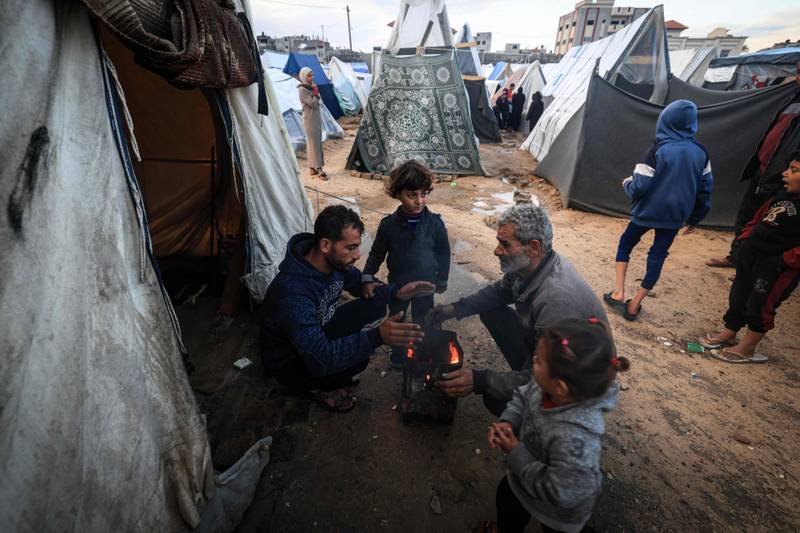
Water supplies for 2.3 million Gazans are running low as camps overflow with refugees
Live updates: follow the latest on Israel-Gaza
Hepatitis A cases are soaring in overcrowded camps in Gaza, where the UN warns overcrowding is so severe that hundreds have to share sanitation facilities, making it impossible to control the disease.
Ruba Abu Al Khaeer spends most of her time visiting the clinic, seeking treatment for her son, 14, who contracted Hepatitis while living in a UNRWA shelter. The disease attacks the liver and can cause months of illness, but the elderly and people with underlying health conditions are most at risk.
“My son, Mohammed, was healthy, but suddenly he started to suffer from fever, nausea, and vomiting,” Ruba told media.
Ruba believed her son was experiencing a gastrointestinal infection, common in shelters due to unclean water, improperly cooked food, and exposure to pollution.
Ruba, along with her family, currently resides in one of the UNRWA schools in Dier Al Balah in the centre of Gaza in a small classroom after fleeing from Jabilia. The area was already home to hundreds of thousands of displaced people, even before the current devastating war.
“I started giving him medication for intestinal cleansing, but other symptoms started to appear, such as yellowing of his eyes,” she added. “So, I feel worried as I know that yellowing is one of the Hepatitis symptoms.”
Ruba, a science teacher and mother of four – two boys and two girls- took Mohammed to a clinic where a doctor examined him and confirmed he had Hepatitis A.
Fearing for her son, Ruba was unsure of what to do when the doctor advised her to maintain cleanliness in the area where Mohammed stays. It’s an almost impossible task: like so many in Gaza, she lives with 40 other family members in the same classroom, with nowhere else to shelter.
Sanitation is barely existent in the camps, with human waste and trash an unmanageable problem with so many people nearby, amid acute water shortages.
Throughout the war, local and international health organisations have warned of the spread of epidemics among the displaced due to the unavailability of water.
“We are living in unhealthy conditions. My father passed away in this shelter due to the lack of cleanliness. What should I do? Should I wait for my son’s health to deteriorate further?” Ruba says.
Dr Bahaa Al Alool, who works at the UNRWA clinic in Dier Al Balah in the south of Gaza, is monitoring Mohammed’s case said the primary reason for Hepatitis in the area is unclean water and overcrowded shelters.
“The main reason for the spread of Hepatitis in the Gaza Strip is the overcrowding in shelters, where unclean bathrooms and a large number of people using the same facilities contributes to the problem,” Dr Al Alool told media.
“Additionally, cooking food in the same room where there is crowding has caused the disease to spread.”
Dr Al Alool emphasised the importance for Hepatitis patients to stay in a clean environment. “Unfortunately, shelters have become an environment that spreads the disease in Gaza due to overcrowding, especially when sewage sometimes overflows in these small camps and shelters.”
“The only medication I have here is for reducing fever, but Hepatitis patients need vitamins to strengthen the immune system, which, unfortunately, is not available at the clinic,” he said.
The Ministry of Health in Gaza announced earlier this month that “the spread of Hepatitis A, is a result of overcrowding and low hygiene levels in displacement areas in the Gaza Strip”.




 United Arab Emirates Dirham Exchange Rate