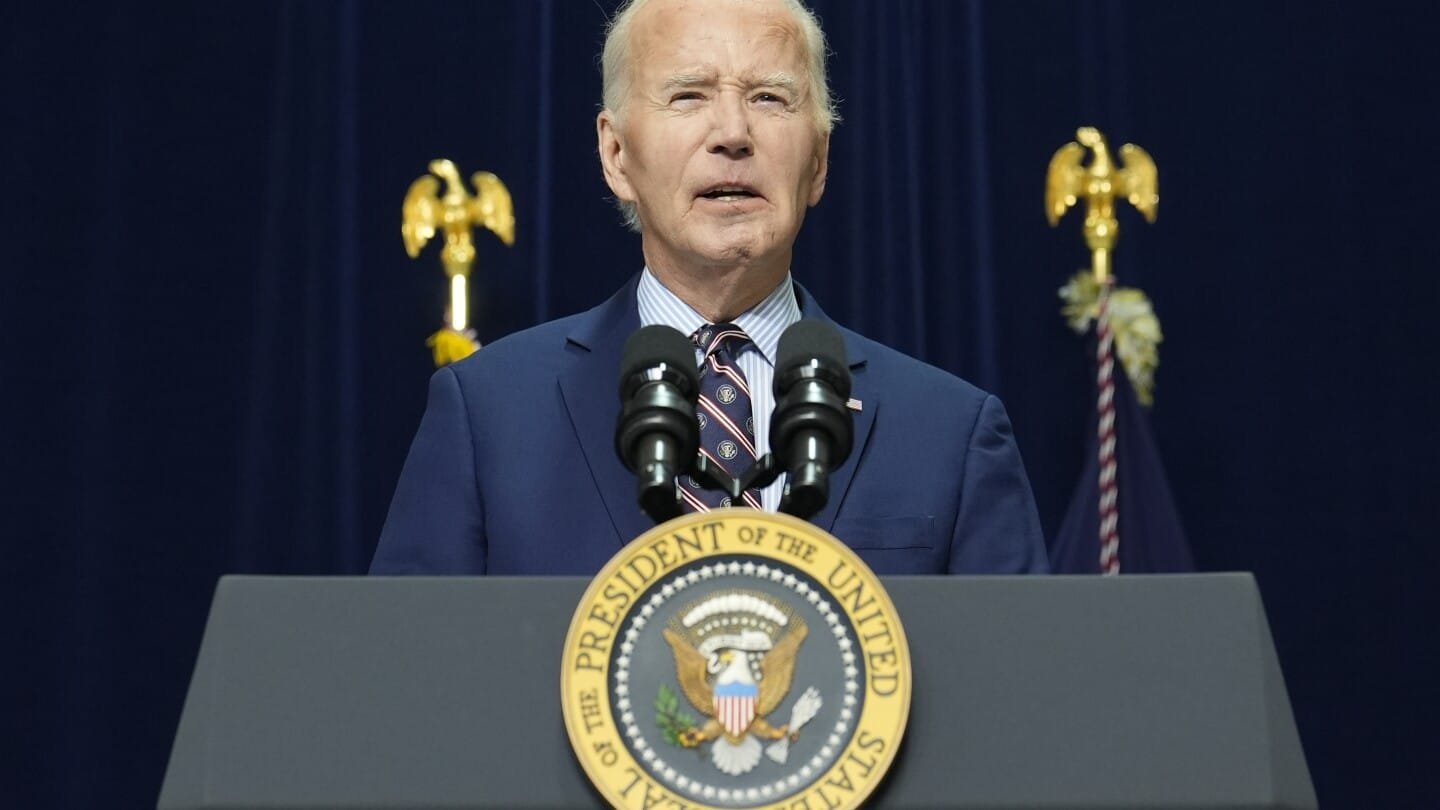
WASHINGTON (news agencies) — President Joe Biden ends his term with a gulf between his policy record and his public reputation.
The Democrat spent so much of his time addressing long-term priorities that many voters felt he did not adequately deal with more immediate problems like high inflation that peaked in 2022 and illegal crossings at the U.S. border with Mexico.
Biden’s term ends just as many of his major domestic policy achievements are being implemented, meaning that the story of his presidency will continue to be written long after he turns over the White House to Republican Donald Trump.
A look at major elements of Biden’s domestic record:
Within months of becoming president, Biden along with congressional Democrats delivered $1.9 trillion toward powering the United States out of the COVID-19 pandemic.
It provided most households with direct payments of $1,400. State and local governments were eligible for $350 billion in assistance, while school systems got $130 billion. Families received an expanded child tax credit deposited monthly in their bank accounts, while renters had a temporary eviction moratorium. Similar to previous pandemic relief under Trump, there were forgivable loans for small businesses to meet payrolls and expanded unemployment benefits.
There was also $14 billion to distribute the COVID-19 vaccine that led to roughly 70% of the country being fully vaccinated, according to the Centers for Disease Control and Prevention.
The funding helped enable growth to roar back — 17 million jobs added, including 5.6 million more jobs than what the Congressional Budget Office forecast before the relief package’s passage. But voters increasingly cared about another economic metric that began to creep up: inflation.
There was never one single cause for the inflation that hounded Biden’s presidency, nor was there a satisfying solution for the public. Republicans were quick to blame the spending from the pandemic relief, relying on forecasts such as those by the economist Larry Summers to suggest that Biden had flooded America with too much money. That political argument obscured a far more complicated reality that involved multiple factors, not just pandemic aid.
Factories around the world shut down during the pandemic. There were not enough computer chips to build new cars, not enough household appliances and not enough shipping containers and dockworkers to get people what they had bought on time. Prices rose because of the kinks in the global supply chain, a challenge the Biden administration sought to unravel by improving the efficiency of U.S. ports.
Domestic oil production was initially slow to ramp up in tandem with the recovering economy, pushing up gasoline prices. Then on Feb. 24, 2022, Russia invaded Ukraine and energy and food prices shot up further as Biden tapped the strategic petroleum reserve for the second time in his presidency. The consumer price index’s annual inflation rate hit a four-decade peak of 9.1% in June 2022. The Federal Reserve jacked up its benchmark interest rates, making mortgage rates and auto loan rates higher as the inflation rate steadily eased though still elevated at 2.7% as of this past November.
Biden noted with pride that inflation had fallen without the recession that many economists had forecast, a talking point that largely failed to resonate with the wider public. He also tried to criticize oil companies he judged as profiteering and food companies that reduced the size of their items through “shrinkflation.”
Labor Department data shows that consumer prices rose a combined 20.8% during the course of Biden’s presidency, but people’s average weekly earnings rose just 17.4% over the same period. That meant people’s incomes didn’t keep pace with their expenses — and it, predictably, left people viewing an otherwise healthy economy as weak.
As the U.S. economy improved, there was a sharp increase in illegal crossings on the U.S. border with Mexico. The increase in unauthorized immigrants overwhelmed many states and cities while the Biden administration haggled with Congress over how to add more resources for border security. Biden’s eventual deal with Senate Republicans was sabotaged by Trump in early 2024. That led Biden to take — too late for public sentiment — the executive actions that Republicans said he should have done all along.
But the impact was clear as government arrests at the southern border topped 2 million in fiscal 2022 and fiscal 2023. That number fell to 1.53 million in fiscal 2024, according to U.S. Customs and Border Protection. Republicans blamed the arrivals for more homelessness and higher home prices, though the economy also benefited somewhat as the migration boosted job growth without adding to wage pressures that could have worsened inflation.
Arrests at the southern border decreased after Mexico took more aggressive actions in December 2023 to curb the crossings and the U.S. government launched an online system called CBP One that let unauthorized people seeking immigration status enter the country with pre-set appointments.
“Infrastructure week” became a punchline during the Trump administration, an event routinely overshadowed by competing news or controversy. Trump had promised to fix the country’s roads and bridges but found little success.
Biden loved to ding Trump over the $1 trillion infrastructure deal he signed into law in November 2021 that was achieved on a bipartisan basis. There have been 66,000 projects announced so far with a price tag of $568 billion, but major projects such as the Brent Spence Bridge in the Cincinnati area and new rail tunnels on the East Coast will take several years to finish — a delay that smothered some of the oomph the work may otherwise have carried with voters. The Biden administration has stressed that it was quick to stand-up an array of new programs, yet what mattered politically were the delays in showing visible impacts in people’s lives.
The delays also have serious policy implications, possibly hurting Biden’s efforts to encourage more people to buy electric vehicles. The law allocated $7.5 billion to build a network of charging stations, but the spending has been slow. As of late last year, the Federal Highway Administration said just 214 operational chargers had been built in 12 states, though 24,800 projects are slated nationwide. That shortfall has occurred as China has begun to aggressively increase its own production of EVs in a challenge to U.S., European, Japanese and Korean automakers.
Biden told USA Today this month that he wished there had been more shovel-ready projects and he expressed regret that he didn’t do a better job of branding all the benefits and projects his policies helped start.






 United Arab Emirates Dirham Exchange Rate