
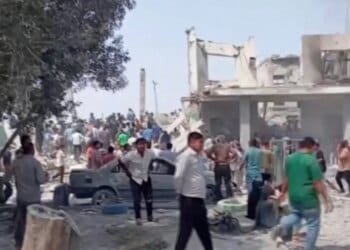
On Saturday, July 27, at least 12 children from the Druze community were killed in a rocket attack on the town of Majdal Shams in the Israeli-occupied Syrian Golan Heights.
Israel blamed the strike on Hezbollah, declaring that it constituted “the crossing of all red lines”. Hezbollah, which generally has no qualms owning up to its handiwork, vehemently denied the accusation.
Regardless of who is responsible, it is no less than ludicrously obscene that Israel should fancy itself qualified to talk about “red lines” when the Israeli army is presently perpetrating straight-up genocide in the Gaza Strip. Since October 7, nearly 40,000 Palestinians have officially been killed in Gaza. A recent Lancet study suggests the true death toll could exceed 186,000.
Israel’s education minister, Yoav Kisch, called on his government to respond “with full force” to the Majdal Shams attack and threatened the possibility of “all-out war” with Hezbollah. Again, it takes a special sort of logic to threaten war in retaliation for an attack on a territory you are illegally occupying.
But, hey, that’s how Israel rolls. Aggressor becomes victim, occupier becomes rightful owner, genocide becomes self-defence.
As for the threat of “all-out war” in Lebanon, it bears mentioning that Israel has killed more than 500 people in the country since October, including more than 100 civilians. It seems pretty “all-out” already.
Not that this is the first time Israel has gone on a mass Lebanese killing spree. Recall the 34-day Israeli war on Lebanon in July and August of 2006, which reduced the country’s population by approximately 1,200 people and produced the so-called “Dahiyeh Doctrine”, defined by the Times of Israel as a “military strategy that advocates the use of disproportionate force against a militant entity by destroying civilian infrastructure”.
In other words, never mind international law and those things known as the Geneva Conventions.
The doctrine was named for the southern Beirut suburb of Dahiyeh, an area the Western media delight in defining as a “Hezbollah stronghold”. Hitchhiking through Lebanon in the aftermath of the 2006 war, I, myself witnessed the outcome of the “disproportionate force” used on Dahiyeh and other parts of the country. I saw apartment blocks converted into craters and villages reduced to rubble.


 United Arab Emirates Dirham Exchange Rate