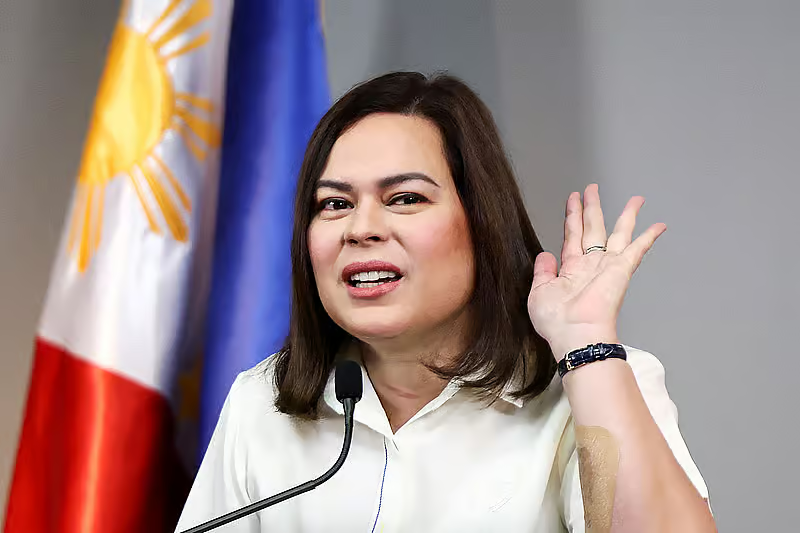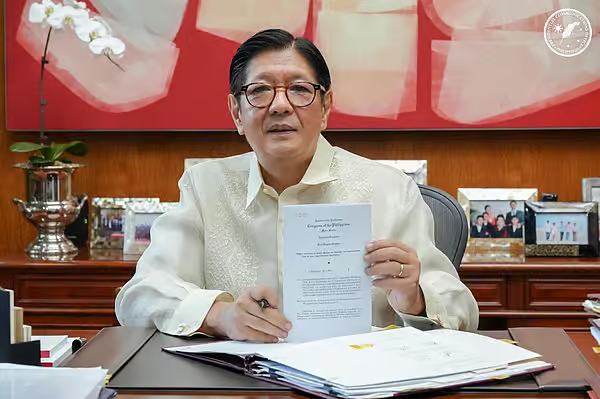
President Ferdinand Marcos Jr. signs Republic Act No. 12317, delaying the inaugural polls for the Bangsamoro region for the third time, citing ongoing political and legal challenges.
MANILA: The inaugural elections for the Bangsamoro Autonomous Region in Muslim Mindanao (BARMM) have been postponed for the third time after President Ferdinand Marcos Jr. signed a new law rescheduling the polls to September 14.
Republic Act No. 12317, signed by Marcos, amends the Bangsamoro Organic Law (Republic Act No. 11054), which had originally mandated that the region’s first elections be held concurrently with the national and local elections in May 2022.
Under the new legislation, the Bangsamoro Transition Authority (BTA)—the interim governing body—will remain in place until the delayed polls are conducted. This marks the latest extension for a region that has faced a protracted journey toward establishing its own fully elected government.
A History of Delays
The postponement is the third since the original 2022 date, driven by a combination of political hurdles and legal uncertainties. A key factor has been the contentious exclusion of Sulu province from the BARMM—a decision currently being challenged before the Supreme Court.
The BARMM was established in 2019 following the ratification of the Bangsamoro Organic Law through a plebiscite. It replaced the former Autonomous Region in Muslim Mindanao (ARMM), which had been in place since 2000. The creation of the BARMM was hailed as a landmark achievement in decades of peace negotiations between Manila and various Bangsamoro groups, offering a political entity with its own executive, legislative, and judicial branches.
Political Complexities and Historical Context
According to the Bangsamoro Organic Law, the region was created “in recognition of the justness and legitimacy of the cause of the Bangsamoro people,” aiming to provide meaningful self-governance while maintaining national sovereignty and territorial integrity.
However, the path to governance has been complicated by local political dynamics. Analysts note that competing demands from prominent political families—particularly regarding the creation of new congressional districts—have contributed to the delays in holding elections.
Muslim Mindanao holds a distinct historical identity. It was the site of powerful sultanates, such as Sulu and Maguindanao, and successfully resisted Spanish and American colonization. The region’s 13 ethno-linguistic groups maintain a unique Islamic-Malay culture, and its current pursuit of autonomy stems from historical grievances over its inclusion in the Philippine republic without consent.



 United Arab Emirates Dirham Exchange Rate