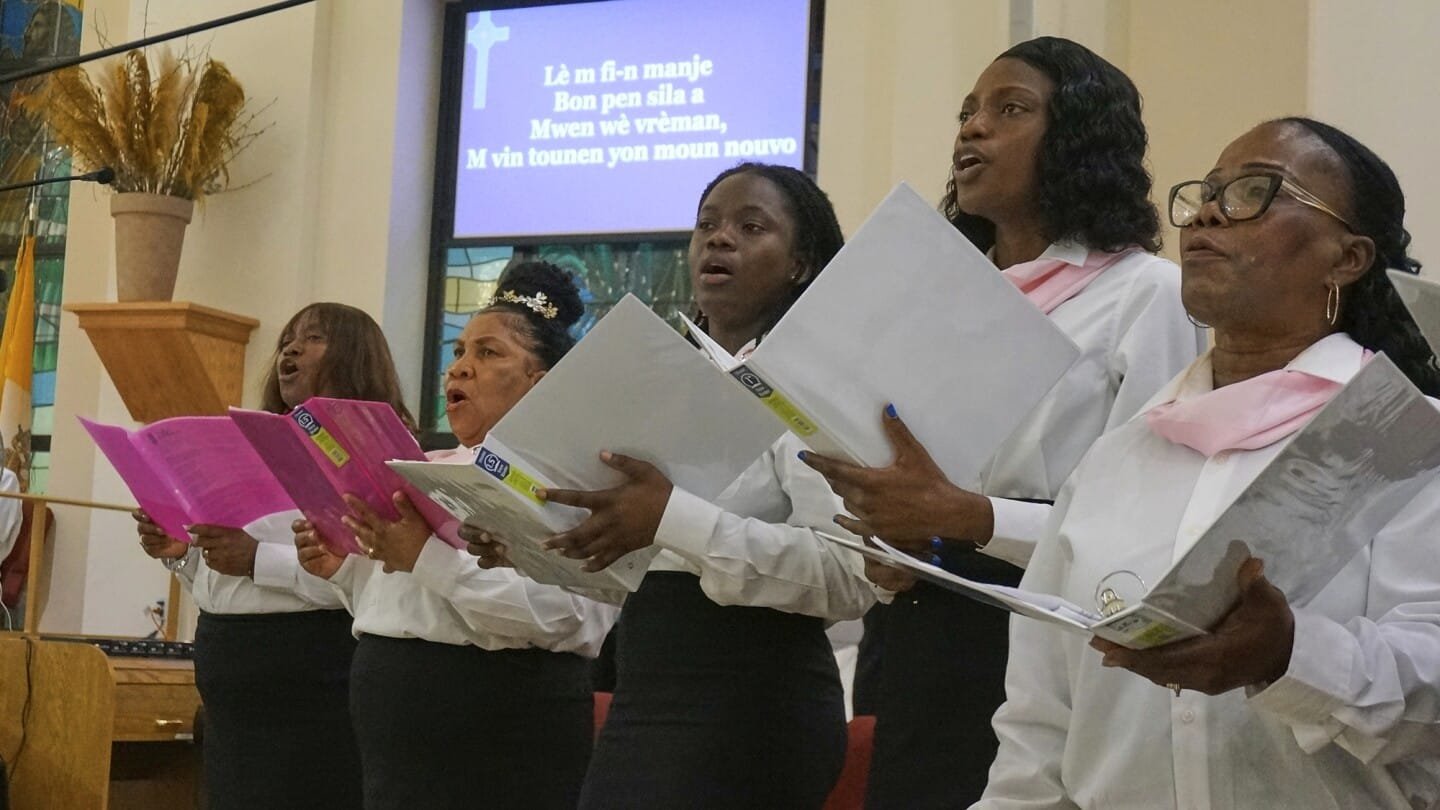
MIAMI (news agencies) — Packed pews, rollicking singing and emotional devotions have marked Lent worship services at Notre Dame d’Haiti, the Catholic church at the heart of the largest Haitian diaspora in the United States. For a community caught in the crossfire of growing violence in their island homeland and disappearing humanitarian protections in the U.S., clinging to faith in God is one of the few lifelines left.
“We believe in him. We pray for possibilities,” said Kettelene Fevrier. She fled Haiti two years ago under a temporary humanitarian program created by the Biden administration and canceled by Trump’s, effective later in April.
At the weekend Mass closing a Lent revival program, Fevrier sang with the choir that kept more than a thousand congregants dancing in the aisles well past midnight. Singing is praying, she said, and she has two main intentions.
“First, that I stay here,” she said. “Second, that God will lead me on the right path.”
Among those swaying to the Creole hymns was Sandina Jean, an asylum-seeker who fled Haiti in 2023. In her increasingly gang-controlled homeland, such a celebration would be hard to safely hold, she said.
“Haiti is getting worse. We don’t have a home to go back to,” Jean said. “When you pray, when you come to Mass, it helps you to keep moving.”
Notre Dame d’Haiti was founded nearly 50 years ago as a mission of the Catholic Church in Little Haiti, a neighborhood near downtown Miami that grew as people fled waves of turmoil. About half a million Haitians live in Florida, making greater Miami by far their largest home away from home.
“Notre Dame d’Haiti is the point of rallying of this community,” said the Rev. Reginald Jean-Mary, who has led the parish since 2004. “We accompany Haitian migrants to integrate in U.S. life.”
Today, their greatest need is a sense of peace.
“People are very desperate, broken, hopeless and at the same time, they continue to believe,” Jean-Mary said.
The gangs that control the vast majority of Haiti’s capital, Port-au-Prince, have stepped up the attacks that have killed thousands of people across the country and left more than one million homeless. Sixty thousand were displaced in a single month — a record — according to a late March United Nations report.
So growing numbers of Haitians have fled to the United States. More than 200,000 came under a “humanitarian parole” program created in late 2022 that the Department of Homeland Security said it would revoke in late April.
Earlier this year, the U.S. government also announced that in August it would end “temporary protected status” for about half a million Haitians. Their status had been renewed by the Biden administration, which had widely expanded that type of humanitarian visa.
Some Notre Dame congregants felt that these new arrivals strained available resources — and voted for President Donald Trump, whose immigration policies have found support among many in Miami’s long-established Latino communities, too.
But most congregants are still stepping up to help their compatriots who often sold what little they had in Haiti to take advantage of legal protections in the United States, Jean Suffrant said. He leads the Pierre Toussaint Leadership and Learning Center, Notre Dame’s social services hub, which offers free day care, job training, and language and tech classes.
Last week, one immigration session — held by Catholic Legal Services on church grounds — lasted until 1 a.m. because so many people lined up, desperate for advice, Suffrant said.
“It’s never been this bad” for Haitians in the U.S. and on the island, he said. “What a heavy burden, being told you’re no longer allowed in a country that welcomed you.”
Octavius Aime said the new arrivals’ difficulties affect the entire community, which he’s seen grow over 40 years at Notre Dame. Many are terrified to lose their work permits, which came with humanitarian protections, since their U.S. salaries are lifelines for families in Haiti.
“We’re hurting,” Aime said. “We are so worried, we don’t know what to do.”
The uncertainty makes it especially important to gather and uplift all Haitians at events like the revival, at which Aime volunteered. It centered on the biblical story of the Jewish people’s miraculous escape from slavery in Egypt after Moses parted the Red Sea.




 United Arab Emirates Dirham Exchange Rate