The alert reportedly followed radar tracking of projectiles launched during regional hostilities, prompting immediate safety protocols.
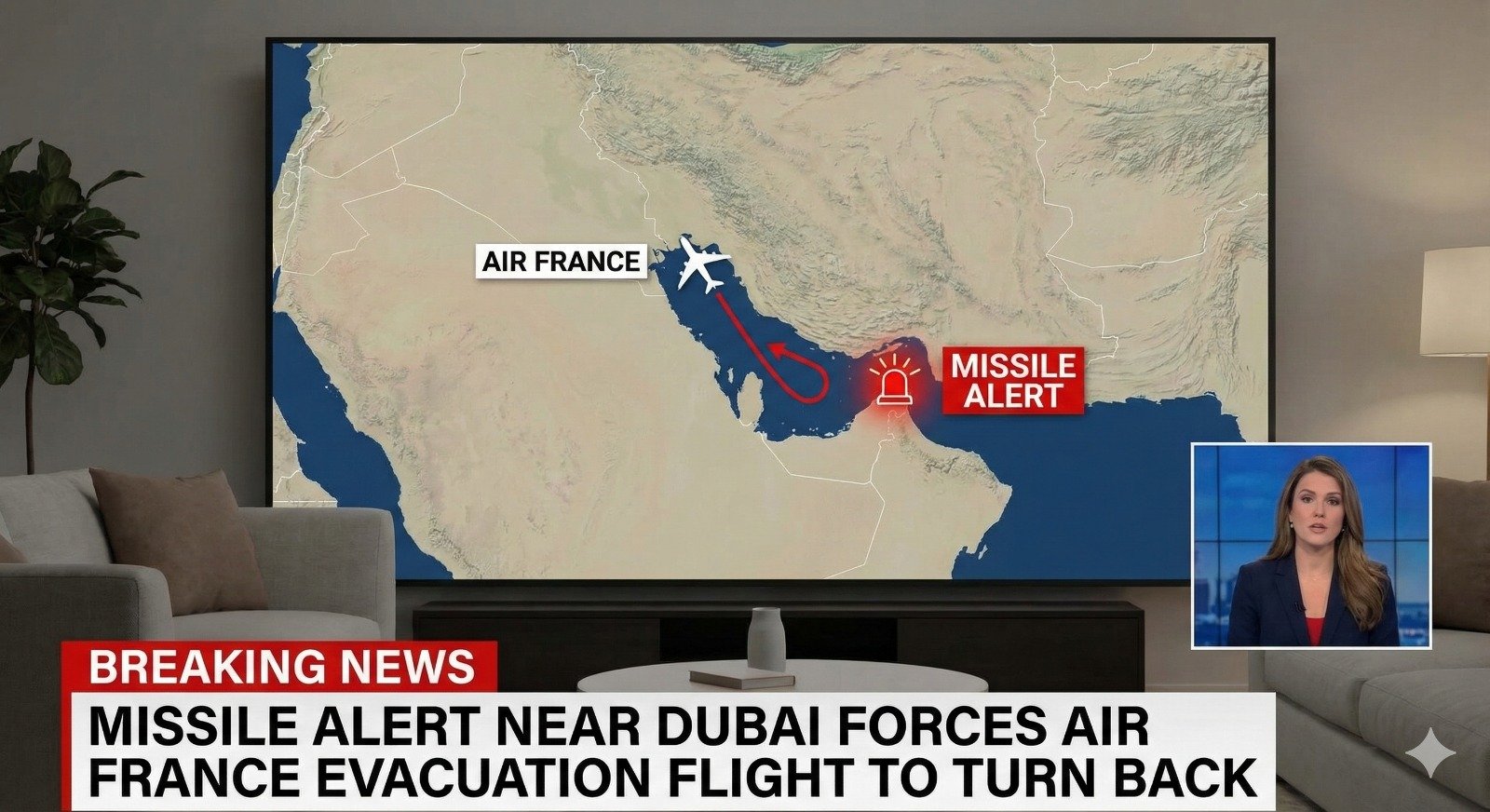
An Air France charter flight dispatched to evacuate French nationals from the UAE was forced to turn back after missile‑detection systems issued alerts near Dubai, French authorities and the airline confirmed on Friday.
According to aviation sources, the aircraft had been flying along a designated humanitarian corridor when air‑traffic controllers issued an urgent NOTAM (Notice to Air Missions) warning pilots of possible missile trajectories detected south of Dubai. The alert reportedly followed radar tracking of projectiles launched during regional hostilities, prompting immediate safety protocols.
The flight crew received automated threat notifications from onboard systems shortly after the NOTAM was circulated. In coordination with UAE air‑traffic control and the airline’s operations centre in Paris, the pilot executed a rapid diversion maneuver, abandoning the planned route and initiating a return to base.
French Transport Minister Philippe Tabarot said the incident highlights the increasing operational risks facing evacuation missions as the regional conflict escalates.
“The situation reflects the instability gripping the region and the growing complexity of repatriation operations,” Tabarot said in a post on X, noting that flight paths once considered safe are now subject to sudden closures or rerouting.
French Foreign Minister Jean‑Noël Barrot said that around 750 people have already been evacuated, but nearly 5,000 French nationals have requested assistance. He confirmed on French television Thursday that the government is preparing “additional extraction flights,” though each mission is being reassessed hourly due to airspace volatility.
European governments across the bloc are now accelerating contingency plans as Middle Eastern airspace becomes increasingly unpredictable. Several carriers have already diverted or suspended services after reports of intermittent missile activity near major aviation corridors, raising concerns that even commercial routes previously deemed low‑risk may no longer be secure.
Understanding Missile Alerts and their Impact on Civil Aviation
Aviation security specialists say the missile alert issued near Dubai underscores the increasingly volatile environment civilian and evacuation flights are operating in as regional hostilities intensify.
1. How Missile Alerts Are Detected
Experts explain that missile alerts typically originate from a combination of military radar networks, satellite surveillance, and air-defense tracking systems. When any of these sources detect a projectile launch or a suspicious trajectory, air-traffic authorities rapidly issue NOTAMs (Notices to Air Missions) to warn aircraft in the vicinity.
In regions experiencing active conflict, these alerts may be triggered by:
- Long‑range ballistic missile launches
- Cruise missile movement spotted on radar
- Drone swarms or loitering munitions entering controlled airspace
- Misfires or errant projectiles straying off their intended course
“These alerts are designed to give pilots minutes—or sometimes seconds—of reaction time,” one senior aviation analyst noted. “In a congested airspace like the Gulf, that margin is razor thin.”
2. Why Even Distant Missile Activity Can Force a Flight to Divert
Aviation specialists stress that civilian aircraft are not built to withstand proximity to military projectiles, and even a launch occurring dozens of kilometres away may prompt immediate rerouting.
Factors that increase risk include:
- Unpredictable missile paths, especially in conflicts involving multiple actors
- Fragmentation hazards, where debris or shrapnel can travel far from the impact zone
- Potential radar interference, which can temporarily disrupt cockpit instrumentation
- The risk of misidentification, where civilian aircraft could be wrongly perceived as military assets in crowded skies
“In high‑tension theatres, any unidentified airborne object can be interpreted as a threat. That is why civilian aircraft must err on the side of extreme caution,” said a former European air-defense official.
3. Why Evacuation Flights Face Greater Risk
Unlike commercial routes that can be suspended or rerouted far from danger zones, evacuation flights are often time‑sensitive and must operate closer to unstable air corridors.
Experts highlight three key vulnerabilities:
- Limited routing flexibility due to the need to reach affected nationals quickly
- Reduced operational windows, meaning flights often travel during periods of heightened military activity
- Dependence on host‑nation air defenses, which may be overwhelmed or unable to guarantee protective coverage during active hostilities
“Evacuation missions are uniquely exposed,” said a crisis‑response aviation consultant. “They must fly when commercial carriers can simply choose not to.”
4. Implications for Future Air Operations in the Region
Security analysts warn that missile alerts like the one near Dubai may become more frequent as the conflict evolves, prompting:
- Increased airline rerouting across the Gulf
- Greater reliance on military-escorted humanitarian corridors
- Potential expansion of no‑fly zones over parts of the Middle East
- Heightened insurance costs for carriers operating near conflict zones
“Airspace over the Gulf is among the busiest in the world. Missile alerts inject a level of unpredictability that civil aviation systems are not designed to absorb for long,” said an aviation risk expert.
5. The Broader Strategic Picture
Experts also note that missile activity near major transport hubs—even without direct targeting—can have significant geopolitical consequences, including:
- Pressure on regional governments to tighten air defenses
- Disruptions to global travel and supply chains
- Increased urgency for Western nations to accelerate evacuation planning
“In a conflict where missile ranges extend hundreds of kilometres, no major Gulf city can be considered completely insulated,” one analyst observed.







 United Arab Emirates Dirham Exchange Rate