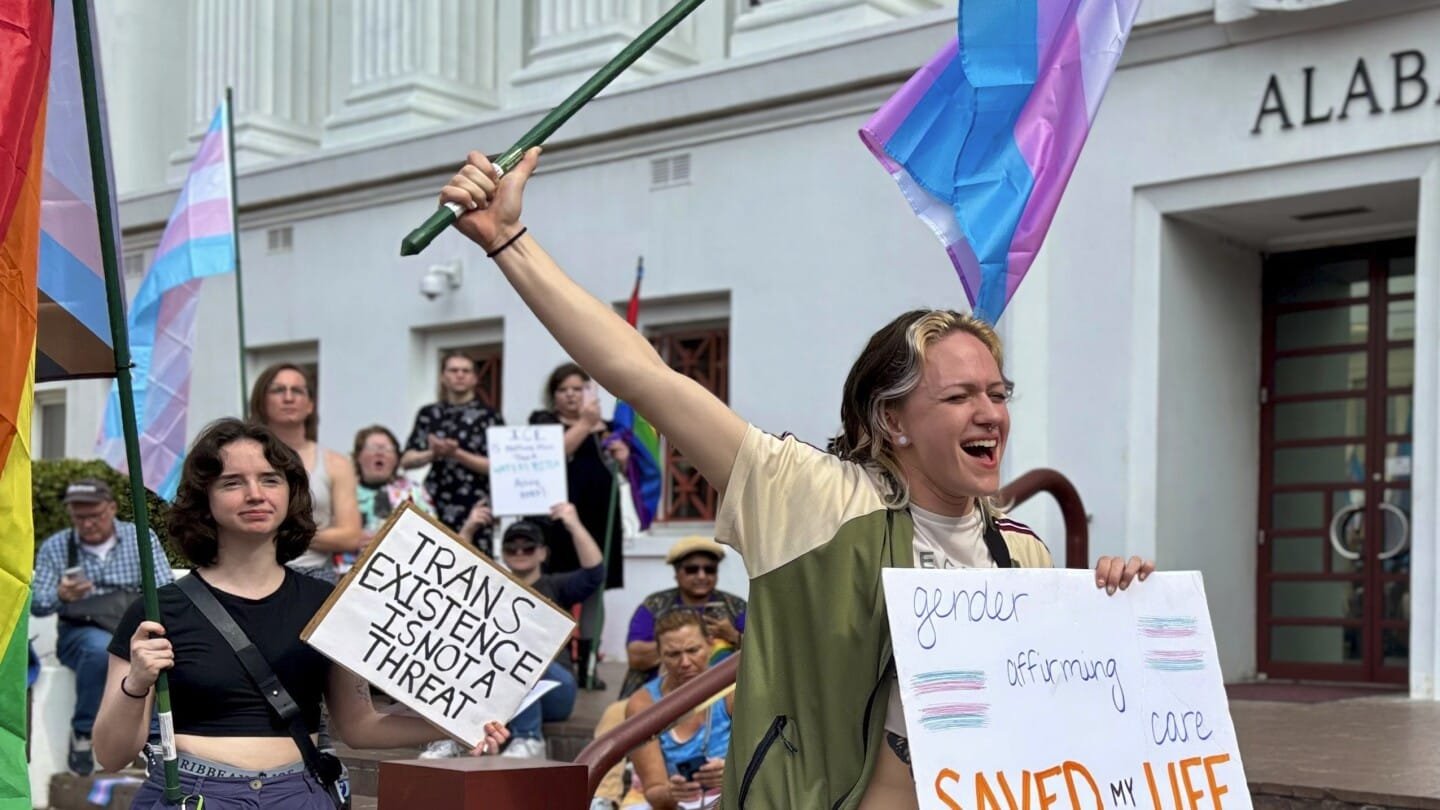
MONTGOMERY, Ala. (news agencies) — Katherine Bartle said she spent her years growing up in Alabama trying anything to “fix” herself and exist as a man. Eventually she realized it wasn’t possible.
“I am a woman. I assure you that this is not a costume, nor is it by my own choice,” Bartle, 24, of Huntsville, Alabama, told Alabama lawmakers this week as they debated legislation that would define her and other transgender women in Alabama as men based on the sex they were assigned at birth.
The Alabama legislation, which passed the Senate Thursday, would create legal definitions of male and female based on the reproductive organs at birth. At least nine other states have already enacted similar laws.
Now Alabama and a small but growing number of other GOP-led states are pushing to enact more laws this year following President Donald Trump’s executive order declaring there are two sexes and rejecting the idea that people can transition to another gender.
“That provides a framework for the states to be able to enact their own without fear of reprisals from the federal government,” said Nebraska state Sen. Kathleen Kauth, who is sponsoring a measure there.
Republican Nebraska Gov. Jim Pillen issued an executive order to impose definitions for male and female, and he is backing Kauth’s bill. The measure also would restrict transgender people’s use of bathrooms and locker rooms. A committee hearing was set for Friday.
Several other GOP-led states are considering similar bills this year.
Trump’s move affects passports, federal prisons and federal funding. State laws affect state-controlled policies.
For example, after Kansas enacted its law in 2023, the state stopped allowing transgender people to change their birth certificates and driver’s licenses so that the listing for “sex” would match their gender identities. Even transgender residents who have had their gender identities reflected on their licenses face having the listing reversed if they have to renew their licenses.
Legislation defining male and female passed the Wyoming House last month, and similar proposals have been introduced in Arizona, Indiana, Missouri and South Carolina, according to groups that track measures rolling back transgender rights.
“It’s based on fundamental truths that are as old as the Book of Genesis and as reliable as the sun in the sky. Men are born men, women are born women and one can never become the other,” said Republican Sen. April Weaver, a sponsor of an Alabama proposal. She said a person “can identify as whoever you want to identify as, but this just puts into law what your sex is.”
The Alabama Senate passed the bill with a 26-5 vote, with all five Democrats voting against it. The bill will now move to the Alabama House of Representatives.
Alabama Sen. Linda Coleman-Madison, a Democrat, didn’t disagree with the definitions in the bill but questioned its purpose. She said the bill wouldn’t “change the perception about how people feel about themselves,” but instead intended “to change attitudes as people go in to get services, to have people looked at differently, to target, to isolate.”
“I believe people are going to be killed and die behind this,” Coleman-Madison said.
Alabama Gov. Kay Ivey promised to sign the bill if it reaches her desk.
The bills began popping up in statehouses several years ago, but they gained traction in the last two years.
Kauth said that even five years ago, the definition of male and female seemed fixed in people’s minds. Republicans often describe recognition of transgender people’s gender identities as an ideology being pushed by the political left.
“The intensity of this ideology and the push through society has been pretty extreme, so we need to actually push back on it,” Kauth said.
The American Medical Association and other mainstream medical groups say that extensive research shows that sex and gender are better understood as a spectrum than as an either/or definition. Strict definitions can also leave out a range of variations that include intersex people, who have physical traits that don’t fit typical definitions for male or female categories.
Conservatives pushing the bills often argue that states have an interest in protecting “women-only” spaces such in bathrooms, locker rooms and sport teams and prevent transgender women from accessing them. “It would prevent males who identify as women from claiming that they have an automatic right to access these specific women’s spaces. I believe we as women should be standing up to this,” Alabama’s Weaver said.







 United Arab Emirates Dirham Exchange Rate