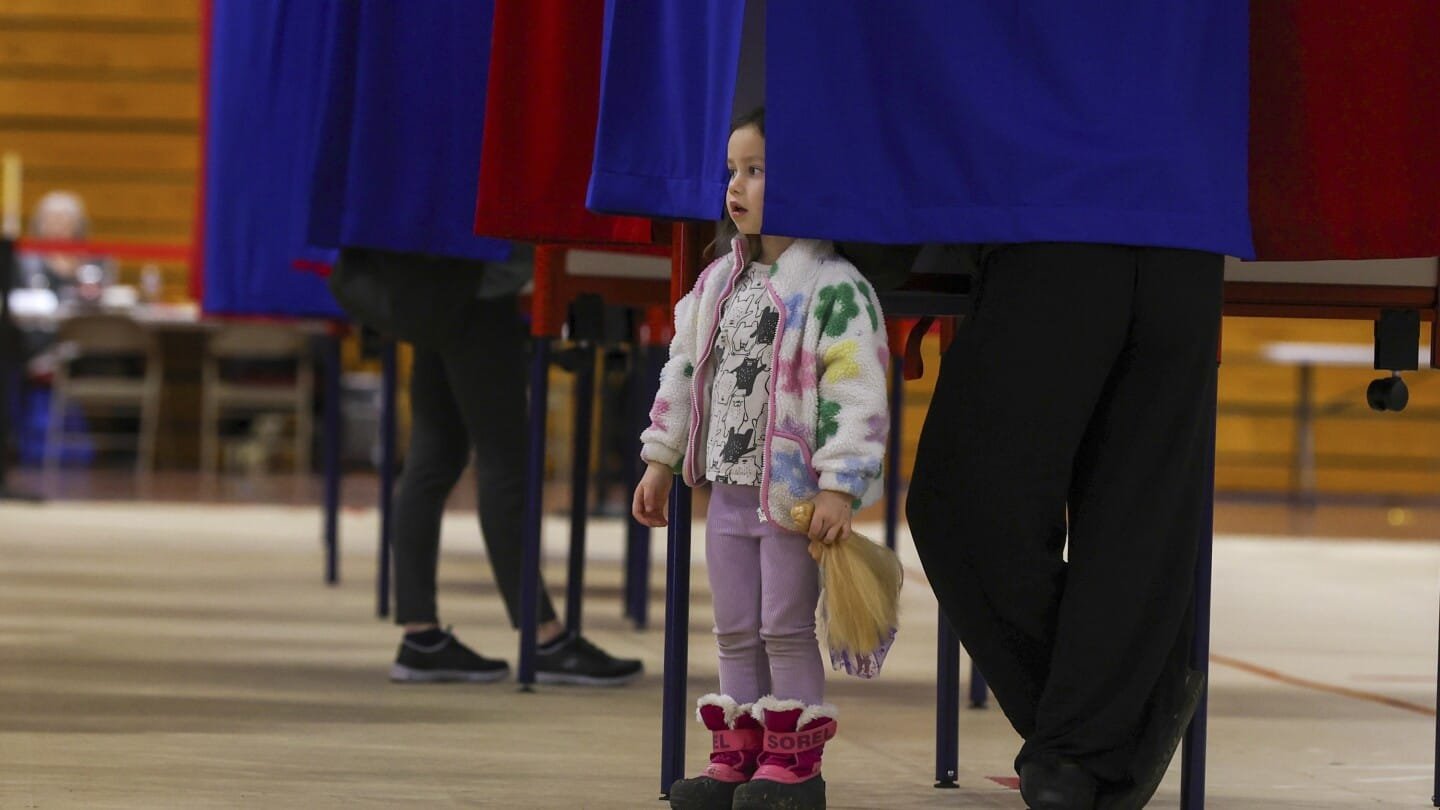
CONCORD, N.H. (news agencies) — A voter in Milford, New Hampshire, missed out on approving the town’s $19 million operating budget, electing a cemetery trustee and buying a new dump truck. In Durham, an 18-year-old high school student did not get a say in who should serve on the school board or whether $125,000 should go toward replacing artificial turf on athletic fields.
Neither was able to participate in recent town elections in New Hampshire thanks to a new state law requiring proof of U.S. citizenship to register to vote. Their experiences, recounted by town clerks, could prove instructive for the rest of the country as the Safeguard American Voter Eligibility Act advances in Congress and more than a dozen states consider similar legislation.
“Everything that conservatives tried to downplay, New Hampshire told us exactly what would happen on a national scale under the SAVE Act,” said Greta Bedekovics, a former policy adviser for Senate Democrats who is now with the Center for American Progress.
Voting rights groups are particularly concerned that married women who have changed their names will encounter trouble when trying to register because their birth certificates list their maiden names.
That is exactly what happened to Brooke Yonge, a 45-year-old hairstylist who showed up at her polling place in Derry last week determined to show her support for public education.
She was turned away initially because she did not have proof of citizenship. When she returned with her birth certificate, that still was not enough because the name on the document did not match the one on her driver’s license. Back home she went to fetch her marriage license to prove she had changed her name.
“Third trip around the sun and here we are,” said Yonge, who called the registration requirements reasonable despite the hassle. “If I did a little research, I probably would have known that is what I needed.”
New Hampshire is among the 20 states that allow voters to register on the day of an election. According to the New Hampshire Campaign for Voting Rights, at least 56 people who tried to register statewide the day of the March 11 town elections were turned away, though it is unknown how many of them later completed the process.
Derry’s town clerk, Tina Guilford, wonders how it will go during a November general election, when turnout is much higher.
“It’s just heartbreaking to me to see people turn around and think, ‘I hope they come back,’” she said.
At least one person who tried to register in Milford on Tuesday did not return, said Joan Dargie, the town clerk. Neither did an older woman who tried to register at Town Hall before the election. The first of the woman’s three marriages was in Florida in the 1970s and that license was long gone, Dargie said.
“Sometimes people are like, ‘I didn’t save any paperwork for that. I wanted to forget all that,’” Dargie said. “It’s disenfranchising women.”
The U.S. House passed legislation last year to require proof of citizenship for voter registration, but it stalled in the Senate amid Democratic opposition. With Republicans now in full control of Congress, the House is expected to take up the issue again soon.
Before the 2024 election, Donald Trump falsely claimed that noncitizens might vote in large enough numbers to sway the outcome. In fact, research and reviews of state cases have shown voting by noncitizens to be rare and typically a mistake rather than an intentional effort to subvert an election.
Republicans argue that even small numbers of noncitizens voting undermines public confidence.
New Hampshire’s new law also has had broad support. About 8 in 10 New Hampshire voters in the 2024 election favored requiring people in their state to show a passport, birth certificate or other evidence of U.S. citizenship when they register to vote, according to news agencies VoteCast, including about 6 in 10 who were strongly in favor. The vast majority of Trump voters were in support of the requirement, but so were more than half of voters for Democratic Vice President Kamala Harris in the race against Republican Trump.
During the recent town hall elections, Michael Appleton had to return home to get his birth certificate and provide proof of a name change before he could register and vote. Even so, he wasn’t critical of the new law.
“It’s inconvenient for me personally in this moment, but I don’t think it’s an unreasonable thing to ask,” he said.
Republican state Rep. Bob Lynn, who sponsored New Hampshire’s law, does not believe there is rampant voter fraud in the state. He also does not believe the new citizenship requirements are unduly burdensome.
“It seems to me that voting is pretty important, and it’s not unreasonable to say to people, look, you’re going to have to give a little bit of forethought to what you need in order to vote,” said Lynn, a former chief justice of the New Hampshire Supreme Court.







 United Arab Emirates Dirham Exchange Rate