
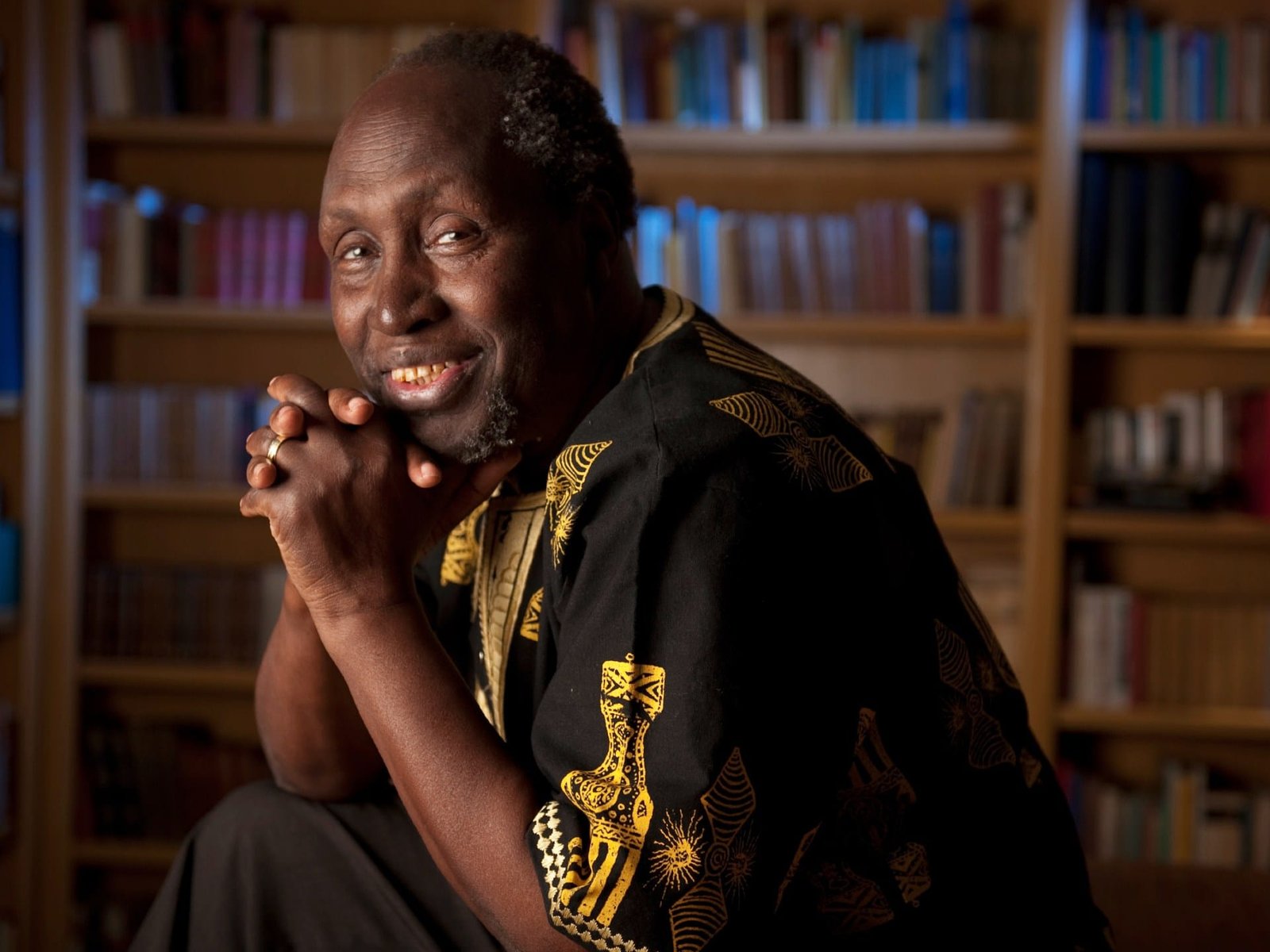
Ngugi wa Thiong’o loved to dance. He loved it more than anything else – even more than writing. Well into his 80s, his body slowed by increasingly disabling kidney failure, Ngugi would get up and start dancing merely at the thought of music, never mind the sound of it. Rhythm flowed through his feet the way words flowed through his hands and onto the page.
It is how I will always remember Ngugi – dancing. He passed away on May 28 at the age of 87, leaving behind not only a Nobel-worthy literary legacy but a combination of deeply innovative craft and piercingly original criticism that joyfully calls on all of us to do better and push harder – as writers, activists, teachers and people – against the colonial foundations that sustain all our societies. As for me, he pushed me to go far deeper up river to Kakuma refugee camp, where the free association of so many vernacular tongues and cultures made possible the freedom to think and speak “from the heart” – something he would always describe as writing’s greatest gift.
Ngugi had long been a charter member of the African literary canon and a perennial Nobel favourite by the time I first met him in 2005. Getting to know him, it quickly became clear to me that his writing was inseparable from his teaching, which in turn was umbilically tied to his political commitments and long service as one of Africa’s most formidable public intellectuals.
Ngugi’s cheerfulness and indefatigable smile and laugh hid a deep-seated anger, reflecting the scars of violence on his body and soul as a child, young man and adult victimised by successive and deeply intertwined systems of criminalised rule.
The murder of his deaf brother, killed by the British because he did not hear and obey soldiers’ orders to stop at a checkpoint, and the Mau Mau revolt that divided his other brothers on opposite sides of the colonial order during the final decade of British rule, imbued in him the foundational reality of violence and divisiveness as the twin engines of permanent coloniality even after independence formally severed the connection to the metropole.
More than half a century after these events, nothing would arouse Ngugi’s animated ire more than bringing up in a discussion the transitional moment from British to Kenyan rule, and the fact that colonialism didn’t leave with the British, but rather dug in and reenforced itself with Kenya’s new, Kenyan rulers.
As he became a writer and playwright, Ngugi also became a militant, one devoted to using language to reconnect the complex African identities – local, tribal, national and cosmopolitan – that the “cultural bomb” of British rule had “annihilated” over the previous seven decades.
After his first play, The Black Hermit, premiered in Kampala in 1962, he was quickly declared a voice who “speaks for the Continent”. Two years later, Weep Not Child, his first novel and the first English-language novel by an East African writer, came out.
As he rose to prominence, Ngugi decided to renounce the English language and start writing in his native Gikuyu.







 United Arab Emirates Dirham Exchange Rate