
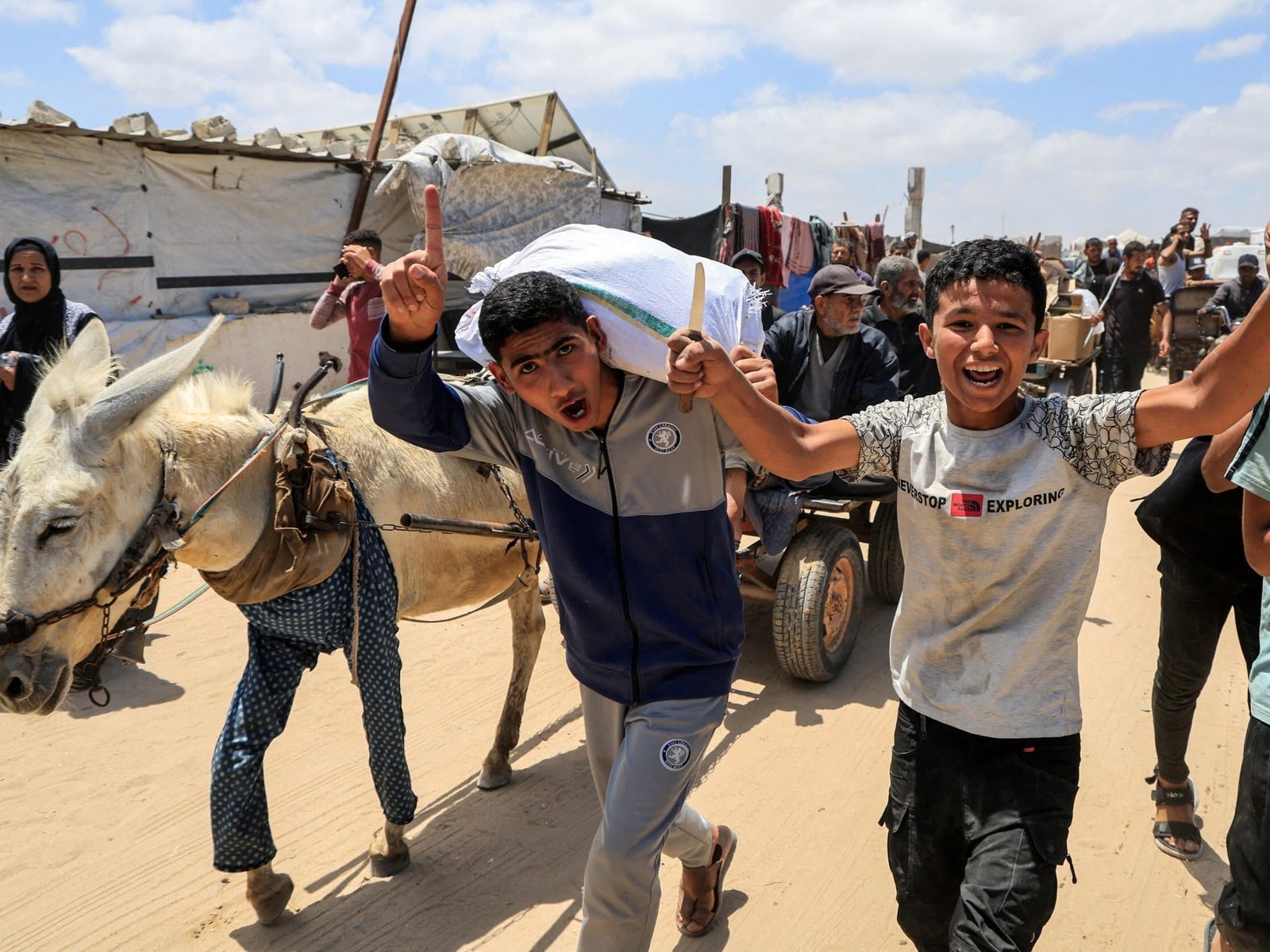
Palestinians in Gaza recount journeys to Gaza Humanitarian Foundation’s aid distribution sites, as starvation looms.
Deir el-Balah, Gaza Strip – Jehad Al-Assar left his tent in central Gaza’s Deir el-Balah early in the morning on a new and exhausting journey to get food for his family.
His destination on Wednesday: an aid distribution point in Rafah, in the far south of Gaza, run by the United States-backed Gaza Humanitarian Foundation (GHF).
Jehad walked a “gruelling” 10km (6.2 miles) to reach the site, driven along primarily by the weight of responsibility for his pregnant wife and two hungry daughters.
With starvation spreading throughout Gaza, a direct result of Israel’s months-long blockade on the territory, the GHF site was Jehad’s only hope.
This is despite the controversy surrounding the organisation, whose own head resigned on Sunday, saying that the GHF could not adhere “to the humanitarian principles of humanity, neutrality, impartiality, and independence”.
The GHF’s lack of experience in dealing with aid distribution was highlighted on Tuesday, when at least three Palestinians were killed in the chaos that surrounded the relief effort.
But in Gaza, people are hungry and desperate. Jehad is among them.
After walking for 90 minutes, the 31-year-old reached the iron gates of the distribution centre, alongside thousands of others, before they suddenly opened.
Inside the hall, people snatched whatever they could carry. “Anyone who could lift two boxes took them. Sugar and cooking oil were the priorities. They grabbed what they wanted and rushed out.”
“There was no trace of humanity in what happened,” he said. “I was nearly crushed by the crowd.”
Just a short distance away, armed foreign forces stood watching without intervening. Jehad said he approached one of them and confronted him.
“I told them, ‘You’re not helping – you’re overseeing a famine. You should leave. You’re not needed here.’”
Jehad managed to retrieve only a few items: cans of tuna, a small bag of sugar, some pasta and a packet of biscuits scattered on the ground. He carried them in a plastic bag slung over his shoulder and made the long journey back home.
Apocalyptic
“I only got a little. I was afraid to stay longer and get trampled in the stampede – but I had to bring back something. My girls need to eat. I have no choice,” he said.
When he returned to the tent, his daughters greeted him joyfully – even for the little he had brought.
Awad Abu Khalil was also among the desperate crowds on Wednesday. The 23-year-old described the crowds rushing to get to the food as “apocalyptic”.
“Everyone was running. It was chaos. The aid was piled up and everyone just attacked it, grabbing what they could.”
Awad said he heard gunfire in the distance, likely targeting young men trying to bypass the designated routes.
He expressed deep frustration with the staff. “I expected the American staff to distribute aid at tables, handing each person their share – not this madness.”
The images that emerged on Tuesday and Wednesday have added fuel to international criticism of the GHF, with representatives from several countries denouncing Israel’s decision to prevent the United Nations and international humanitarian organisations from bringing aid into Gaza.
Israel stopped the entry of aid into Gaza in early March, while a ceasefire was still ongoing. It has since unilaterally broken the ceasefire, and doubled down in its war on Gaza, with the official death toll now more than 54,000 Palestinians.
“We used to receive aid from international agencies and the UN,” said Jehad. “It was delivered by name, in an organised way – no chaos, no humiliation.”
By the end of Wednesday, Gaza’s Government Media Office reported that at least 10 Palestinians desperately seeking aid had been killed by Israeli forces in the previous 48 hours.



 United Arab Emirates Dirham Exchange Rate