
Oil prices rose on the first day of trading this year on fears of Red Sea supply disruptions and hopes of an improving demand outlook in China.
Brent, the benchmark for two thirds of the world’s oil, was trading 2.14 per cent higher at $78.69 a barrel at 4.11pm UAE time. West Texas Intermediate, the gauge that tracks US crude, was up 2.18 per cent at $73.21 a barrel.
Crude futures recorded their biggest annual drop since 2020 last year at a time of record US oil production and a slowdown in major economies.
On an annual basis, Brent ended 2023 more than 10 per cent lower, while WTI dropped by nearly 11 per cent.
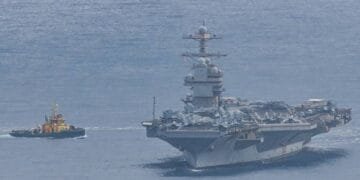
On Sunday, the Yemeni Houthi rebel group launched three anti-ship missiles at a commercial vessel, the Maersk Hangzhou, a Singapore-flagged container ship.
One struck it, causing damage but no casualties, while two of the missiles were shot down by the destroyer USS Gravely.
The US said that a naval task force formed in December had shot down four ballistic missiles and 17 drones fired by the Iran-backed militia.
The Bab Al Mandeb, located at the southern edge of the Red Sea, is a route for oil tankers and vessels between the Arabian Gulf and Asia, as well as to Europe by way of the Suez Canal.
About 12 per cent of the seaborne oil trade and 8 per cent of liquefied natural gas passes through the strait.
Meanwhile, manufacturing activity in China, the world’s second-largest economy, fell for the third month in a row, raising expectations of stimulus measures to revive growth.
China’s official manufacturing purchasing managers’ index (PMI) fell to 49 last month from 49.4 in November, the third consecutive month of a reading below the neutral 50 mark, and below consensus expectations of an improvement to 49.6.
The deterioration in the official manufacturing PMI stood in contrast to the Caixin manufacturing PMI reading, which rose above expectations, to 50.8 in December from 50.7 the month before.






 United Arab Emirates Dirham Exchange Rate