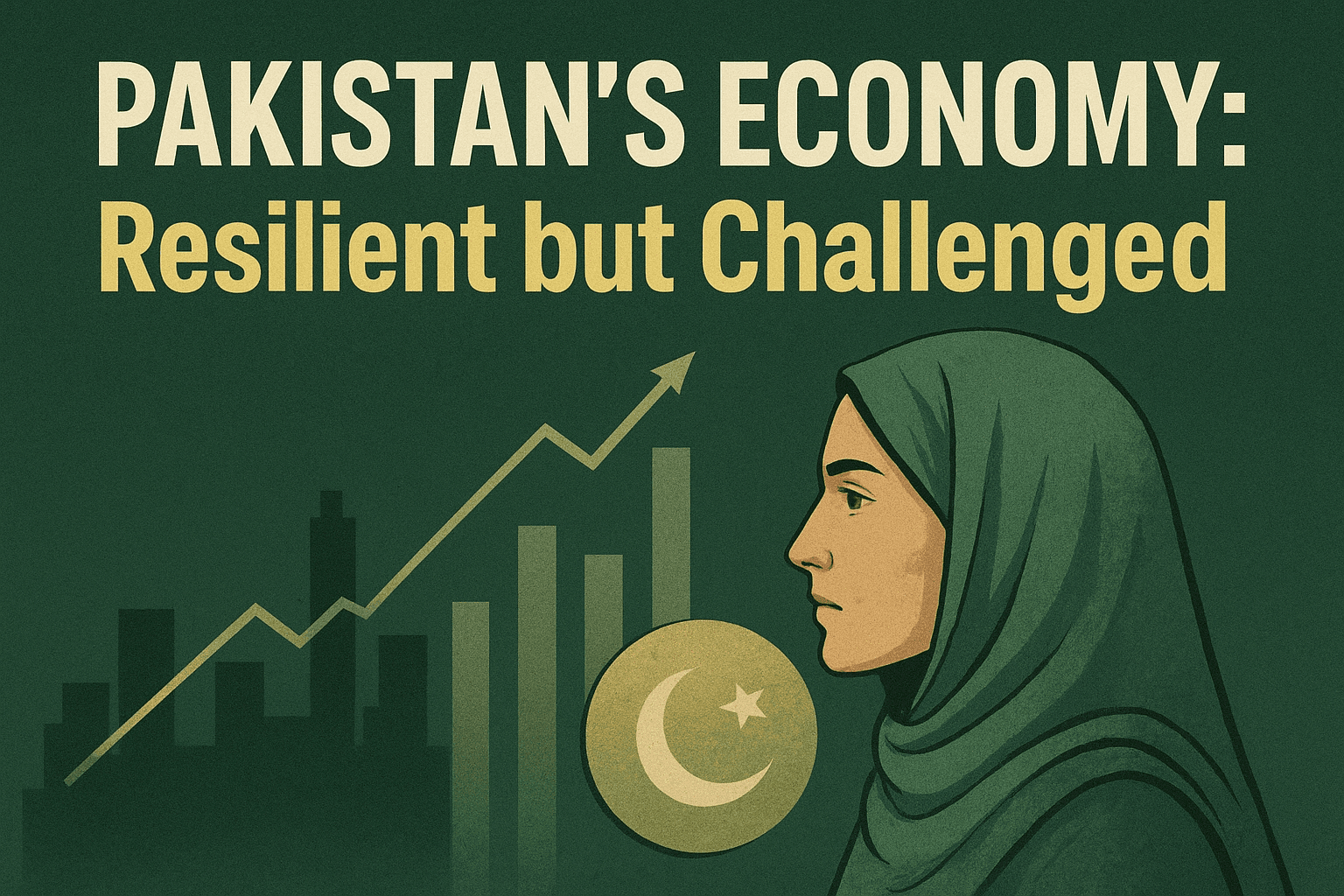
For now, Pakistan is not in a boom, but it is breathing easier — and if the right choices are made, it could begin to stride rather than stumble.
By Ghulam Haider
Pakistan’s economic trajectory in 2025 appears more stable than it has been in recent years, as it is supported by a combination of prudent monetary policy, stabilizing macroeconomic indicators, and cautious optimism reflected in recent reports by international financial institutions. While the country still faces serious structural and external challenges, emerging green shoots signal a potential turnaround — provided that policy consistency, investor confidence, and external conditions remain favourable. This will enable sustainable growth, foster resilience, and gradually restore Pakistan’s standing in the competitive global economic landscape.
In recent times, Pakistan is witnessing a remarkable economic transformation. In the very first month of the new fiscal year, the country’s exports reached an impressive USD 2.7 billion — a clear testament to this progress. Last fiscal year, Pakistan received USD 34.9 billion in remittances — an increase of 28.8% compared to FY 2023-24. The Pakistan Stock Exchange’s 100 Index also crossed the 145,000 mark, showcasing a historic performance in recent days. Pakistan received USD 34.9 billion in remittances this year, marking a 28.8% increase compared to the 2023–24 fiscal year. The Pakistan Stock Exchange’s 100 Index has surpassed the historic 145,000 milestone. These economic indicators have led the international rating agencies to improve the credit rating of Pakistan
In its latest country report, The International Monetary Fund (IMF) has upgraded Pakistan’s GDP growth projection to around 3.5% for FY2025, citing macroeconomic stability, fiscal consolidation, and improving investor sentiment. Similarly, the World Bank revised its outlook, highlighting moderate recovery driven by better agricultural output and a rebound in exports. In its third quarterly report, The State Bank of Pakistan (SBP) has noted that inflationary pressures are beginning to ease, reserves are being rebuilt, and the current account deficit is narrowing — all signals that the worst may be over.
More importantly, Pakistan’s re-entry into international capital markets through the issuance of green and diaspora bonds has helped shore up confidence. With foreign exchange reserves recently rising above $10 billion for the first time since early 2022 and the rupee showing relative stability, investor perception is improving, particularly among those seeking long-term exposure in emerging markets.
Several structural and policy-based factors are underpinning the country’s gradual return to growth. After successive years of underperformance due to floods and climate-related shocks, the agriculture sector is witnessing a rebound, particularly in wheat and sugarcane production. This is a direct result of better weather conditions, government seed subsidies, and improved water availability through recent hydrological investments.
The textile sector, despite global headwinds, remains Pakistan’s most competitive export domain. Renewed demand from the EU and GCC markets is helping stabilize external revenues. In parallel, remittance inflows from the Pakistani diaspora continue to provide a vital cushion for the balance of payments, expected to reach nearly $30 billion by end of FY2025, according to SBP projections.
A quiet but powerful transformation is underway in Pakistan’s tech sector. With over 30% growth in IT exports over the past year and rising startup activity — particularly in fintech, edtech, and logistics — the digital economy is emerging as a key growth frontier. The government’s push towards digitizing payments, streamlining taxation, and encouraging freelance platforms is likely to have spillover effects across services and retail.
The SBP’s consistent stance on inflation targeting and policy rate adjustments has helped anchor expectations. Real interest rates are beginning to turn positive, which, while restrictive in the short term, will support disinflation and restore financial sector confidence over time. Inflation, which had spiked to 38% in mid-2023, is projected to average around 13-15% this year, a significant improvement.
Several sectors stand to benefit from this emerging economic stability. With a resumption of infrastructure projects and improving private sector confidence, the cement and construction industries are poised for recovery. Lower raw material prices and declining interest rates may further stimulate real estate development.
Investment interest in solar, wind, and hydroelectric projects has picked up, particularly following Pakistan’s commitments under climate agreements. A growing energy deficit and rising fuel costs have made alternative energy both economically and strategically imperative.
With rising digital penetration, the logistics sector is seeing strong investor attention, particularly in last-mile delivery and supply chain solutions. Growth in e-commerce, catalyzed by the pandemic, is now maturing into a broader digital consumer economy.
As demand returns, local automobile assemblers and food processing units are witnessing renewed activity, especially those linked to export markets or import substitution.
Despite this cautious optimism, multiple fault lines remain that could hinder or reverse economic progress.Pakistan’s public debt remains above 70% of GDP, and external debt obligations are high. While short-term rollovers by friendly countries and IMF tranches offer breathing space, any disruption in international support or tightening of global financial conditions could reignite balance of payment crises.
Political instability, policy reversals, or erosion of institutional credibility could rattle investor sentiment. Economic growth requires continuity in reforms, not policy fragmentation.
Pakistan remains highly susceptible to climate change, particularly floods, droughts, and heatwaves. Agricultural gains could be easily undone by a single season of extreme weather, unless resilience and adaptation strategies are urgently scaled up.
Energy circular debt, weak tax collection, underperforming state-owned enterprises, and limited access to credit for SMEs continue to drag productivity and competitiveness. Reforms in these areas remain either delayed or piecemeal.
Pakistan’s economic trajectory for the FY2025 has witnessed more stability and less volatility than in previous years. Encouraging signals from international institutions, combined with improved fundamentals, suggest that the worst phase of economic contraction may be over. However, growth remains fragile and conditional on political discipline, continued structural reforms, and careful management of external shocks.
For now, Pakistan is not in a boom, but it is breathing easier — and if the right choices are made, it could begin to stride rather than stumble.




 United Arab Emirates Dirham Exchange Rate