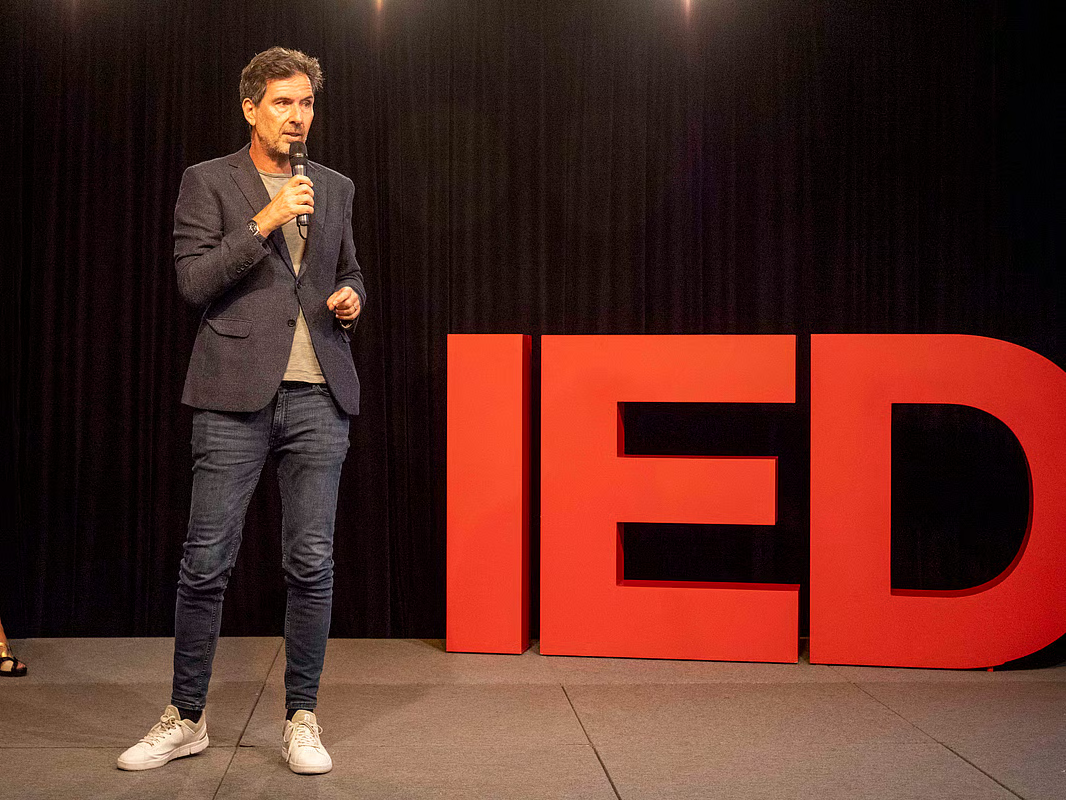
In an era of digital transparency, strategist Jürgen Salenbacher explains why Middle Eastern executives are treating leadership identity as critical economic infrastructure—not self-promotion.
SHARJAH – In a global economy increasingly defined by digital visibility and public scrutiny, personal branding has evolved from a peripheral marketing tool into a fundamental pillar of executive leadership. Across growth-driven markets like the UAE and Saudi Arabia, a leader’s reputation is now viewed as a tangible asset that directly influences commercial success.
According to Jürgen Salenbacher, a Barcelona-based personal brand strategist and author who has coached over 14,000 professionals across more than 100 countries, the shift is driven by one core commodity: trust. “Trust has become the new currency of leadership,” Salenbacher asserts. “In a fast-moving, globalized environment, stakeholders don’t just evaluate the business model; they evaluate the person driving it.”
This recalibration of priorities comes as the line between corporate identity and individual leadership blurs. In the Gulf region, where business culture is deeply rooted in long-term relationships, a visible and authentic leader gains a distinct competitive edge. Salenbacher notes that investors, top-tier talent, and strategic partners are now making decisions based on the credibility of the founder or CEO just as much as the balance sheet.
Beyond Visibility: The Infrastructure of Trust
Contrary to the common misconception that personal branding revolves around self-promotion or social media volume, Salenbacher argues that true leadership presence is about “strategic clarity.” He frames visibility not as an option, but as “strategic infrastructure.”
“During times of rapid transformation—driven by AI, generational shifts, and regional expansion—a leader who communicates with coherence reduces uncertainty,” he explains. This introduces the concept of “reputational sustainability.” Unlike environmental sustainability, which focuses on external impact, reputational sustainability is built internally through consistency. “Stakeholders do not trust perfection,” Salenbacher warns. “They trust reliability. A sustainable personal brand is built on alignment—where values match decisions and character matches communication.”
The Network Economy
In global hubs like Dubai, where cultural intelligence is paramount, leaders must navigate diverse audiences while maintaining a distinct core identity. Salenbacher observes that modern strategy is no longer a one-way projection but a continuous dialogue.
Furthermore, in the Gulf Cooperation Council (GCC) region, where networks function as a form of economic currency, a strong personal brand amplifies a leader’s leverage. “Strong networks reduce friction and accelerate opportunity,” Salenbacher states. “Real influence is built through contribution, not extraction. It’s systemic.”
As the Middle East cements its role as a laboratory for next-generation leadership, the takeaway is clear: In a trust-driven economy, a leader’s identity is no longer just a reflection of the company—it is a primary driver of its growth.




 United Arab Emirates Dirham Exchange Rate