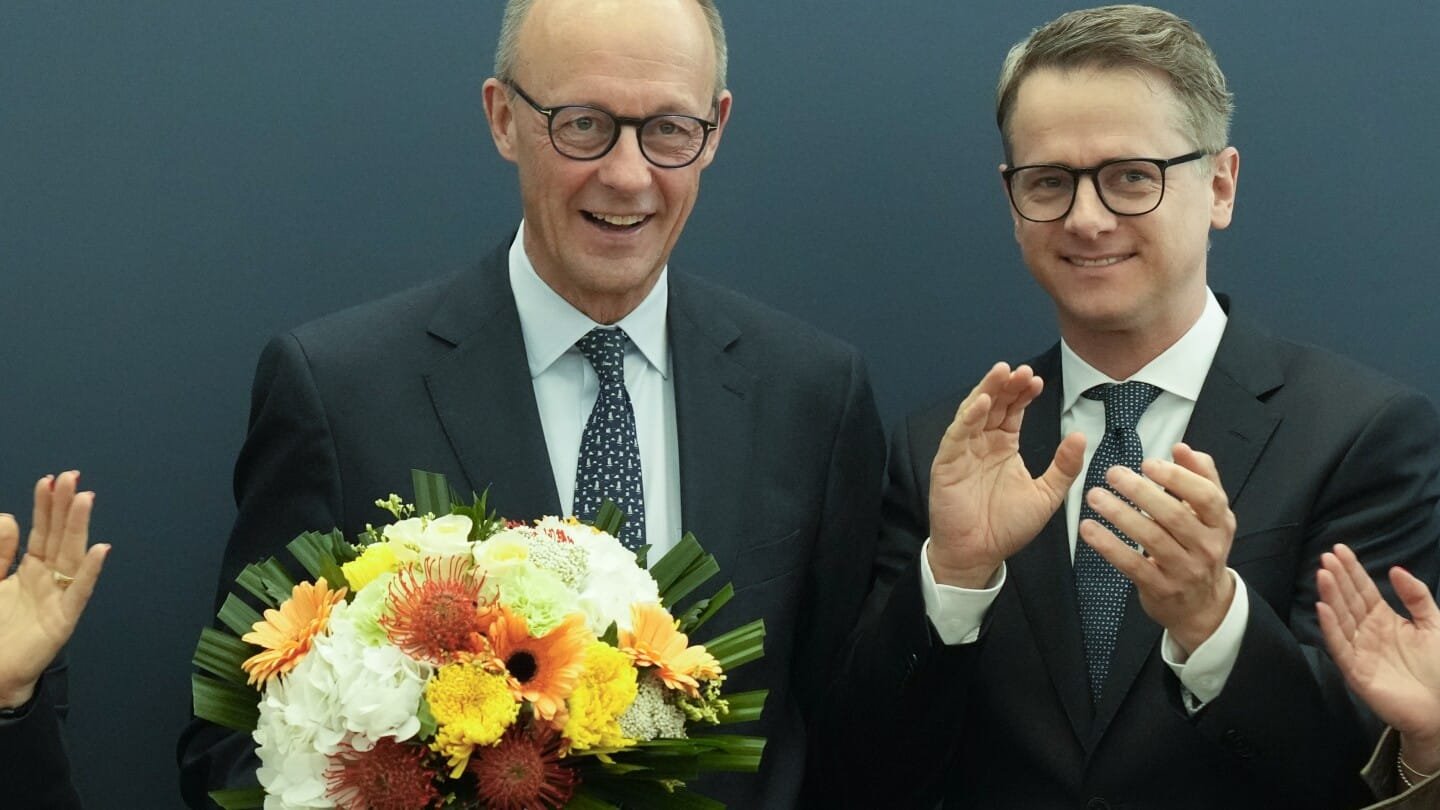
BERLIN (news agencies) — Germany faces its second change of leader in fewer than four years after the head of the center-right opposition, Friedrich Merz, won Sunday’s election, which saw a surge for a far-right party and a stinging defeat for outgoing Chancellor Olaf Scholz.
After the collapse of Scholz’s three-party government in November, it’s now up to Merz to restore stability to the European Union’s most populous country and traditional political heavyweight, which also has the continent’s biggest economy.
Merz has one realistic option to form a government: a coalition with Scholz’s Social Democrats. His Union bloc and its center-left rival have a combined 328 seats in the 630-seat parliament.
He says he hopes to do the deal by Easter. That’s a challenging timeframe: The possible partners will have to reconcile contrasting proposals for revitalizing the economy, which has shrunk for the past two years, and for curbing irregular migration — an issue that Merz pushed hard during the campaign. That will likely require diplomacy and a readiness to compromise that often weren’t evident in recent weeks.
It’s still a much easier task than it might have been. For hours on Sunday night, it looked likely that Merz would need to add a second center-left partner, the environmentalist Greens, to put together a parliamentary majority.
The Union and Social Democrats were post-World War II Germany’s heavyweights. But their support has been eroding for at least two decades as the political landscape has become more fragmented. Their combined showing Sunday was their weakest since the postwar federal republic was founded in 1949.
The Social Democrats had their worst postwar showing with just 16.4% of the vote. The Union had its second-worst with 28.5%. This is only the second time that the winning party polled less than 30%; the first was in 2021.






 United Arab Emirates Dirham Exchange Rate