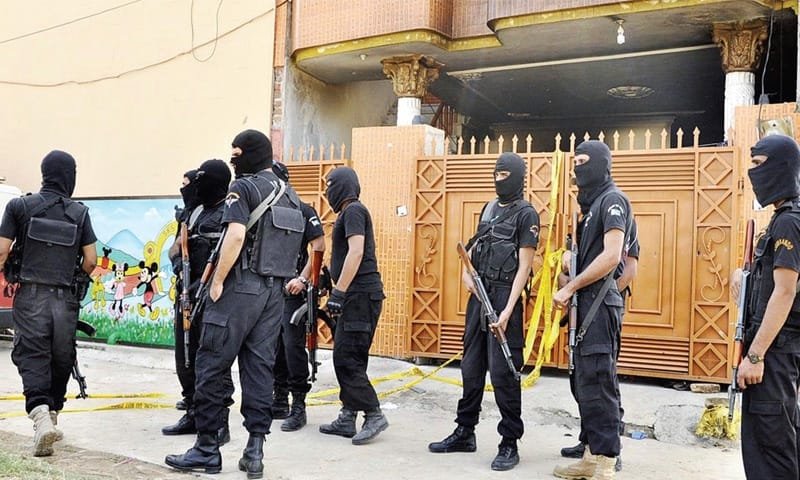
Nearly four weeks have passed since a harrowing pre-dawn raid shook the home of senior journalist Muhammad Sudhir Chaudhry in one of Lahore’s busiest residential neighborhoods. The silence since has been deafening.
Despite the outrage from civil society, condemnation from journalist unions, and persistent media coverage, not a single member of the raiding party — all allegedly in civilian clothing — has been held accountable. The trail, for now, remains cold, and with it, the faith in due process is rapidly fading.
On that fateful night, approximately two dozen individuals — believed to be law enforcement personnel — stormed the home of Muhammad Sudhir.
Instead of coming through the door, they entered the house by climbing over the walls, violating the sanctity of the veil and the four walls.
Currently abroad, Sudhir has worked in Pakistan’s mainstream television channels and newspapers for over twenty-four years. Their search whole house and demand: the whereabouts of Mr. Sudhir Chaudhry. When my brother asked him about this raid thet brutally beat him before the family.
But the incident turned into something far more sinister. In the absence of the journalist himself, his wife, children, elder brother, and his brother’s family bore the brunt of the raid. What should have been an operation guided by legal norms and ethical conduct devolved into an episode of intimidation and outright harassment.
In a climate already fraught with pressures on freedom of expression and the shrinking space for independent journalism, this raid represents not just a physical intrusion, but a symbolic assault on press freedom in Pakistan. The Lahore Press Club was quick to denounce the raid, calling it an “unforgivable act of terror against a journalist’s home.” Other media associations followed suit, demanding immediate action and transparency.
Yet despite this growing chorus, the police response has been stunningly inadequate. A case has indeed been registered — but, tellingly, against “unidentified persons.” This vague classification, in a context where officials moved in large numbers and reportedly without uniforms or warrants, has served less as a step toward justice and more as a bureaucratic escape hatch.
The inquiry, currently led by the SSP Discipline, has revealed disturbing indications. Mr. Chaudhry and his family suspect that two sub-inspectors from the local police station were directly involved. These suspicions are not baseless; they stem from behavioural patterns, prior interactions, and alleged informal admissions. While the two officers in question have privately pleaded innocence to brother of Chaudhry, they have not yet been formally exonerated or subjected to meaningful scrutiny.
What message does this send to the wider journalistic community? When journalists and their families are subjected to violent, state-style raids — and the institutions tasked with protecting them opt for ambiguity, delay, or deflection — it sends a chilling signal. It undermines not only the safety of media professionals but also the broader social contract between citizens and the state.
“The rot runs deep into the very structure of law enforcement, we are left to question who watches the watchmen,” said Muhammad Murtaza, a human rights advocate and development leader.
Mr. Chaudhry, a veteran journalist with a long-standing reputation for fearless reporting, has kept a low profile since the incident, understandably fearing for the safety of his loved ones. His silence, however, is not surrender — it is a reflection of the gravity of his circumstances and a society where speaking truth to power increasingly comes at a personal cost.
The path forward must begin with a clear, impartial, and transparent investigation. If the alleged officers are innocent, they must be cleared formally. If not, justice must be swift, decisive, and public. Moreover, there must be a full accounting of how such a raid — lacking warrants, oversight, or identification — could be allowed to occur in the first place.
In a nation as vibrant and resilient as Pakistan, the press has always stood as a pillar of democratic hope. But when its defenders are dragged from the safety of their homes into the shadows of fear, the system begins to fracture.
This case must not be another entry in the long ledger of unresolved violations. For the sake of the press, public accountability, and Pakistan’s democratic future, impunity cannot be the final verdict.
Over the past two decades, Pakistan has witnessed a deeply troubling pattern of violence and intimidation against journalists, raising serious concerns about press freedom in the country. According to data compiled by the Committee to Protect Journalists (CPJ), more than 90 journalists have been killed in Pakistan since 2000, with a significant number targeted specifically for their work. Many of these cases remain unresolved, reflecting a climate of impunity that emboldens perpetrators and silences dissenting voices.
Alongside the killings, a growing number of journalists have been forced into exile due to sustained harassment, threats, arbitrary arrests, censorship, and, in some cases, physical attacks. Estimates by media watchdogs suggest that dozens of Pakistani journalists are currently living abroad in self-imposed exile, seeking safety in countries like the United Kingdom, Germany, the United States, and Canada. These exiled voices include prominent anchors investigative journalists who have spoken critically of powerful state institutions.
Prominent journalists including Kashif Abbasi, Arif Hameed Bhatti, Habib Akram, Moeed Pirzada, Sabir Shakir, Imran Riaz, Shakir Mehmood Awan, three times Lahore Press Club Secretary Sajid Hussain, Rizwan Razi, Shahid Hussain, Waheed Hussain and many other have faced the wrath of the powers that be in Pakistan. The television programmes some of these journalists were put off the air. Others were picked by the law enforcement personnel on civvies from their homes or outside offices for weeks and months as a punishment for not toeing the line of the decision makers of the country. Many of the victims lost their jobs as the media outlets where they worked could not sustain the strong arm tactics of the law enforcement agencies.
This exodus reflects not just a personal tragedy for the journalists themselves, but a broader assault on democratic values. The curbs on free speech—manifested through legal persecution, enforced disappearances, social media restrictions, and advertising boycotts—have severely undermined independent journalism in Pakistan. As a result, the national media landscape has become increasingly polarized, subdued, and vulnerable to manipulation. Unless urgent and credible reforms are introduced to protect press freedom, Pakistan risks further isolating itself from the principles of transparency, accountability, and democratic integrity.



 United Arab Emirates Dirham Exchange Rate