
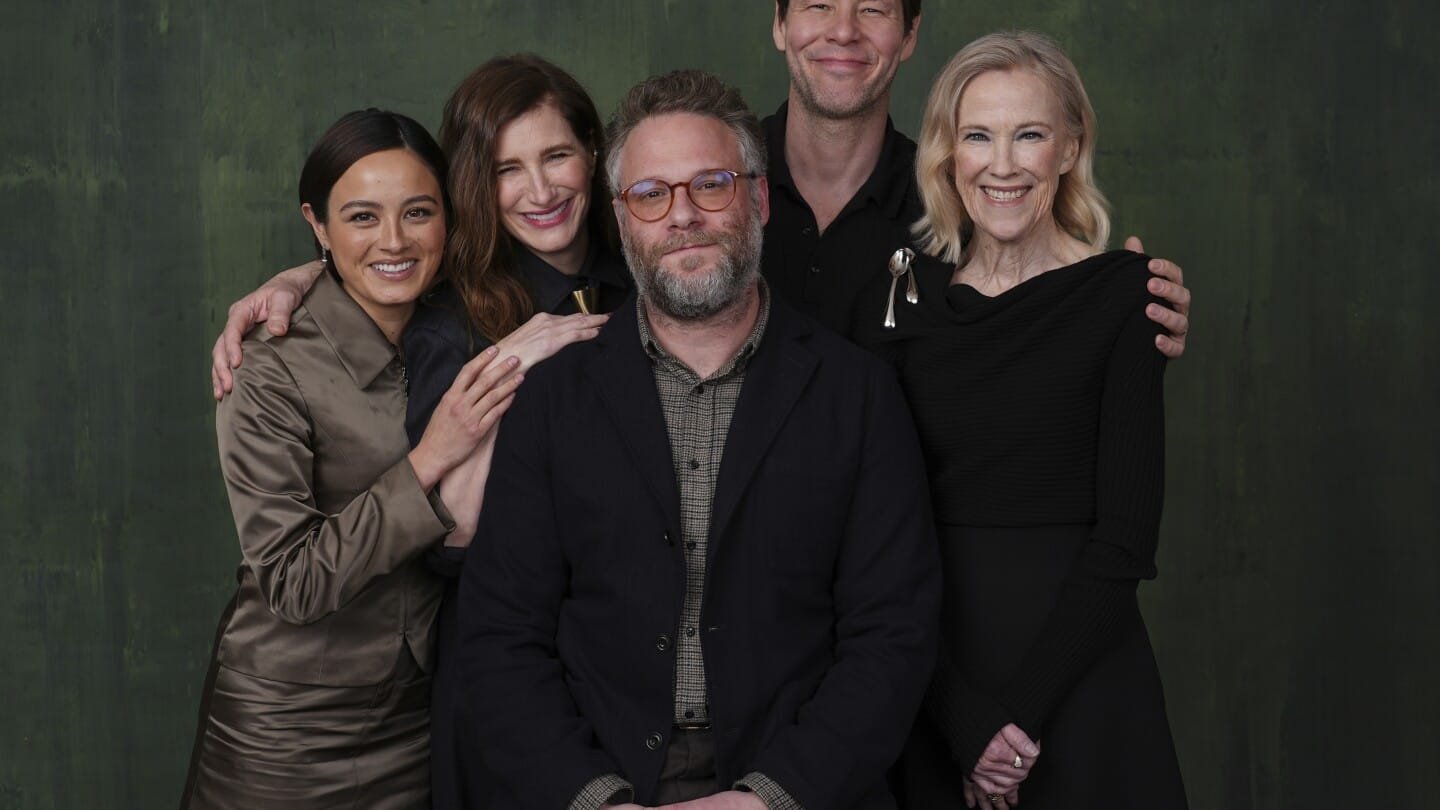
NEW YORK (news agencies) — The studio head has historically been seen as a fearsome and all-powerful figure, capable of ending a career with the snap of a finger or changing lives with an impulsive greenlight. In “The Studio,” though, Seth Rogen’s studio chief is more Selina Meyer (“Veep”) than Louis B. Mayer.
As much as Rogen’s Matt Remick, head of the fictional Continental Studios, sits in a sought-after seat of power, he’s helpless against larger trends in the film industry. He wants to be making “Chinatown,” but instead his most important task is getting a Kool-Aid movie off the ground. Bryan Cranston’s Continental chief executive asks: Can he do this? “Oh, yeah!”
“As pitiful as it is, the conflict that my character lives and breathes every second of his life is one a lot of people with his job are facing in real life,” Rogen says. “They love movies. They’re also responsible to a very specific bottom line and they have to defend the choice they make to a board of people who don’t give a s— about movies.”
“The Studio,” the 10-episode series debuting Wednesday on Apple TV+, may be the definitive portrait of contemporary Hollywood. If movies like “Singin’ in the Rain” and “The Player” captured the movie industry in full swagger, “The Studio” belongs to a more desperate chapter where even the all-powerful feel impotent. Studio heads, too, must tolerate conversations with people who haven’t been to the movies in ages, but who loved “The Bear.”
In a recent interview, Rogen and Goldberg, the longtime writing, producing and directing duo behind “Superbad,” “Pineapple Express” and “This Is the End,” said “The Studio” isn’t quite a Hollywood postmortem, no matter how much Cranston’s performance in the helter-skelter CinemaCon-set finale verges toward “Weekend at Bernie’s” territory.
“We’re people who have been given great lives from this industry who, in general, though it’s been very frustrating, have gotten to do what they want,” Rogen says. “The show is very specifically written from the perspective of people that think things can work out in Hollywood.”
There always is, and probably always will be, reason for optimism in Hollywood. The next big hit is perpetually just around the corner. But as audiences have become increasingly distracted by streaming, TikTok and video games, the film industry — or at least the major studio version of it — has turned into an IP-factory, hoping that franchises, superheroes and horror can sustain itself.
There’s still time for a turnaround (there’s that optimism again), but ticket sales in 2025 are down 6.9% from last year and 38.6% from 2019, according to Comscore. The trends are worse if you look at tickets sold rather than dollars earned, since large-format screens beef up ticket prices.
More than that, though, “The Studio” — with a boatload of cameos of everyone from Martin Scorsese to Netflix chief Ted Sarandos to Zoe Kravitz — taps into a deeper demoralization. Flanked by a team of executives (Kathryn Hahn, Ike Barinholtz, Chase Sui Wonders), Remick finds himself — when not directly obstructing filmmakers he adores, like Scorsese and Sarah Polley — beset with questions over whether they’ve cast a racist Kool-Aid movie, if their “Smile” knockoff “Wink” can work or how to sell a movie with zombie diarrhea.
Matthew Belloni, the former editor of The Hollywood Reporter and founding partner of the media company Puck, appears as himself in the series. He says that there’s truth underlying almost every scene in the “The Studio,” “for better and mostly worse.”
“It captures the existential dread that seems to permeate every conversation,” says Belloni. “People recognize that the glory days of Hollywood are over and the whole concept of what Hollywood even means is being redefined. And that has caused everybody in town to go completely crazy. This show captures that craziness very, very well.”
“The Studio” isn’t the first time Rogen and Goldberg have had a role in revealing the inner workings of a Hollywood studio. When their 2014 North Korean comedy “The Interview” led to the hacking of Sony Pictures, the studio’s private correspondence landed on the internet.
“Without ‘The Interview,’ a show like this would have been much harder for us to write,” Rogen says, chuckling. “We got to the CEO-level of problem.”
Those problems ultimately included Sony Pictures co-chair Amy Pascal stepping down. Pascal, who has since been a highly successful producer, has remained a mentor to Rogen and Goldberg. In “The Studio,” she’s fictionalized by Catherine O’Hara as a savvy producer and Remick’s former boss.
“One of the biggest misconceptions people seem to have with Hollywood is that it’s run by people who only care about money and don’t at all care about film,” Rogen says.
“There’s a few of those people,” Goldberg chimes in.
“They are out there, for sure,” continues Rogen. “But in general, the people who have ascended to Amy’s level to run studios are people who love movies and can sit in a room with the greatest filmmakers on earth and have an on-the-level conversation about filmmaking.”
Rogen and Goldberg, who created the show with Frida Perez and a pair of “Veep” veterans in Peter Huyck and Alex Gregory, began developing “The Studio” during the pandemic. Then, they thought it really might be a satirical elegy for Hollywood. The twin blockbusters of “Barbie” and “Oppenheimer,” though, prompted them to give the series a more hopeful spin. But they were never short on fodder.
“Most of it is very directly from our lives,” Goldberg says.
“As soon as we thought of it, we thought of a hundred episode ideas,” adds Rogen.







 United Arab Emirates Dirham Exchange Rate