US president declares sanctions have ‘served their purpose’ and this gives Syria ‘a chance at greatness’.
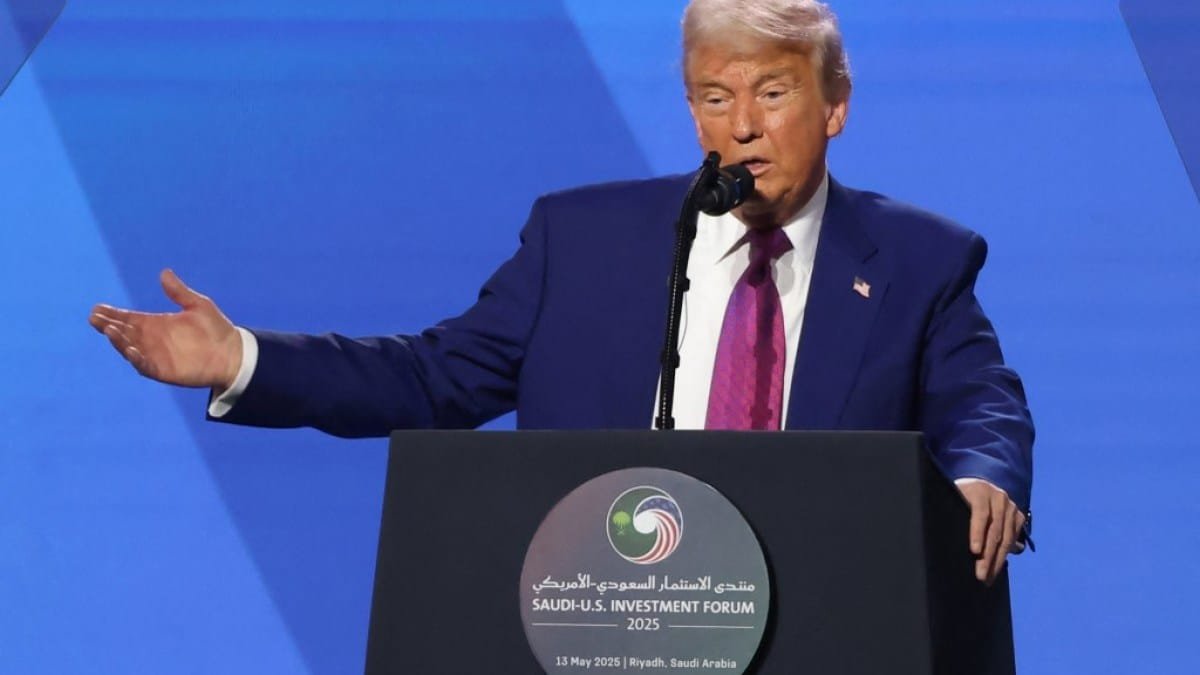
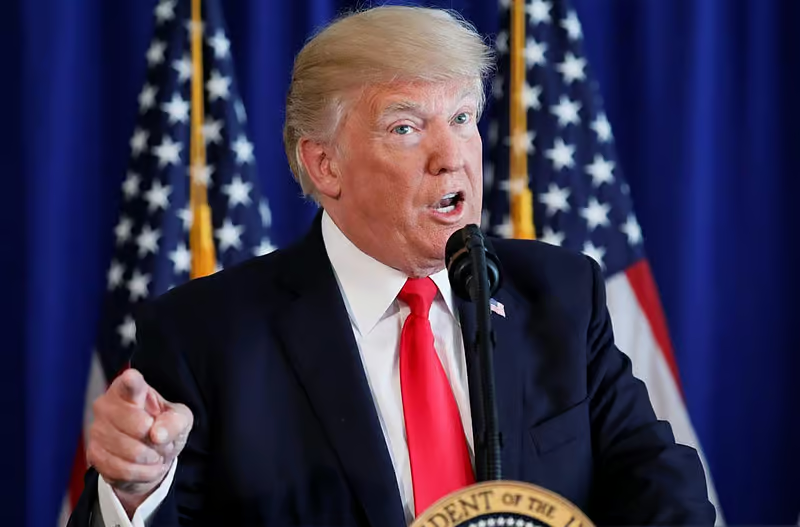
United States President Donald Trump has announced that he will lift all sanctions on Syria, declaring that it was time for the country to “move forward”, giving a nation devastated by years of ruinous civil war a crucial opening in reviving its shattered economy.
Speaking at an investment forum in Saudi Arabia’s Riyadh during his Middle East tour on Tuesday, Trump said the punitive measures had achieved their “purpose” and were no longer needed.
“I will be ordering the cessation of sanctions against Syria in order to give them a chance at greatness,” he said. “It’s their time to shine. We’re taking them all off”.
The president ended his remarks with a direct message to Damascus: “Good luck, Syria. Show us something very special.”
The announcement marks a dramatic shift in Washington’s yearslong policy towards Syria, where sanctions targeted ousted President Bashar al-Assad’s government during years of war, and the country at large over its crackdown on dissent and human rights abuses during that nearly 14-year period.
Syrians suffered hundreds of thousands of deaths, and millions were displaced during the war.
“There’s a new government that will hopefully succeed in stabilising the country and keeping peace,” Trump said in Riyadh, referring to the interim government led by President Ahmed al-Sharaa.
Later Tuesday, media Arabic reported that al-Sharaa will meet with Trump in Saudi Arabia on Wednesday, according to the Director of Relations at Syria’s Ministry of Information.
media’s Senior Political Analyst Marwan Bishara questioned the motives behind Trump’s decision to lift sanctions and what Damascus is prepared to give in return.
While noting that talks are expected between the US and Syrian top diplomats, Bishara asked, “But then what?”
Bishara said that the US had previously laid out conditions for any rapprochement with the new Syrian government, including reported crackdowns on Palestinian groups and possible normalisation with Israel. “There’s also been talk about normalisation with Israel—that the new Syria will join the Abraham Accords at the expense of the Palestinians,” he said.
The sanctions relief will be welcomed by al-Sharaa’s government, which also says it wants to transition away from the corrupt system that gave al-Assad loyalists privileged access to government contracts and kept key industries in the hands of the al-Assad family and its Alawite base.
Omar Rahman, a fellow at the Middle East Council on Global Affairs, says that while it is important not to overestimate the significance of Trump’s promise to lift sanctions on Syria, it is an important step in the future of a nation devastated by years of war.
Key obstacle removed, but others remain
“It takes away a key obstacle in their ability to establish some kind of economic development, economic prosperity,” he told media. “But there are plenty of other obstacles and challenges the country is facing.”
Rahman said that Saudi Arabia helped push the US towards its decision to drop sanctions.
Syria’s new government has sought to rebuild the country’s diplomatic ties, including with international financial institutions. It also counts on wealthy Gulf Arab states to play a critical role in financing the reconstruction of Syria’s war-ravaged infrastructure and reviving its economy.
Saudi Arabia and Qatar announced in April that they will settle Syria’s debt to the World Bank totalling roughly $15m.
The United Kingdom has also removed its sanctions on 12 Syrian government entities, including the Ministries of Defence and Interior and the General Intelligence Directorate.
But military attacks persist.
Israel has carried out multiple air strikes in Syria since al-Assad’s removal. The country’s presidency denounced an Israeli attack near the presidential palace in Damascus as a “dangerous escalation” earlier this month.
Tensions between Israel and Syria soared after the Israeli government accused the Syrian authorities of failing to protect the country’s Druze minority.
The Syrian government and Druze came to an agreement after days of violence, the latter saying they did not need Israel’s intervention or protection.
Israel has previously called Syria’s interim government a “terror group from Idlib that took Damascus by force”.
Bishara warned against ignoring Israel’s role in destabilising Syria. “The one that occupies Syrian territory … is Israel, which is intervening in Syria, trying to divide and weaken it,” he said. He urged US officials to pressure Israel to halt its interference as sanctions are lifted and Syria attempts to rebuild.
A February report by the United Nations Development Programme (UNDP) estimated that at current growth rates, Syria would need more than 50 years to return to the economic level it had before the war, and it called for massive investment to accelerate the process.
The UNDP study said nine out of 10 Syrians now live in poverty, one-quarter are jobless and Syria’s gross domestic product (GDP) “has shrunk to less than half of its value” in 2011, the year the war began.

 United Arab Emirates Dirham Exchange Rate