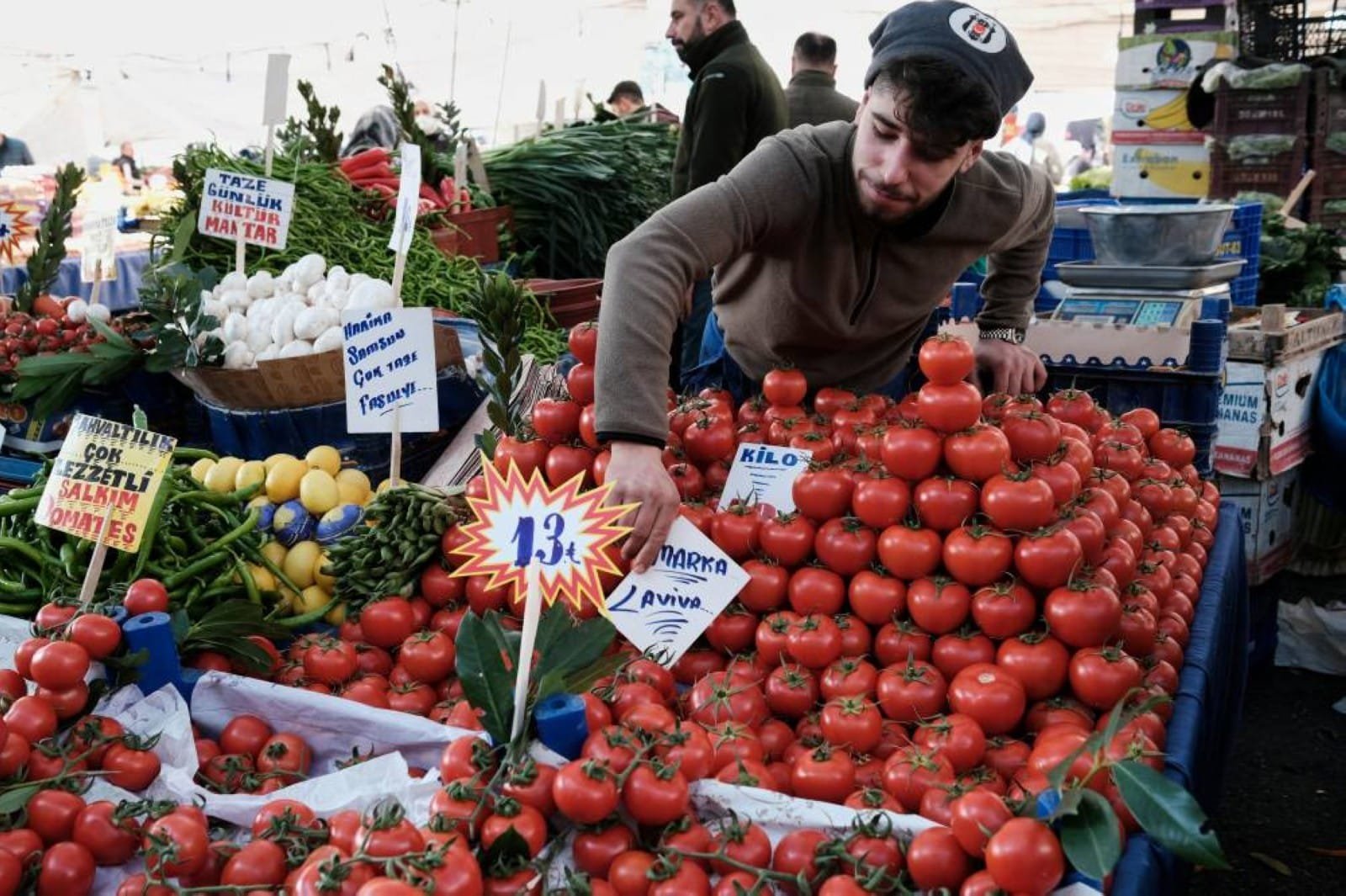
A Turkish regulation lowering patients’ co-payments at public hospitals recently helped to rein in price growth, prompting some analysts to trim their February inflation expectations.
Monthly inflation stood at 2.27 per cent, the Turkish Statistical Institute said, also below forecasts. In January, inflation had stood at 5.03 per cent on a monthly basis and 42.12 per cent on an annual basis.
“We expect the steady decline in inflation to continue thanks to fiscal and income policies that support the disinflation process and the improvement in expectations,” Finance Minister Mehmet Simsek said on X.
“We will resolutely implement our policies to achieve price stability, which will permanently improve the purchasing power and income distribution of our citizens,” he added.
Annual inflation in the key food and non-alcoholic drinks sector was lower than the headline rate, at 35.11 per cent. Price hikes were led by a 94.9 per cent rise in education prices, while housing prices were up 70.81 per cent.
The lira firmed slightly to 36.4775 against the dollar on Monday, from a close of 36.5310 on Friday.
The central bank cut its policy rate to 45 per cent from 50 per cent in December, having kept it steady in the preceding eight months, and is set to hold its next policy-setting meeting on Thursday.
Previously, the bank raised its key rate 4,150 basis points to cool inflation in a shift to orthodox policy, after years of low rates aimed at fostering growth.
The domestic producer price index rose 2.12 per cent month-on-month in February for an annual rise of 25.21 per cent, the data showed.
The UAE and Turkey have seen a rapid expansion of their economic and investment partnership. Recent years have witnessed UAE investments in Turkey exceeding $6 billion, complemented by Turkish investments in the UAE surpassing $3 billion.
Burak Dağlıoğlu, President, Investment Office of the Presidency of Turkey, told the Emirates News Agency on the sidelines of the Investopia 2025, which opened in Abu Dhabi today, that bilateral investment flows are expected to grow further, driven by the Comprehensive Economic Partnership Agreement (CEPA), which has strengthened investment exchanges between the two nations.
He emphasised that Turkish companies are keen to inject significant investments into the UAE and expand their global presence by leveraging the UAE’s position as a global trade hub.
Dağlıoğlu added that Turkey presents compelling investment prospects for UAE investors, leveraging its extensive trade network, including the EU Customs Union and 30 free trade agreements, which provide access to a market exceeding one billion consumers.
He further explained that Turkey has made substantial investments in its infrastructure, making it one of the most connected countries in the region, pointing out that Istanbul alone provides access to 1.3 billion people, with the counter’s GDP approaching $1.2 trillion.
He stressed the importance of enhancing investment dialogue between the two countries, noting that the future of UAE-Turkish cooperation holds great potential for mutual growth.
Meanwhile Murat Efe, Founder and Chairman of the Turkish-Arab Economic Forum, stated that Turkish-Arab economic relations are continuously developing, with trade between the two sides exceeding Dhs200 billion in 2024.
Efe highlighted that the Turkish-Arab Economic Forum is focused on enhancing economic relations with the Gulf Cooperation Council (GCC) countries and North Africa. He noted that more than 80 per cent of Türkiye’s foreign trade is with Central Asia, the Middle East, Europe, and North Africa.
He also pointed out that Turkey’s GDP is approaching $1.2 trillion, and that 80 per cent of its foreign trade reflects a clear expansion in its economic relations.
Last month, the second session of the political consultations between both Ministries of Foreign Affairs of the United Arab Emirates and the Republic of Turkey was launched on 24th January in the Turkish capital, Ankara.






 United Arab Emirates Dirham Exchange Rate