Pentagon document signals potential reduction in U.S. troop posture as focus pivots to China; Seoul boosts defense budget amid regional tensions.
WASHINGTON — The Pentagon unveiled a strategic shift in its approach to Northeast Asia on Friday, announcing that South Korea should assume the “primary responsibility” for deterring North Korea with “more limited” U.S. support—a move that could prescale down the American military footprint on the Korean Peninsula.
The updated National Defense Strategy, released by the Department of Defense, explicitly states that “South Korea is capable of taking primary responsibility for deterring North Korea with critical but more limited U.S. support.” This realignment, the document notes, supports Washington’s interest in “updating U.S. force posture” in the region.
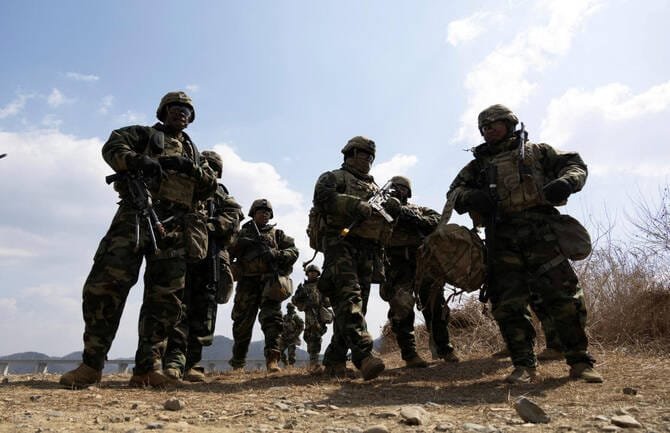
Currently, about 28,500 U.S. troops are stationed in South Korea as part of a longstanding combined defense framework. In recent years, U.S. officials have expressed a desire to make these forces more flexible, potentially deployable beyond the peninsula—including in contingencies involving Taiwan or Chinese military expansion.
Seoul has consistently resisted any change to the U.S. troop mission but has steadily built up its own defense capabilities. South Korea increased its defense budget by 7.5% this year and maintains an active-duty force of 450,000 troops, with a long-term aim to assume wartime operational control of combined forces.
The Pentagon’s strategy identifies China as the “pacing challenge” in the Indo-Pacific, emphasizing the need to prevent Beijing from dominating the region or U.S. allies. While not naming Taiwan directly, the document advocates for a “decent peace” that both the U.S. and China can accept—a delicate balance amid ongoing tensions over the island, which Beijing claims as its own.
The strategy also addresses other global hotspots:
- Iran: Described as seeking to rebuild its military and potentially pursue nuclear weapons, even as the U.S. reinforces its military presence in the Middle East.
- Europe: The U.S. commits to remaining engaged with NATO but will prioritize challenges from China and homeland defense. Russia is assessed as a “persistent but manageable” threat to Eastern Europe.
- Arctic Access: The document notes the administration’s efforts to secure strategic access in regions like Greenland, countering growing Russian and Chinese activity.
Top Pentagon policy official Elbridge Colby is scheduled to travel to Asia next week, with a stop in South Korea anticipated to discuss the strategic transition.
The strategy reaffirms the Trump administration’s focus on shifting burden-sharing responsibilities to allies and reorienting U.S. forces toward great-power competition, particularly with China.






 United Arab Emirates Dirham Exchange Rate