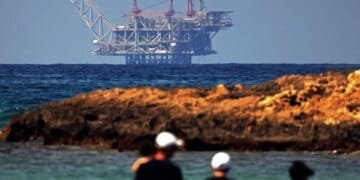

Officials hope the deal will help tackle the foreign exchange crunch and stabilise food prices
A deal between Egypt and the UAE to develop the coastal city of Ras Al Hikma, under which Cairo will receive $35 billion, will provide a big boost to the country’s economy, analysts say.
The deal, signed between Egypt’s government and the Abu Dhabi Developments Holding Company (ADQ) on Friday, comes as the North African country continues to struggle with a foreign exchange crunch.
In turn, this has brought much of its import-reliant industries to a grinding halt and raised the cost of living to unprecedented heights.
A total of $150 billion will be invested to develop Ras Al Hikma into a “fully functional urban community and not just a beach resort”, Egyptian Prime Minister Mostafa Madbouly said.
He did not specify when the project would be completed.
An ADQ-led consortium acquired the rights to develop 130 million square metres along Egypt’s north coast from the Egyptian government, in exchange for $24 billion, the company said.
Additionally, $11 billion of Emirati deposits in Egypt’s central bank would be relinquished to allow “for investment in prime projects across Egypt to support its economic growth and development”, said ADQ.
Egypt’s government will keep a 35 per cent stake in the development, work on which will start in early 2025, ADQ said.
“This deal is huge for Egypt, especially when coupled with the expected agreement with the IMF [International Monetary Fund] that will undoubtedly be facilitated by this agreement,” Monica Malik, chief economist at Abu Dhabi Commercial Bank, told media.
The first tranche of the investment, amounting to $10 billion, will be deposited into Egypt’s central bank within a week of Friday, Mr Madbouly said, adding that the second tranche of $14 billion will be deposited within two months.
The sheer size of the investment – the largest in Egypt’s history – is expected to narrow the gap between the Egyptian pound’s official exchange rate, 31 pounds to the dollar, and the rate on the country’s parallel markets, which went up to 72 pounds in late January.
Unifying the exchange rate was a key request from the IMF, which is currently in discussions with Egypt for another round of funding, the country’s fourth since 2016.
Following a failure by Egypt’s banks and other financial institutions to secure dollars needed for imports, companies have since 2022 increasingly turned to the black market for foreign currency, which resulted in the sharp rise in the parallel exchange rate.
“The cash deposits really are substantial and the largest in the country’s history. Previously, the largest direct investment that Egypt had received was in the financial year 2007/2008 and it was a sum of around $13 billion,” said Ahmed Ghoneim, a professor of economics at Cairo University.
“So, it is safe to say that they will give the country some breathing room for two or three years.”
The timing of the deposits is particularly fortuitous, as it will probably result in a drop in the price of food items ahead of the holy month of Ramadan, which is set to begin around March 10, said Mr Ghoneim.
Ramadan is typically marked by high consumption among Egypt’s Muslim majority.
“One immediate benefit of the deposits will be that imports will be cleared much more easily, which will result in an immediate drop in food prices, especially ones sold under government welfare initiatives. This is particularly important as the population gears for Ramadan when their consumption increases,” Mr Ghoneim told media.


 United Arab Emirates Dirham Exchange Rate