
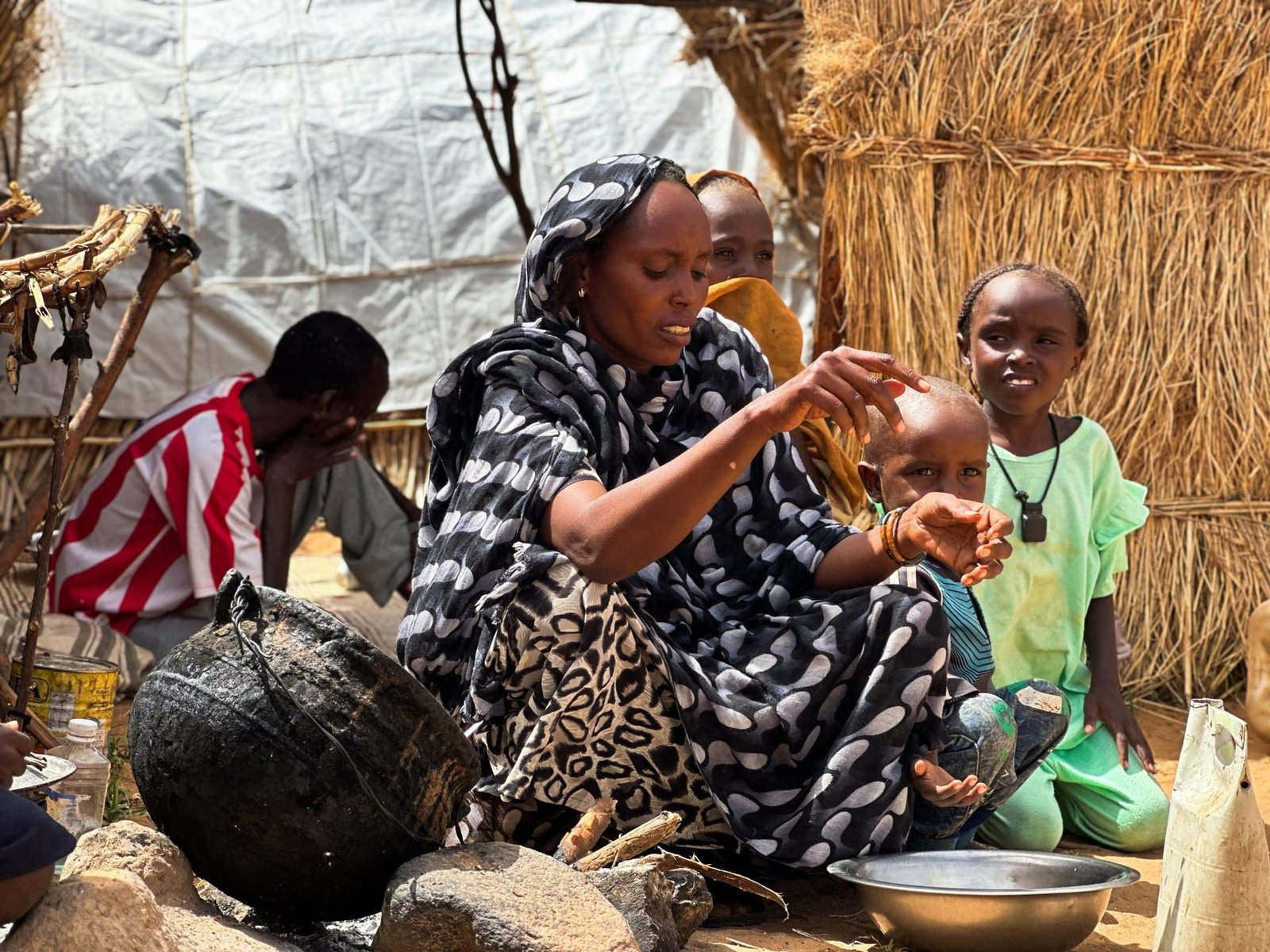
A deadly cholera outbreak adds to the misery in a region that has witnessed fighting between the army and the rebels.
People in Sudan’s North Darfur region are forced to eat animal fodder to survive as the paramilitary Rapid Support Forces (RSF) continues to lay siege to el-Fasher – the last urban centre in the region under army control.
“We are suffering, world. We need humanitarian aid – food and medicine – whether by airdrop or by opening ground routes. We cannot survive in this condition,” Othman Angaro, from a displacement camp in el-Fasher, told media.
Angaro described how he and his family rely on livestock fodder known as ambaz, a type of animal feed made out of peanut shells.
Another woman, veterinarian Zulfa Al-Nour, told media that her family relies daily on a charity kitchen called “Matbakh Al-Khair” for a single meal, amid a total lack of external aid.
She called for urgent international intervention, including airdrops of humanitarian supplies, warning that even the ambaz fodder is nearly depleted.
The Integrated Food Security Phase Classification (IPC) last week warned about starvation in the el-Fasher region. Starvation has reached the most severe level on the United Nations-backed food security scale – ‘IPC Phase 5’, indicating full-blown famine – it said on Friday.
The two-month siege of el-Fasher has complicated aid efforts.
The RSF has blocked food supplies, and aid convoys trying to reach the city have been attacked, locals said. Prices for the goods smuggled into the region cost more than five times the national average.
At least 62 people have died from the disease in Tawila in the North Darfur state, the spokesman for the General Coordination for Displaced Persons and Refugees in Darfur, Adam Rijal, said in a statement on Monday.
Nearly 100 people have also died in the Kalma and the Otash camps, Rijal added, both displacement camps located in the city of Nyala in South Darfur state.
Some 4,000 cases of cholera have been reported in the region, according to the statement.
In recent months, more than half a million people have taken shelter in Tawila, some 60km (37 miles) west of el-Fasher, the state capital, which has been under two months of siege by the RSF rebels. Most of the Darfur region is under the rebel control except for el-Fasher.
Outbreak of cholera
Meanwhile, with Sudan in the throes of the rainy season, along with poor living conditions and inadequate sanitation, the outbreak of cholera is only worsening, warn aid groups.
Doctors Without Borders, or MSF, is operating two cholera treatment facilities in Tawila housing 146 beds – coordinating nearly the entire medical response to the outbreak.
Last month, it warned that “much more” needs to be done to improve “access to water, hygiene, and medical care to curb the spread of the outbreak in the midst of the rainy season”.
Samir, a former teacher displaced to el-Fasher with his family, told Avaaz last week that the situation was “catastrophic” and that the cholera outbreak was being exacerbated by widespread hunger.
“People are dying because they are too weak to survive,” he told the NGO.
“Their immune systems are compromised from severe malnutrition. People are starving in the displacement camps.”
Translation: “The city of el-Fasher in North Darfur state, western Sudan, is experiencing a deadly famine due to the siege imposed on it by the Rapid Support Forces backed by the Emirates. The famine has reached the fifth stage, meaning a full-scale famine and a catastrophic situation. Speak about them.”
Meanwhile, fighting continues.
“The RSF’s artillery and drones are shelling el-Fasher morning and night,” one resident told the Reuters news agency.
“The number of people dying has increased every day, and the cemeteries are expanding,” he said.



 United Arab Emirates Dirham Exchange Rate