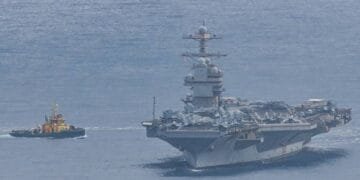
Houthis reported renewed attacks on Yemen on Sunday, an allegation denied by the US
Live updates: Follow the latest news on Israel-Gaza
Western leaders are increasing communication with the Houthi militia group and its backers in Iran after the US and Britain, backed by Canada and Australia, launched dozens of air strikes against Houthi positions in Yemen.
The Iran-backed Houthis reported renewed US and British strikes hit the rebel-held port city of Hodeidah in western Yemen on Sunday night, which the US later denied.
“Air strikes from the American-British aggression hit Hodeidah,” reported the rebel group’s Ansar Allah news website, marking the third consecutive day of reported strikes on the group over its attacks on Red Sea shipping.”
But a US defence official said after reports of the attack: “No US or coalition strike occurred today.”
US President Joe Biden said on Saturday that the White House had delivered a private message to Tehran about the strikes against the Houthis, which followed a series of militia attacks against commercial vessels in the Red Sea.
“We delivered it privately and we’re confident we’re well-prepared,” Mr Biden said at the White House before departing to the Camp David presidential retreat for the weekend.
The US is likely seeking to avoid a direct confrontation with Iran, a possible repeat of 1988’s Operation Praying Mantis, when US and Iranian naval forces clashed in the Arabian Sea after Iranian attacks on commercial shipping.
The Red Sea carries about 12 per cent of global trade, and shipping volumes have collapsed since the Houthis began their attacks there, which they claim are aimed at vessels linked to Israel, although some of the ships attacked had no connection to the country.
The threat to civilian shipping through the route, and the Suez Canal, has forced vessels to detour around South Africa’s Cape of Good Hope to reach Europe and North America, stretching supply chains and pushing up food and fuel prices, which are already high after Russia’s invasion of Ukraine.
In an interview with The Telegraph newspaper on Saturday, British Defence Secretary Grant Shapps said his message to Iran was: “We see you, we see through what you’re doing. We see how you’re doing it, particularly the Houthi rebels, and no good can come from it.”
The militia threatened a “strong and effective response” after the US carried out the strike in Yemen on Saturday, further increasing tensions as Washington vowed to protect shipping from attacks by the Tehran-aligned group.
The guided missile destroyer Carney used Tomahawk missiles “to degrade the Houthis’ ability to attack maritime vessels, including commercial vessels,” US Central Command said in a post on social media.
US National Security spokesman John Kirby said the initial strikes had hit the Houthis’ ability to store, launch and guide missiles or drones, which the group has used to threaten shipping.
He said Washington had no interest in a war with Yemen.
But British officials have suggested that the conflict might not be as short as Washington hopes. Foreign Secretary Lord Cameron warned strikes could continue if the Houthis refuse to stop attacking ships in the Red Sea.
Writing in The Sunday Telegraph, Lord Cameron said the joint action “will have gone some way to degrade Houthi capabilities built up with Iranian backing”.
But, he argued, failure to act would be equivalent to allowing the Houthis to “virtually shut a vital sea lane with relative impunity”.





 United Arab Emirates Dirham Exchange Rate