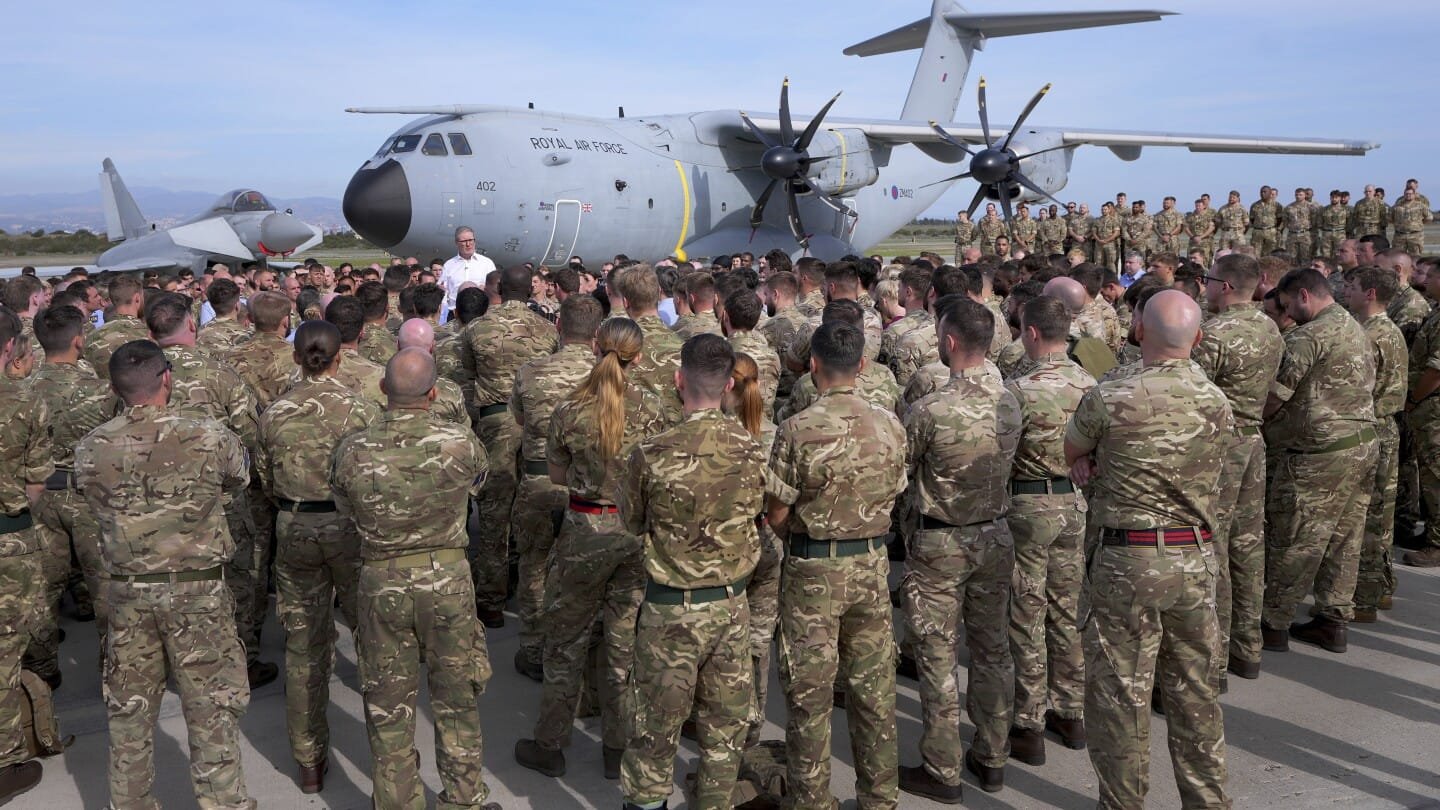
LONDON (news agencies) — As the U.S. and Russia push ahead — so far without Ukraine at the table – on talks to end the war, political and military leaders in Europe are fleshing out details of a plan for European forces to help ensure Moscow doesn’t attack again.
After months of quiet discussions, the proposal has become increasingly public. It will likely be on the agenda when U.K. Prime Minister Keir Starmer and French President Emmanuel Macron, two major backers of the idea, visit Washington on separate days next week for talks with U.S. President Donald Trump.
Starmer, who will visit Thursday, has stressed that the force won’t work without American military might to back it up. Persuading Trump to provide it could be a tall order.
The security guarantee that Ukrainian President Volodymyr Zelenskyy really wants is NATO membership. European members of the military alliance still back that goal, but the U.S. looks to have taken it off the table, along with Ukrainian hopes of regaining the 20% of its territory seized by Russia.
In the absence of NATO membership, Zelenskyy has said that more than 100,000 European troops could be needed in Ukraine to guarantee the conflict doesn’t flare up again after a ceasefire.
But Western officials say what’s being discussed is a “reassurance force,” not an army of peacekeepers posted along the 600-mile (1,000-kilometer) front line in Ukraine’s east.
The proposal supported by the United Kingdom and France would see fewer than 30,000 European troops on the ground in Ukraine — away from the front line at key infrastructure sites such as nuclear power plants — backed by Western air and sea power.
Under the plan, the front line would largely be monitored remotely, with drones and other technology. Air power based outside Ukraine — perhaps in Poland or Romania — would be in reserve to deter breaches and reopen Ukrainian airspace to commercial flights.
That could include American air power.
“There must be a U.S. backstop because a U.S. security guarantee is the only way to effectively deter Russia from attacking Ukraine again,” Starmer said on Monday.
Trump has long expressed the view that Washington’s NATO allies don’t pull their weight and that Europe must do more for its own security.
U.S. Defense Secretary Pete Hegseth has told European allies that “there will not be U.S. troops deployed to Ukraine,” but hasn’t ruled out American support such as air transport or logistics.
Gen. Keith Kellogg, Trump’s Ukraine envoy, said during a visit to NATO this week that all options must be kept on the table because the shape of any force will depend on the outcome of peace negotiations that have yet to be held.
Jamie Shea, a former senior NATO official, said that “different people in the administration are sending different signals … Who do you believe is an issue.”
It’s unclear whether Ukraine will be happy with the proposal.
Russia, meanwhile, has rejected the idea outright. Foreign Minister Sergey Lavrov said that deployment of troops from NATO nations, even if not under the banner of the alliance, “will certainly be unacceptable for us.”
The U.K., France and the Nordic and Baltic states that are the closest NATO nations to Russia appear most likely to play the main roles in any force.
Italy has constitutional limits on the use of its forces. In some countries including the Netherlands, deploying troops would need parliament’s approval.
Polish Prime Minister Donald Tusk said that his country, a key logistics base for support to Ukraine since Russia’s full-scale invasion nearly three years ago, won’t send troops into its neighbor.
After a hastily arranged meeting of European leaders in Paris this week to discuss the war, German Chancellor Olaf Scholz said talk of a Europe-led security force was “premature.” Scholz said that he was “a little irritated” that peacekeeping forces were even being discussed “at the wrong time.” He insisted NATO — not an independent European force — must remain the foundation of security.



 United Arab Emirates Dirham Exchange Rate