
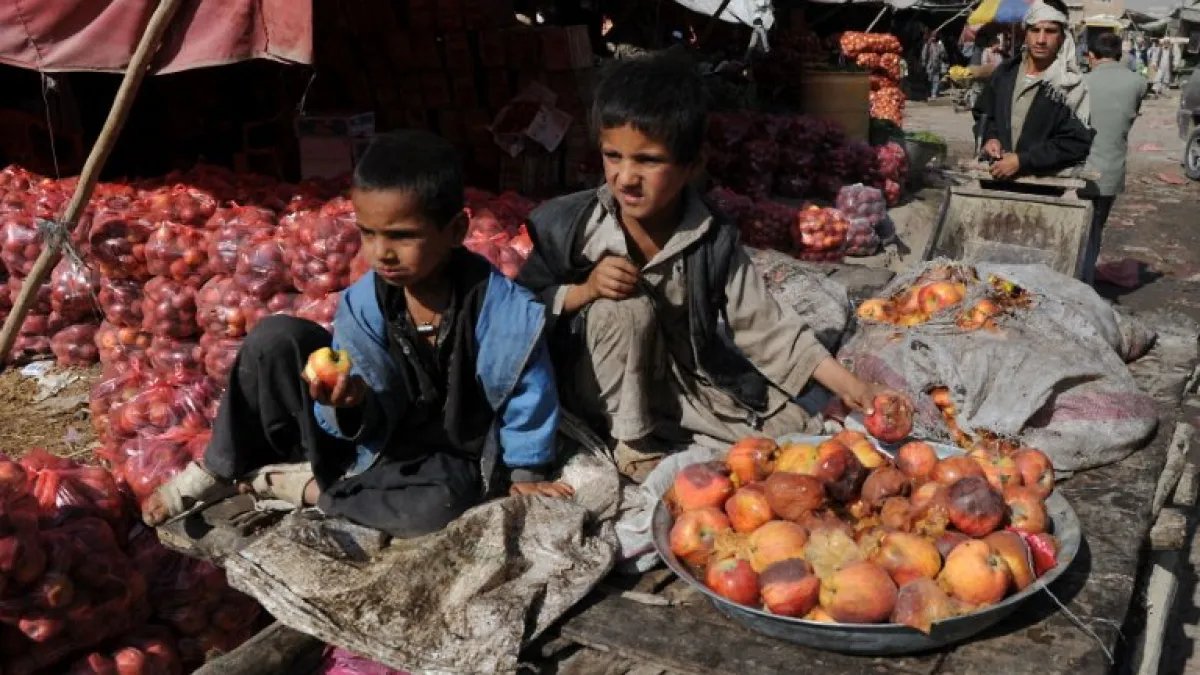
In April, I accompanied a friend on a visit to villages in Daikundi province, central Afghanistan. The purpose of the trip was to speak to farmer beneficiaries of a project that an NGO operating in the agriculture sector had carried out and to follow up on its impact. The week I spent travelling with him was quite eye-opening regarding the state of the non-profit sector in the country.
The project in question provided zero-energy storage houses to preserve harvests, such as fruit and vegetables, in rural areas. On the surface, the idea was promising: provide farmers with storage space so they could sell their produce over a few months.
However, the farmers we spoke to in several villages showed us heaps of apples decaying beneath the trees. They complained that the storage houses had space for the apples of only two to three families in the entire village.
In another village, we saw frustration with another project from a different NGO. That organisation had bought imported seeds for various vegetables and distributed them among farmers. Staff members provided training, conducted weeks of workshops on cultivation methods and techniques, and regularly monitored the crops.
The local participants invested significant time, energy, land, and water in the project. But the harvest they got from these imported seeds was very little and of poor quality. Despite the enormous amount of money spent by the NGO on surveying, training, logistics, transportation, and staff salaries, the vegetables for each family amounted to about 450 Afghans (roughly $7). There was no accountability for the farmers’ losses.
Such stories are common across rural communities in Afghanistan. While aid organisations publish reports of their achievements, many beneficiaries gain little from poorly designed projects that fail to address the real challenges they face. The cost of these projects is extremely high, but the output is often too little.
Since the Taliban took over Kabul and the US-led coalition withdrew from the country, humanitarian aid and funding in Afghanistan have dramatically collapsed. The struggle to secure funds, however, has not led to better efficiency, accountability, and transparency among the NGOs still operating in Afghanistan.
This is not a recent phenomenon. Between 2001 and 2021, Afghanistan became the poster child for corruption, embezzlement, and waste of foreign aid. One US journalist described it as “the $148 bn failure”.
According to the Special Inspector General for Afghanistan Reconstruction (SIGAR), set up by the United States to investigate fraud with US funds, between $26bn and $29bn was lost due to embezzlement or wasteful spending. This was just funding provided by the US government; there is no estimate for how much was wasted from other donors.




 United Arab Emirates Dirham Exchange Rate